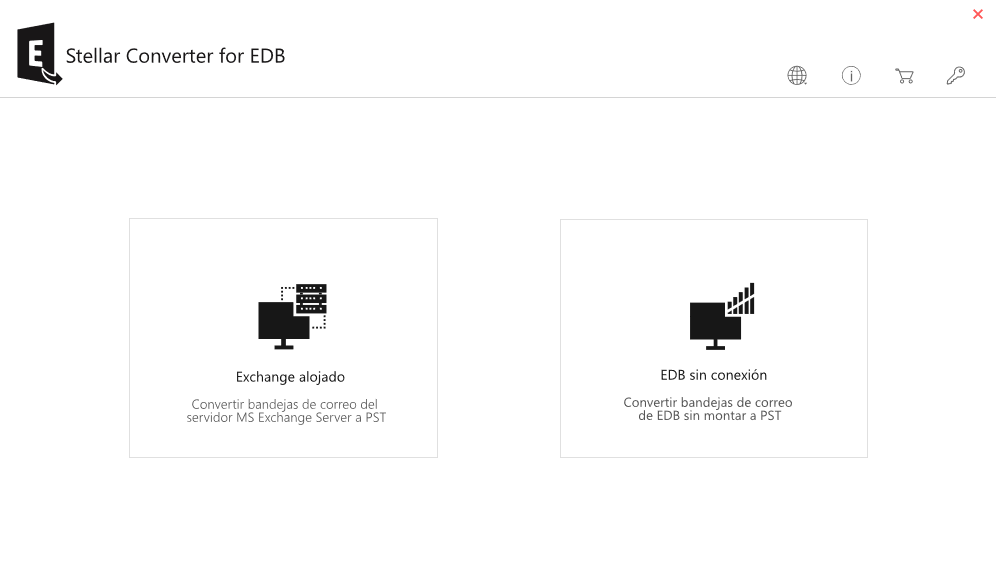
Seleccione «Hosted Exchange» para exportar buzones de correo desde un archivo EDB en línea. Para convertir buzones de correo desde una base de datos sin conexión, seleccione «Offline EDB».
Paso 2
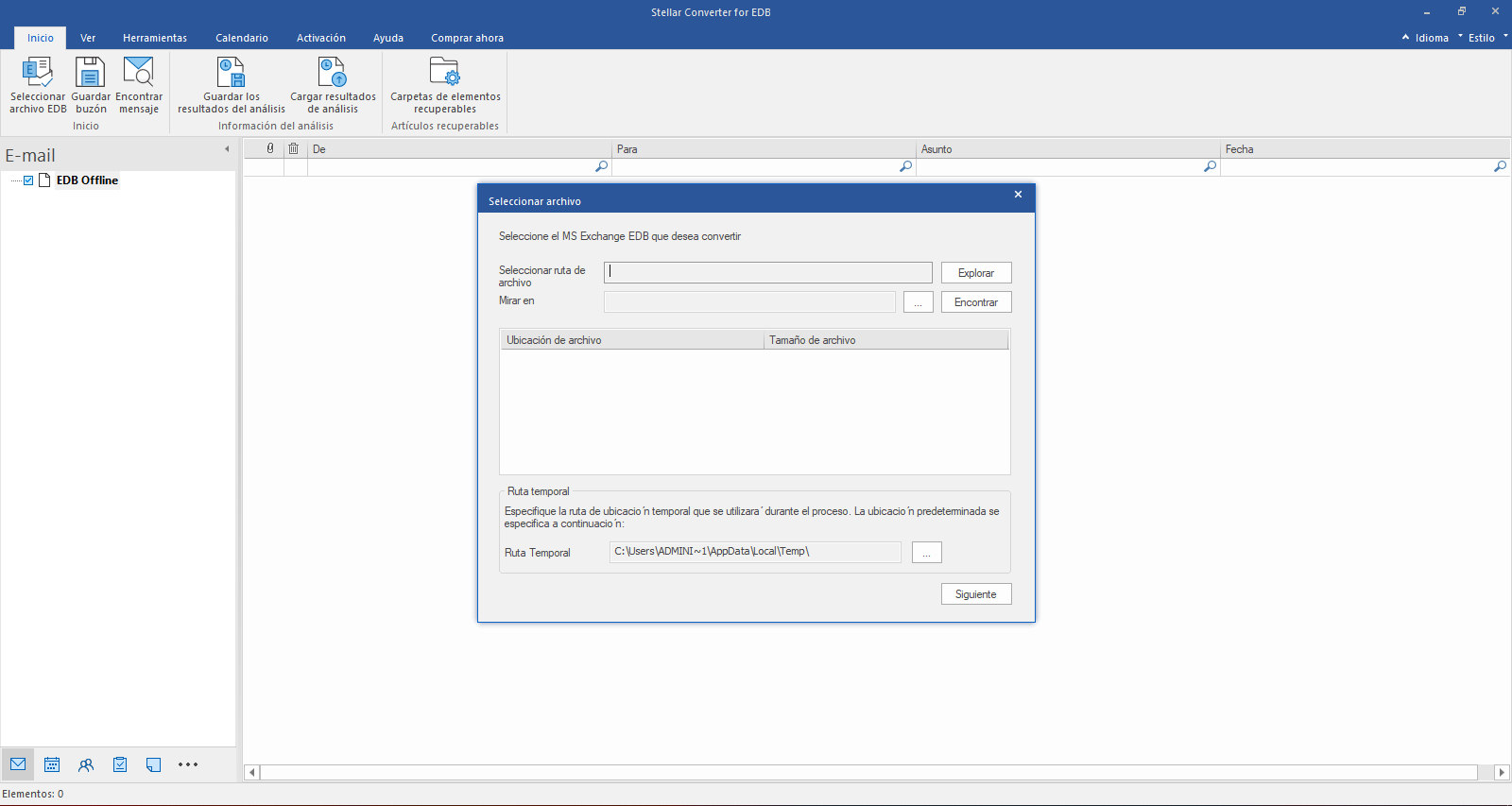
Localice o busque el archivo EDB sin conexión
Haga clic en «Examinar» para seleccionar el archivo EDB si conoce su ubicación, o utilice el botón «Buscar» para localizar el archivo EDB.
Paso 3
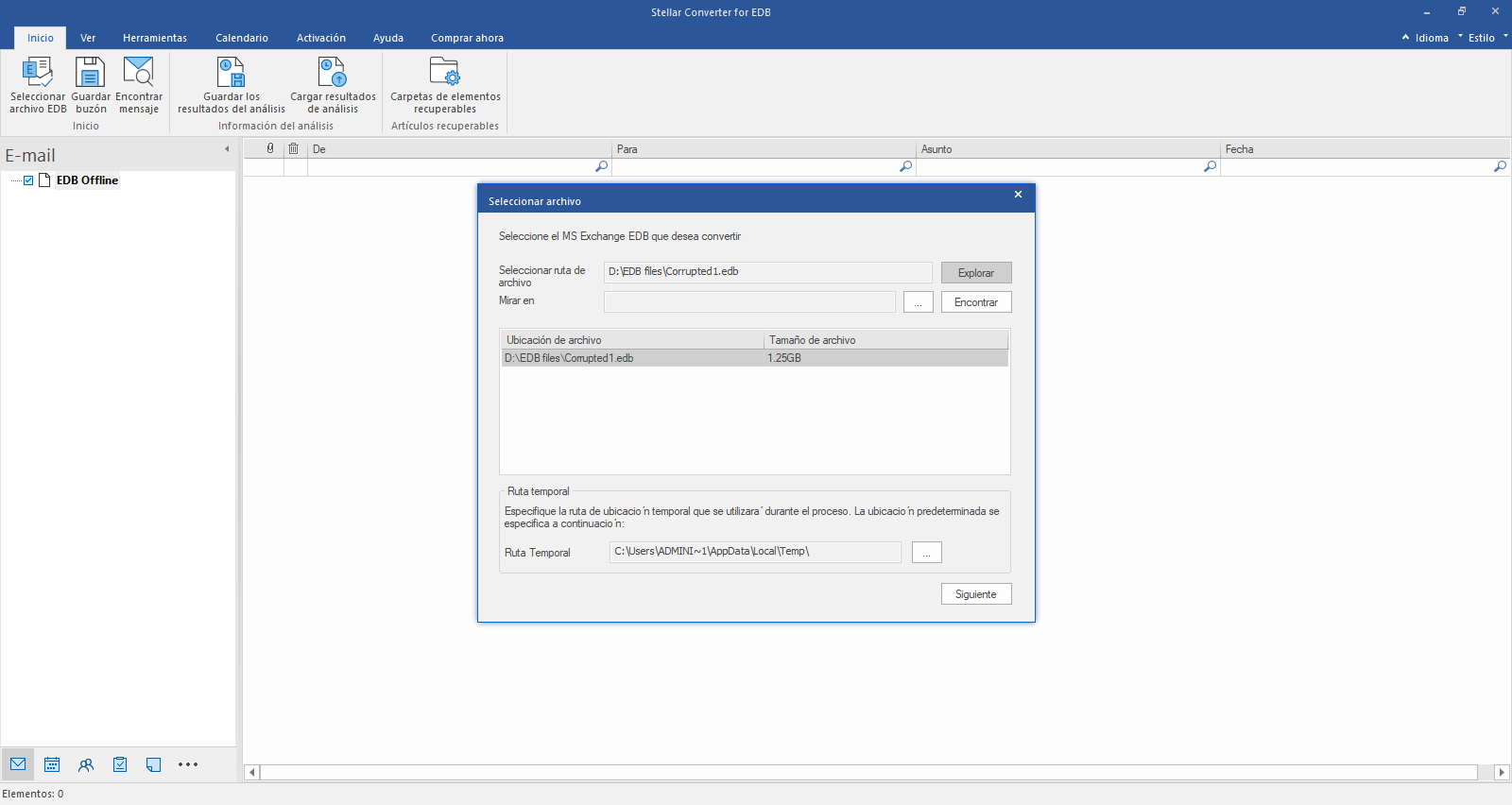
Seleccione el archivo EDB
Seleccione el archivo EDB deseado y haga clic en Siguiente.
Paso 4
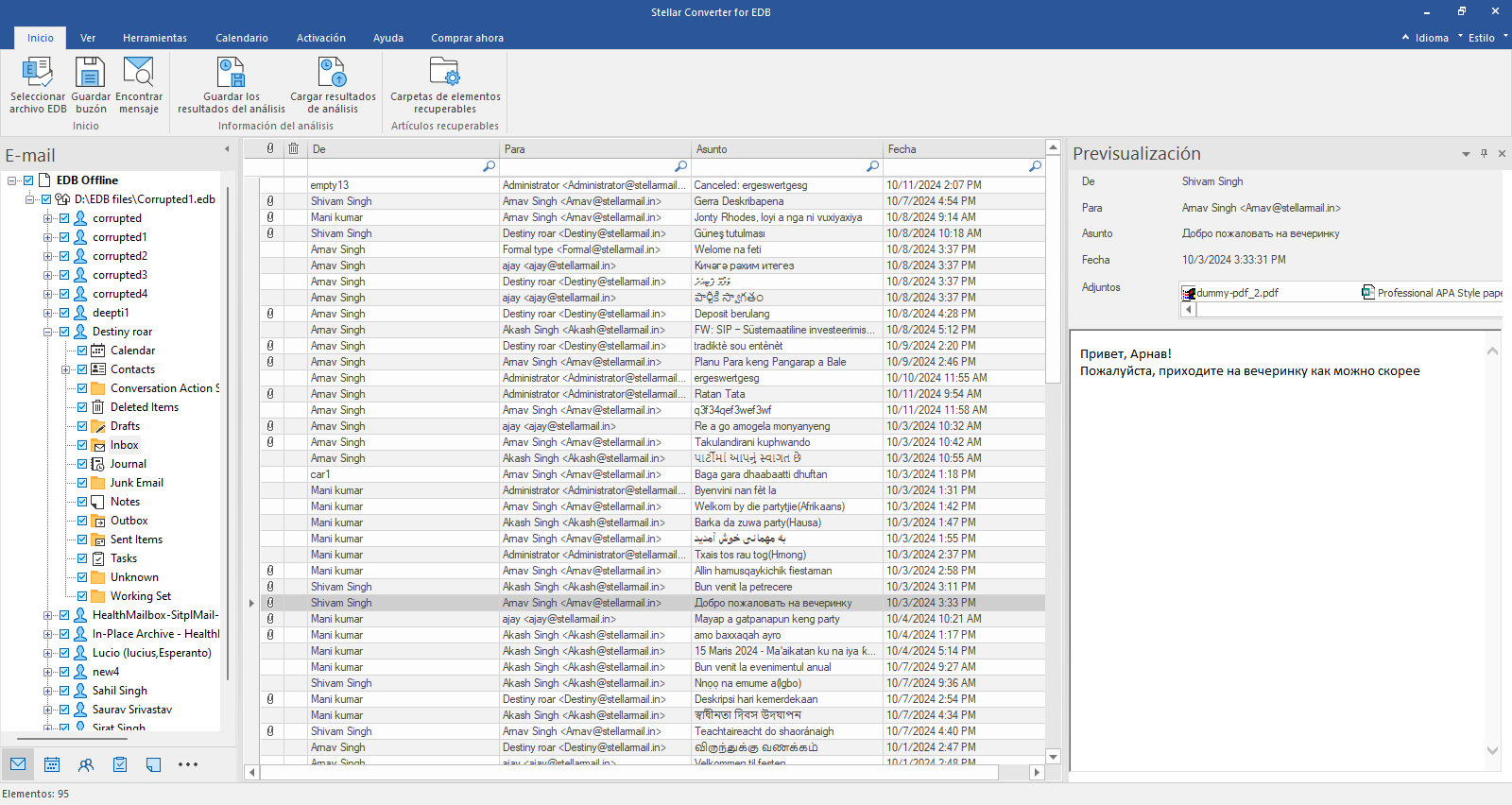
Vista previa de los buzones
Después de escanear, haga clic en un buzón o elemento para obtener una vista previa.
Paso 5
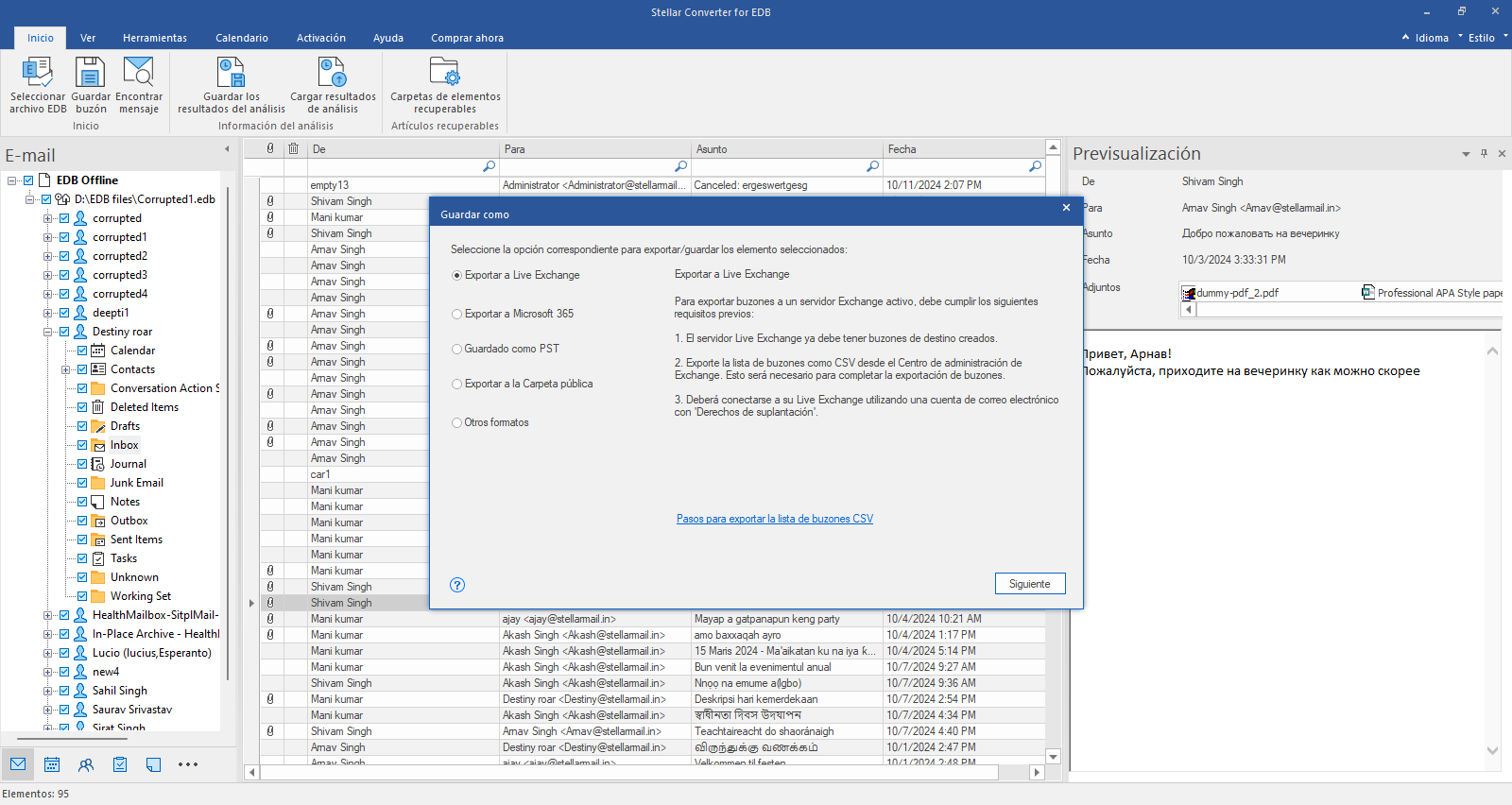
Exportar a Live Exchange
Seleccione todos los buzones que desee convertir y haga clic en «Guardar buzón». Seleccione la opción de guardado deseada, por ejemplo, «Exportar a Live Exchange», y luego haga clic en «Siguiente».
Paso 6
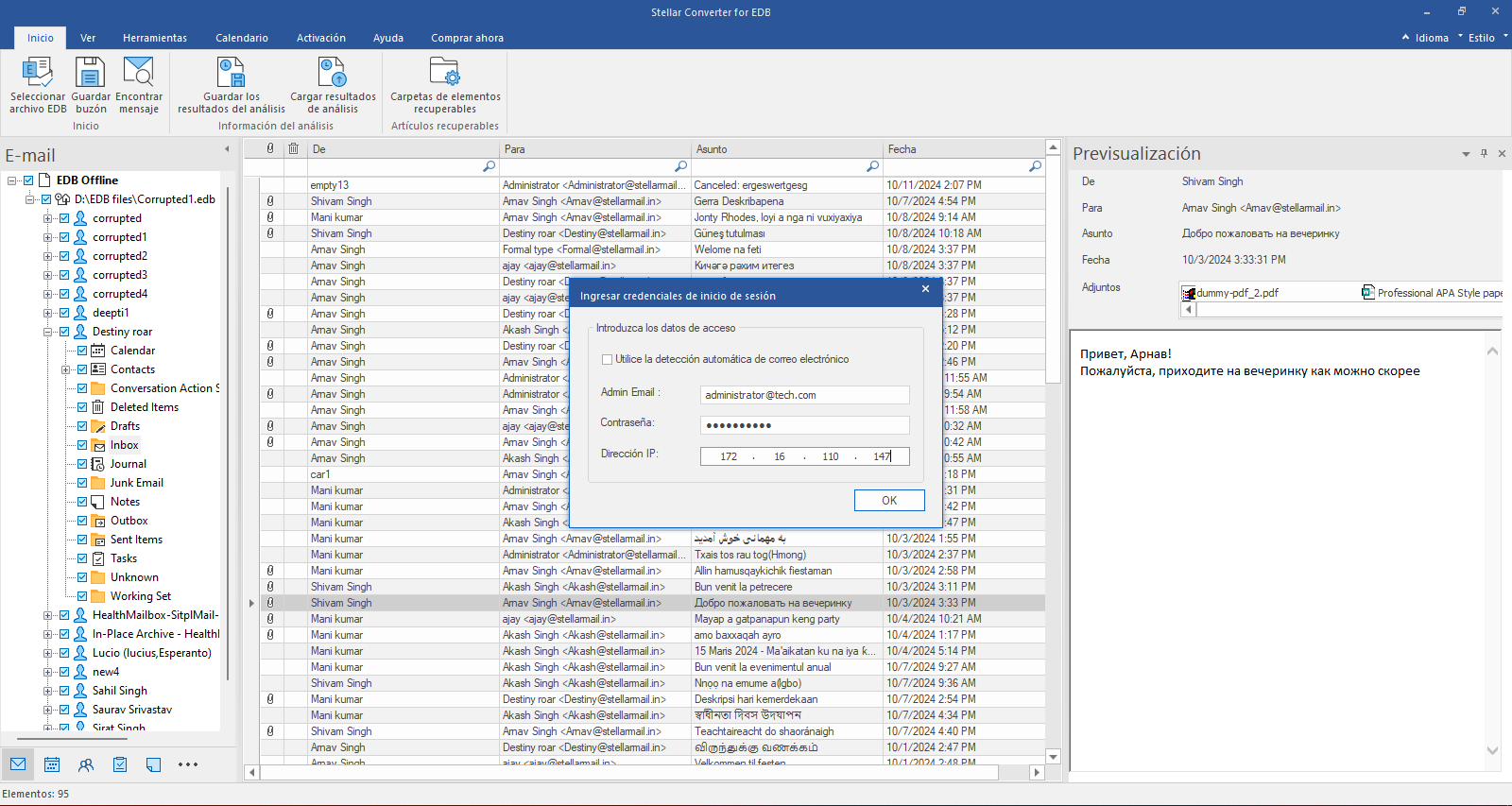
Introduzca los datos de inicio de sesión
Aparecerá el cuadro de diálogo «Introducir datos de inicio de sesión», que ofrece dos opciones para conectarse al servidor Live Exchange. Puede utilizar «Detectar correo electrónico automáticamente» o introducir los datos del servidor manualmente y, a continuación, hacer clic en «Aceptar».
Paso 7
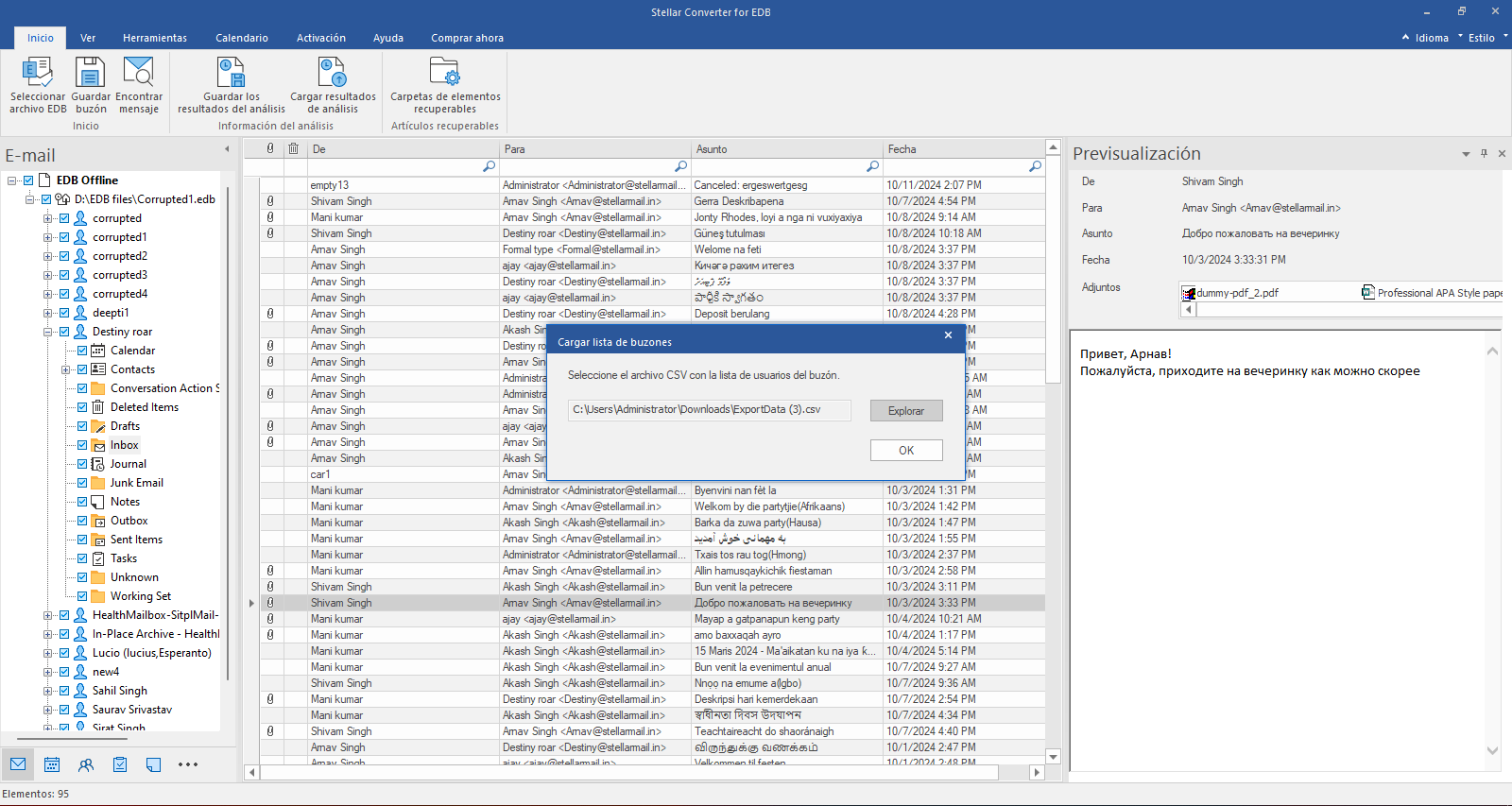
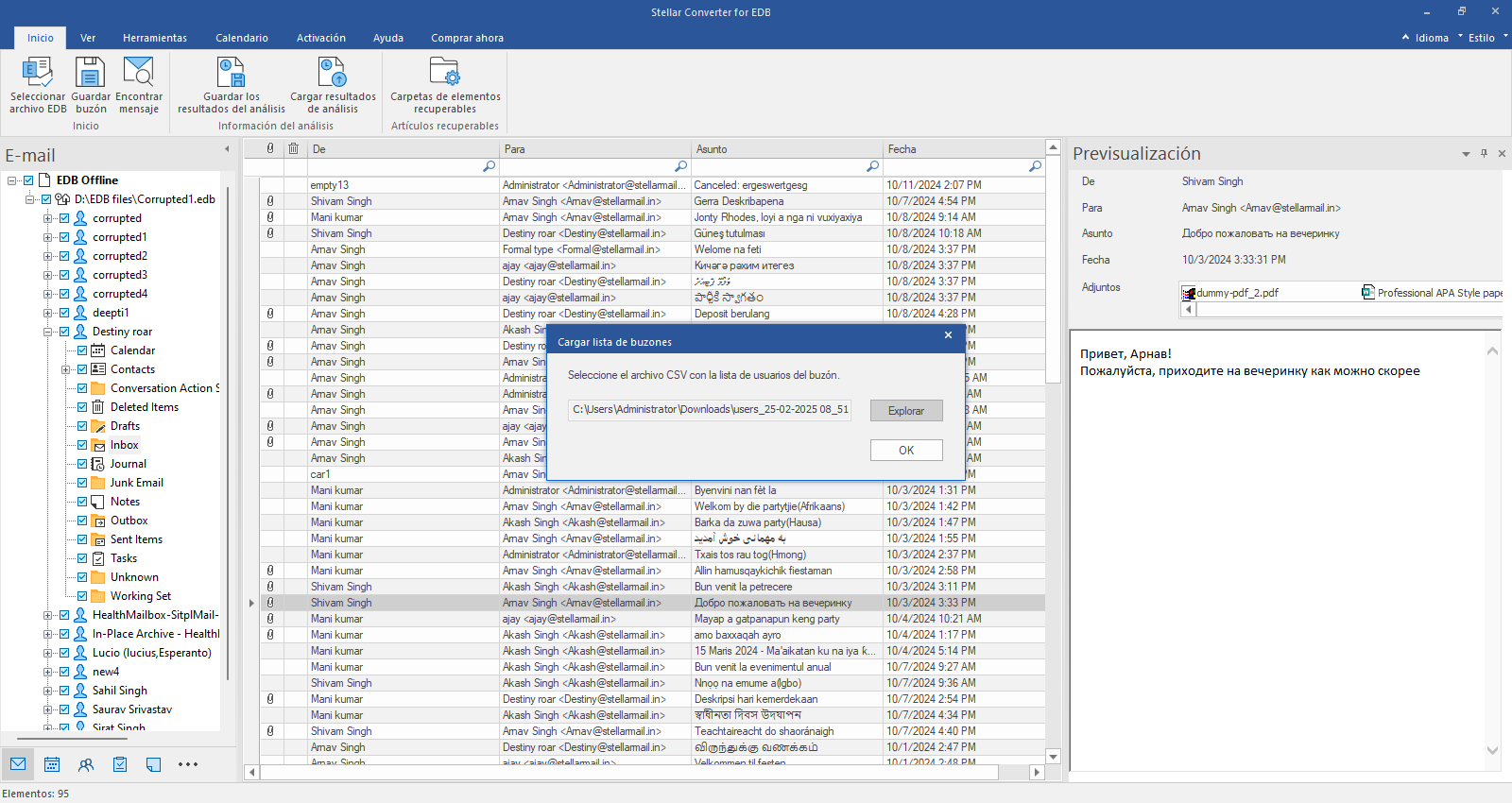
Cargar archivo CSV
Aparecerá el cuadro de diálogo Cargar lista de buzones. Haga clic en el botón Examinar para seleccionar el archivo CSV que contiene la lista de usuarios de buzones. Haga clic en Aceptar.
Paso 8
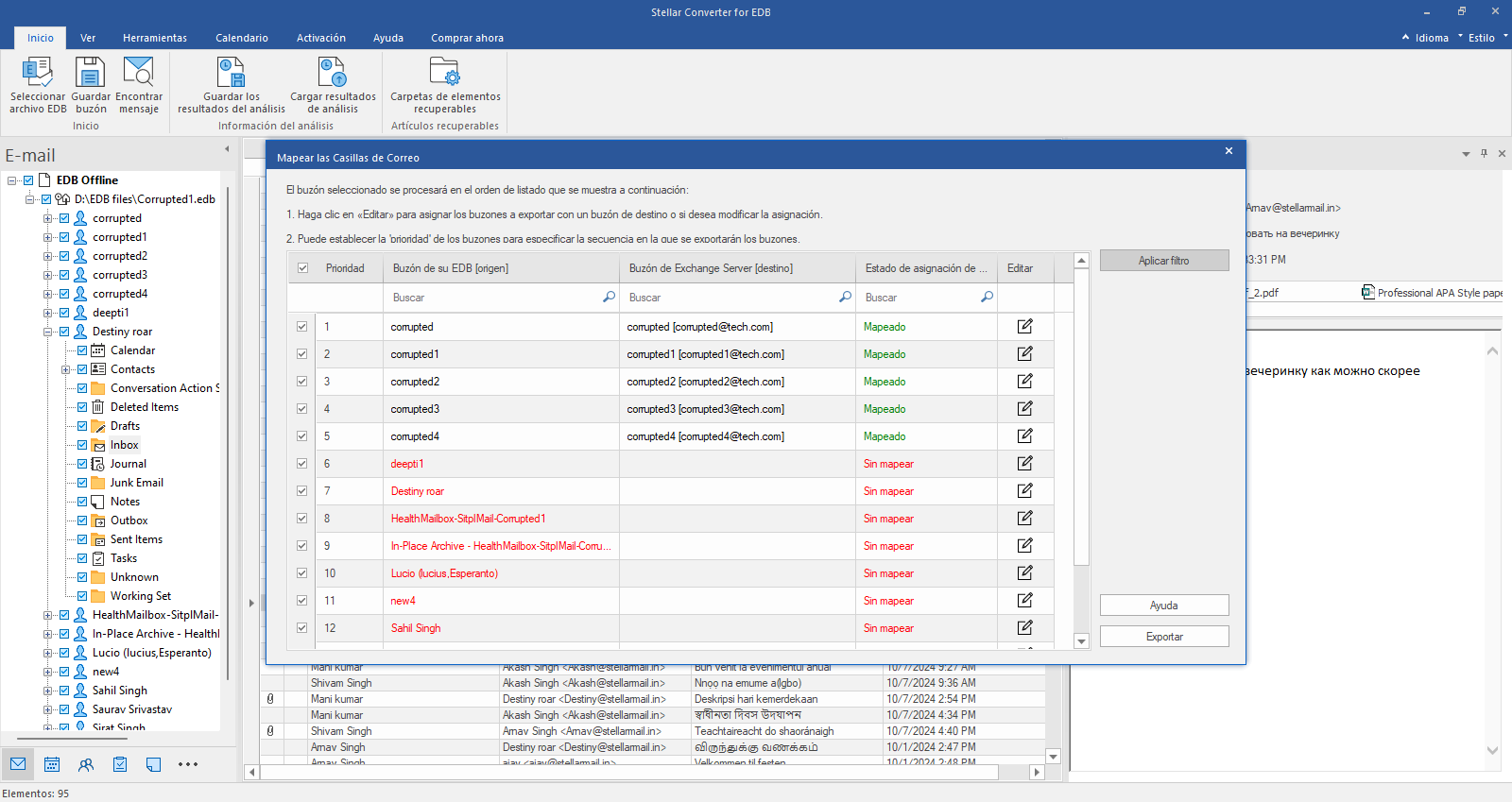
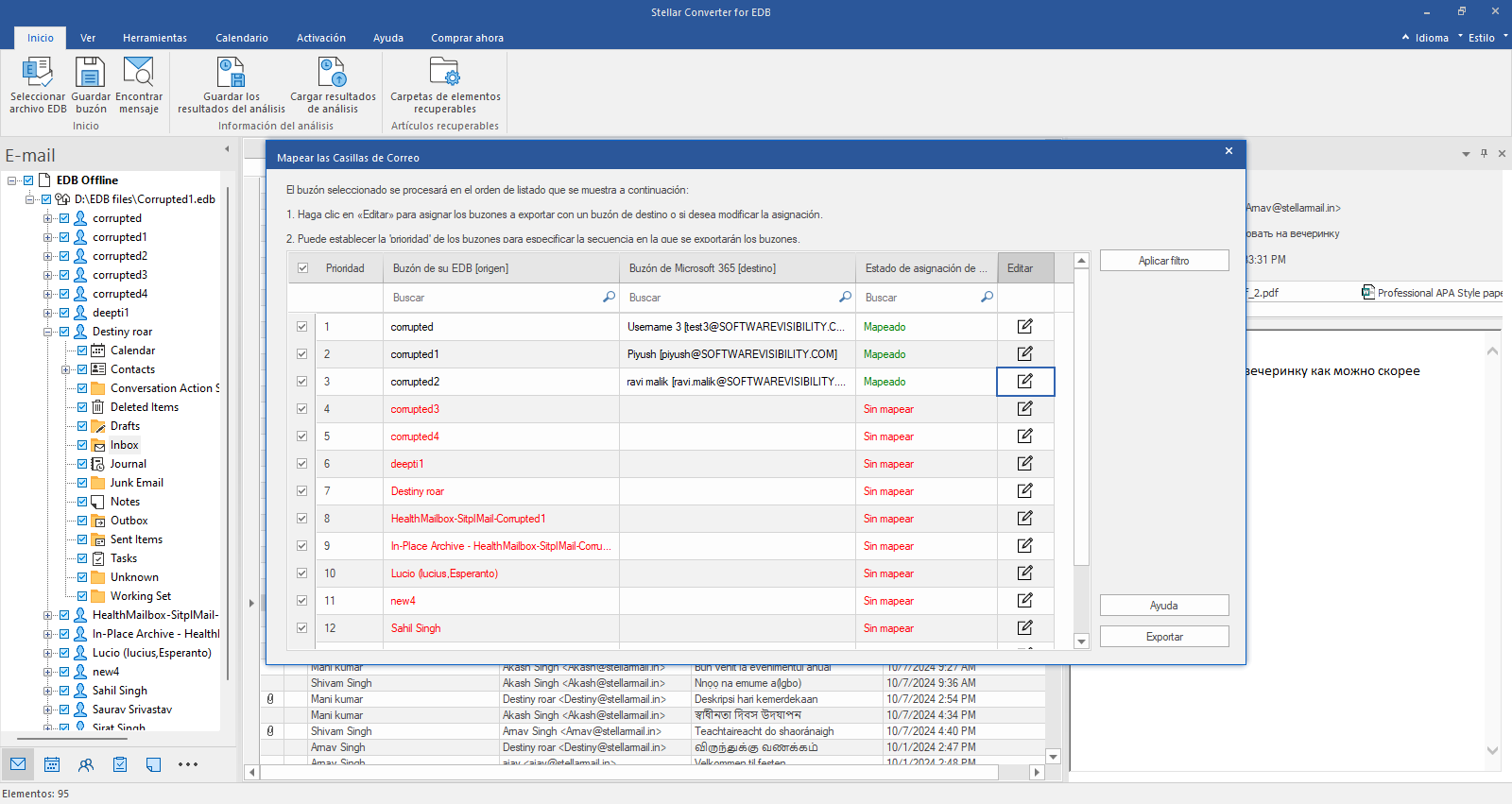
Ventana Asignar buzones
El software asigna automáticamente los buzones de correo de origen y destino. También puede asignar los buzones de correo manualmente y cambiar la prioridad para la exportación de buzones de correo. Utilice Aplicar filtro para incluir/excluir correos electrónicos y, a continuación, haga clic en Exportar.
Paso 9
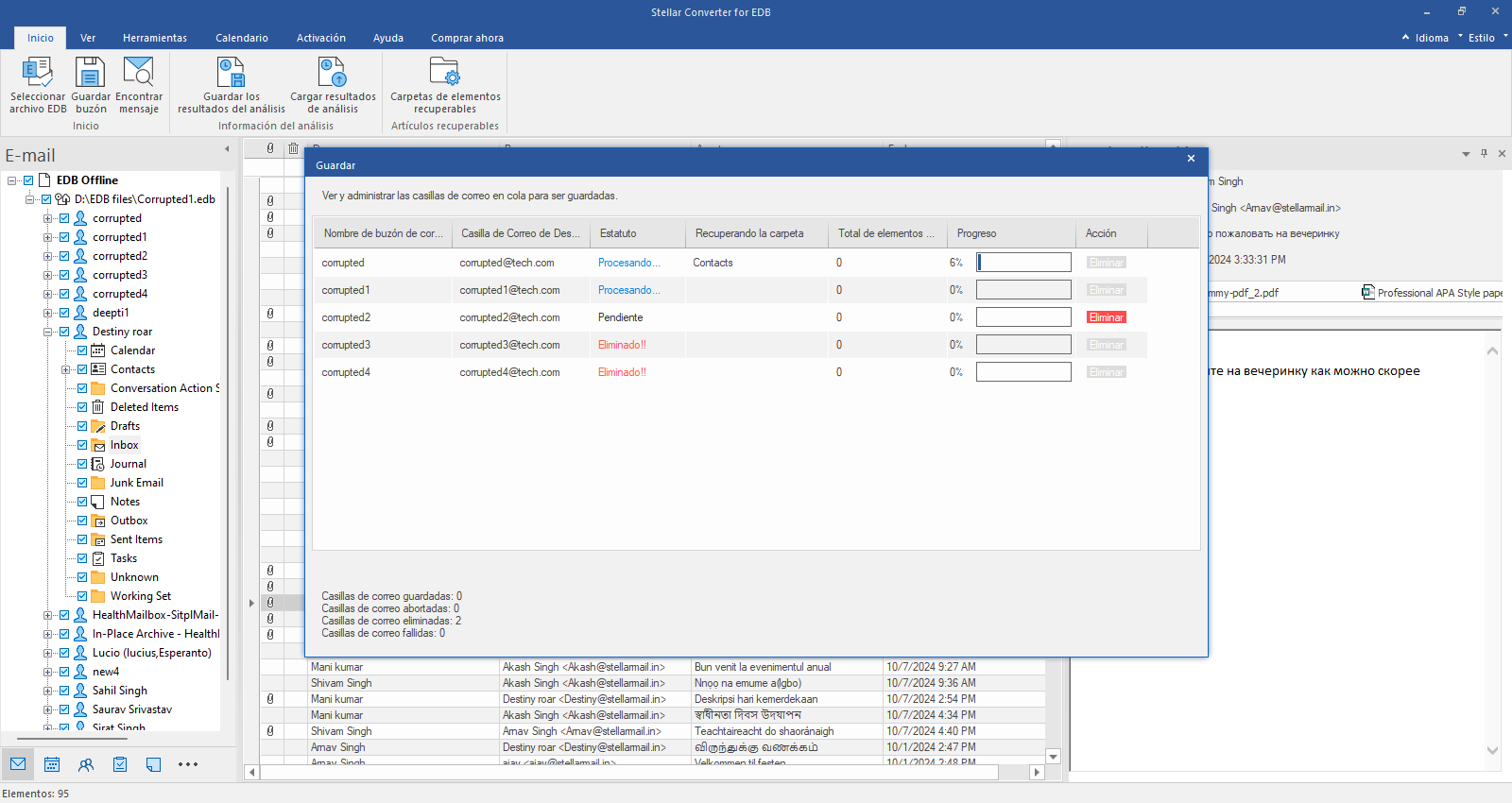
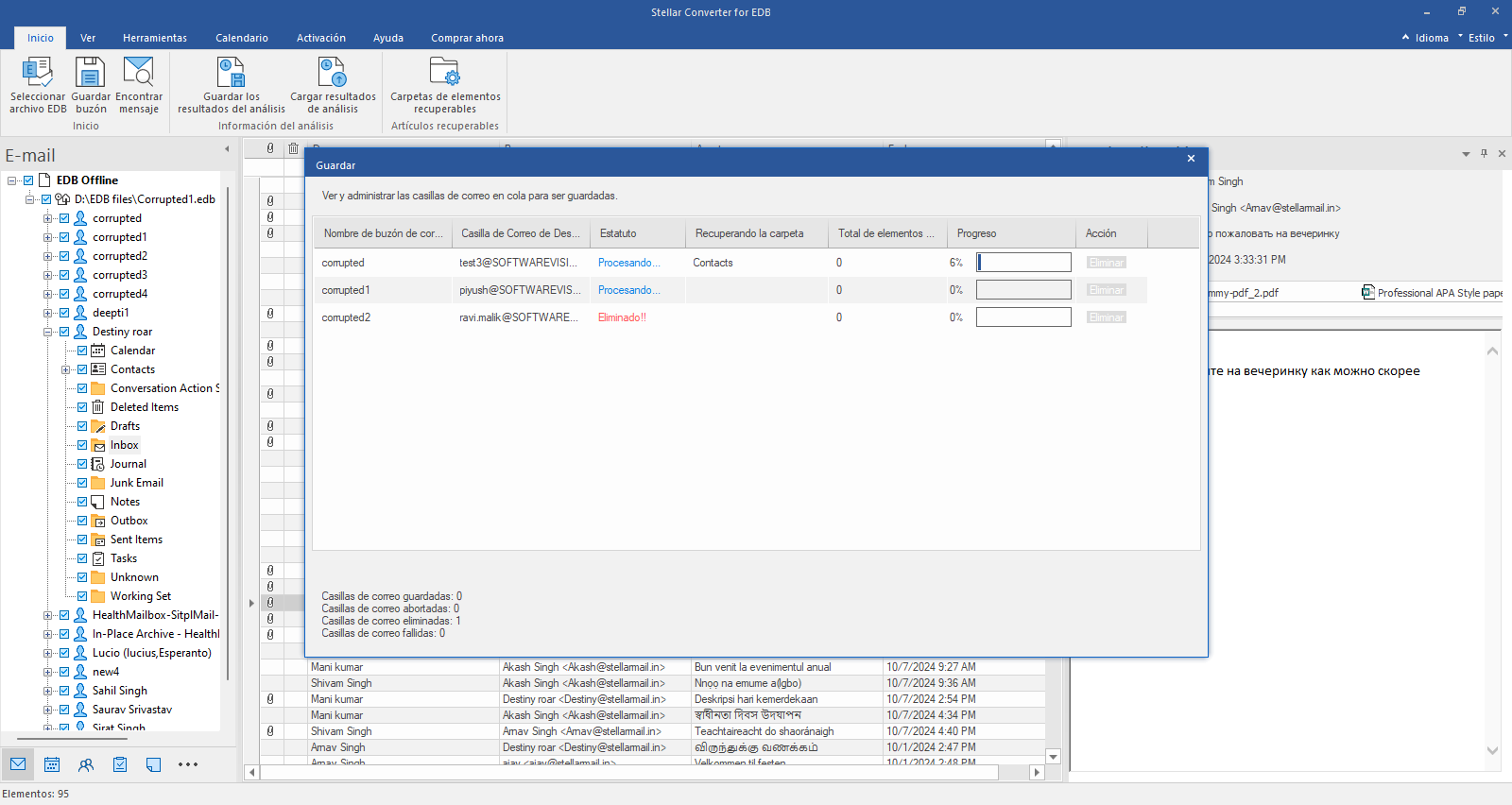
Guardar buzones
El software comienza a exportar los buzones de correo del archivo EDB al servidor Exchange activo.
Paso 10
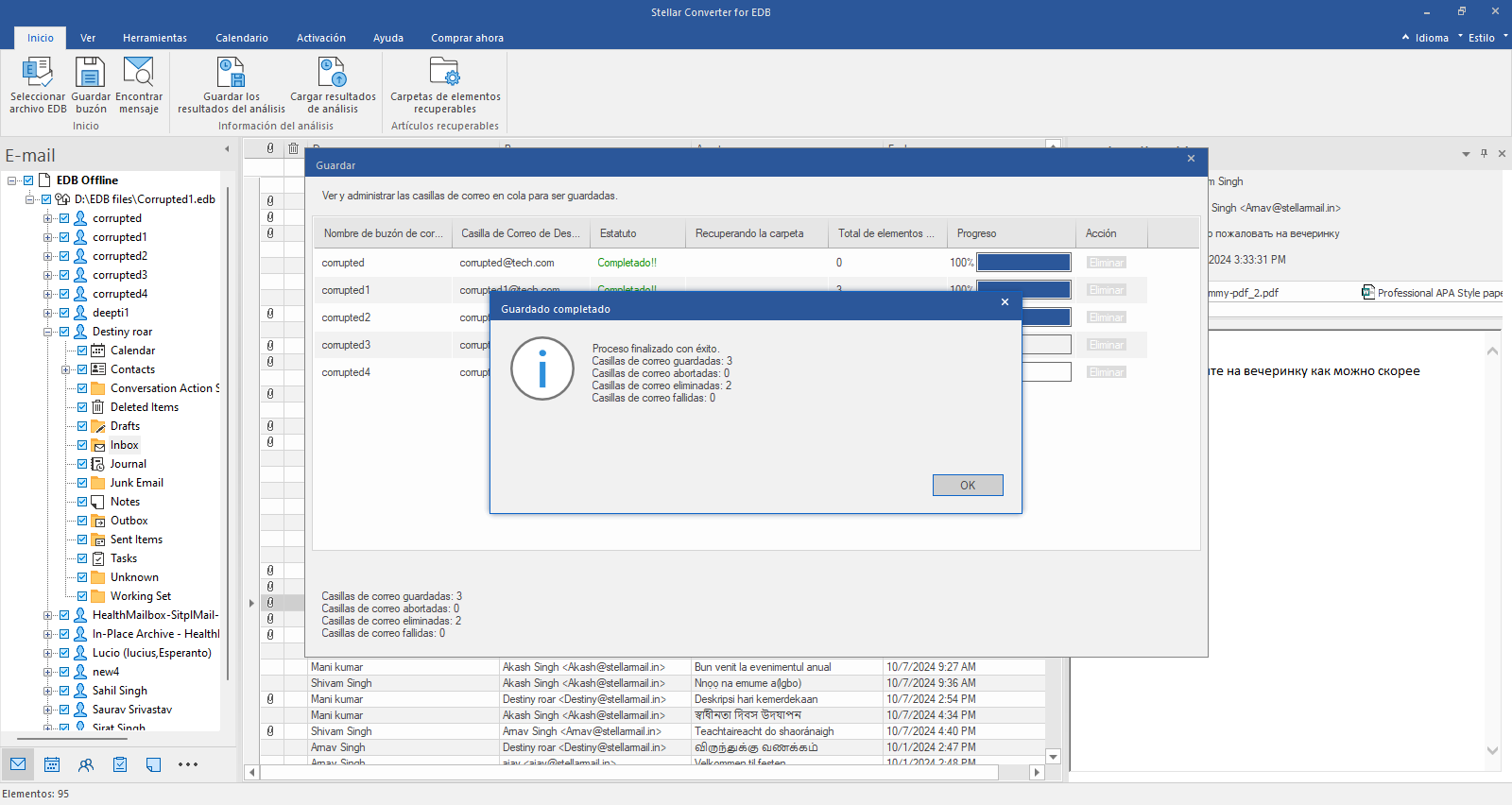
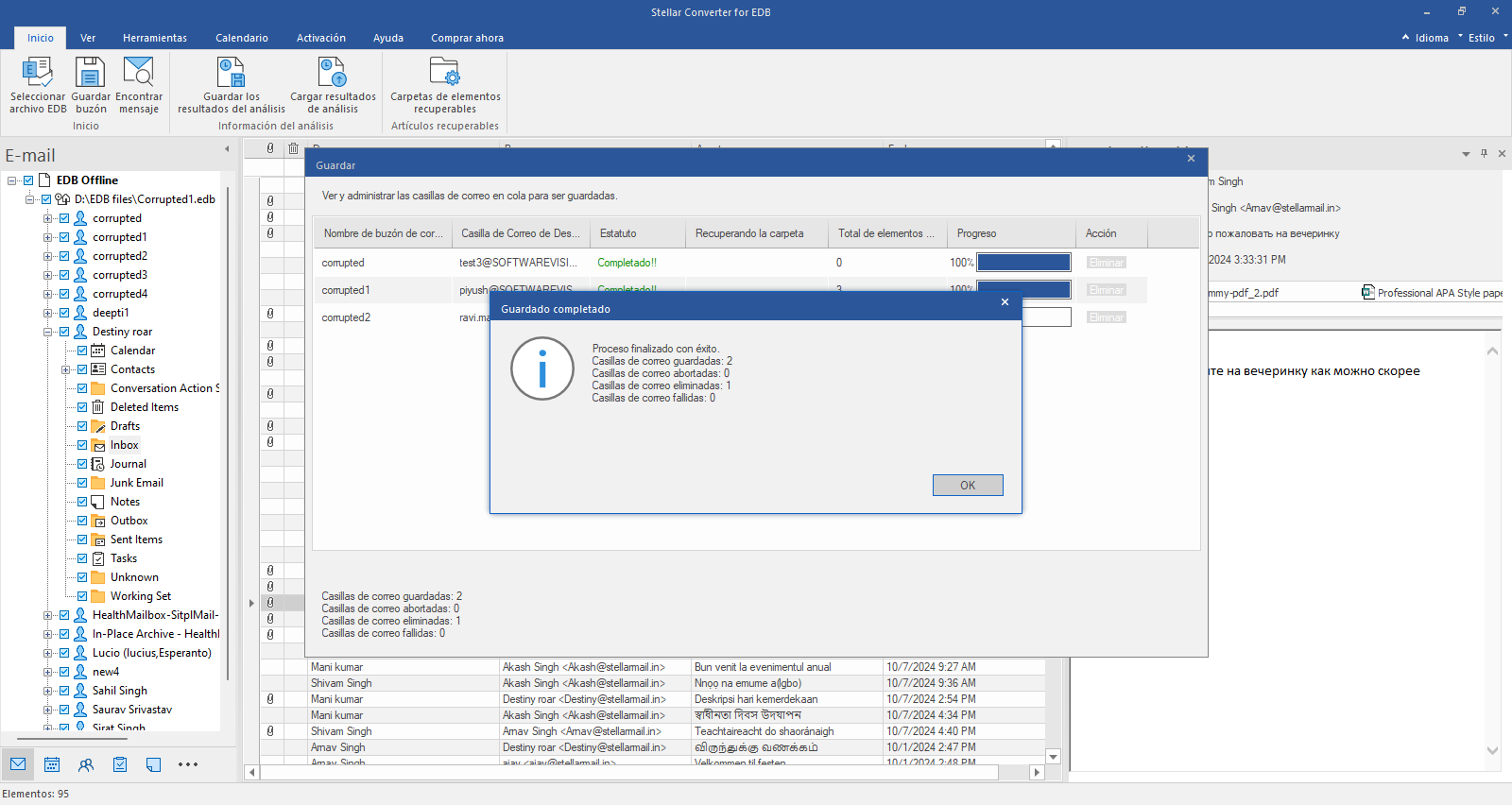
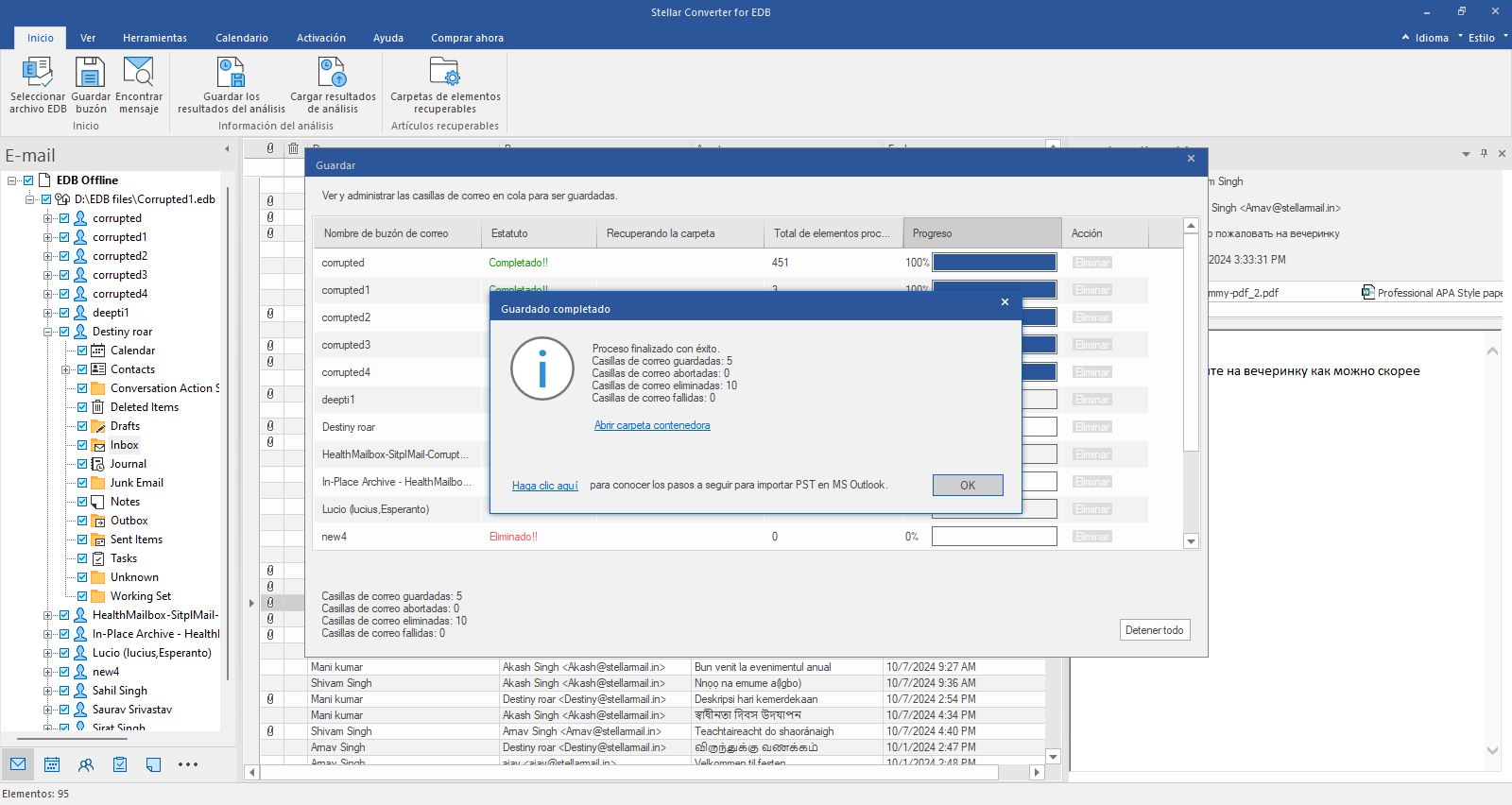
Ventana Guardado completado
Aparece un cuadro de diálogo «Guardado completado» que muestra el número de buzones guardados, cancelados, eliminados y con error. Haga clic en «Aceptar» para cerrarlo.
Paso 11
Exportar a la carpeta de archivo in situ
Para exportar los buzones directamente a la carpeta de archivo in situ del servidor Exchange, seleccione la opción «Exportar a la carpeta de archivo in situ» en la ventana «Guardar como» y haga clic en «Siguiente». A continuación, conéctese al servidor Exchange para exportar los buzones de archivo.
Paso 12
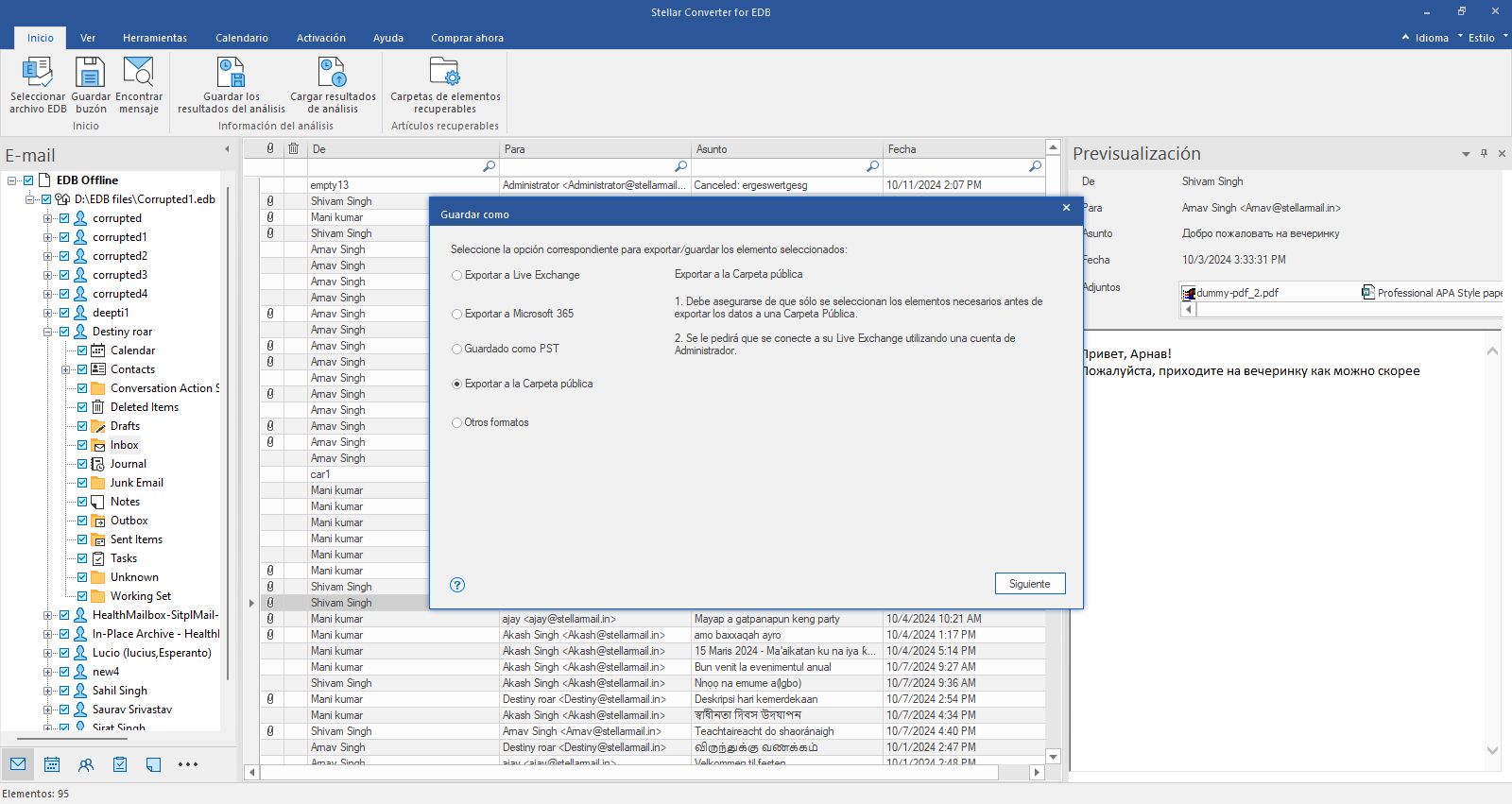
Exportar a carpetas públicas
Si desea exportar los buzones a carpetas públicas en el servidor Exchange, seleccione «Exportar a carpeta pública» y haga clic en «Siguiente».
Paso 13
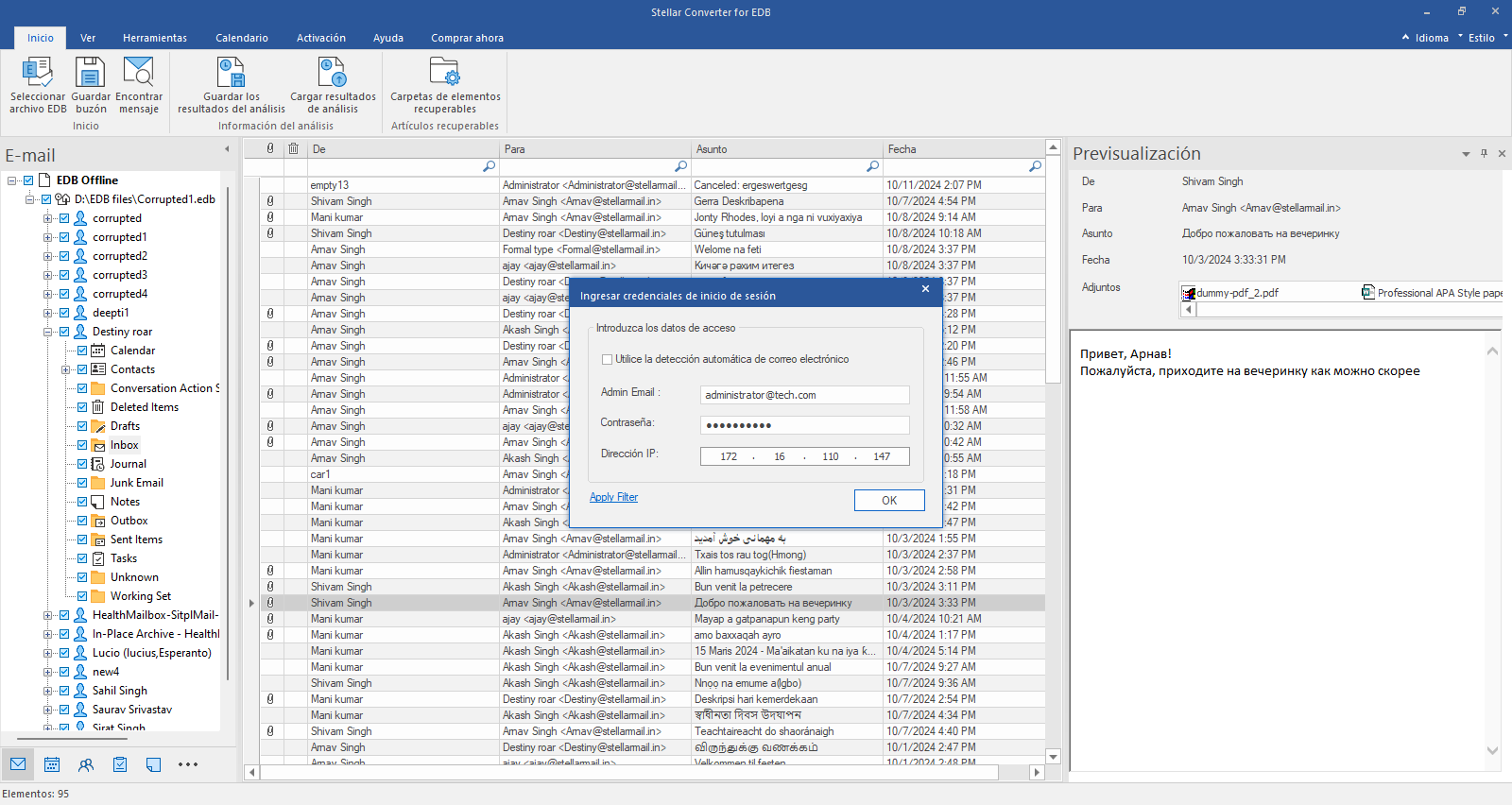
Conectarse al servidor Exchange en vivo
Aparecerá el cuadro de diálogo «Introducir credenciales», que ofrece dos opciones para conectarse al servidor Exchange en vivo. Puede utilizar «Detectar correo electrónico automáticamente» o introducir los datos del servidor manualmente.
Paso 14
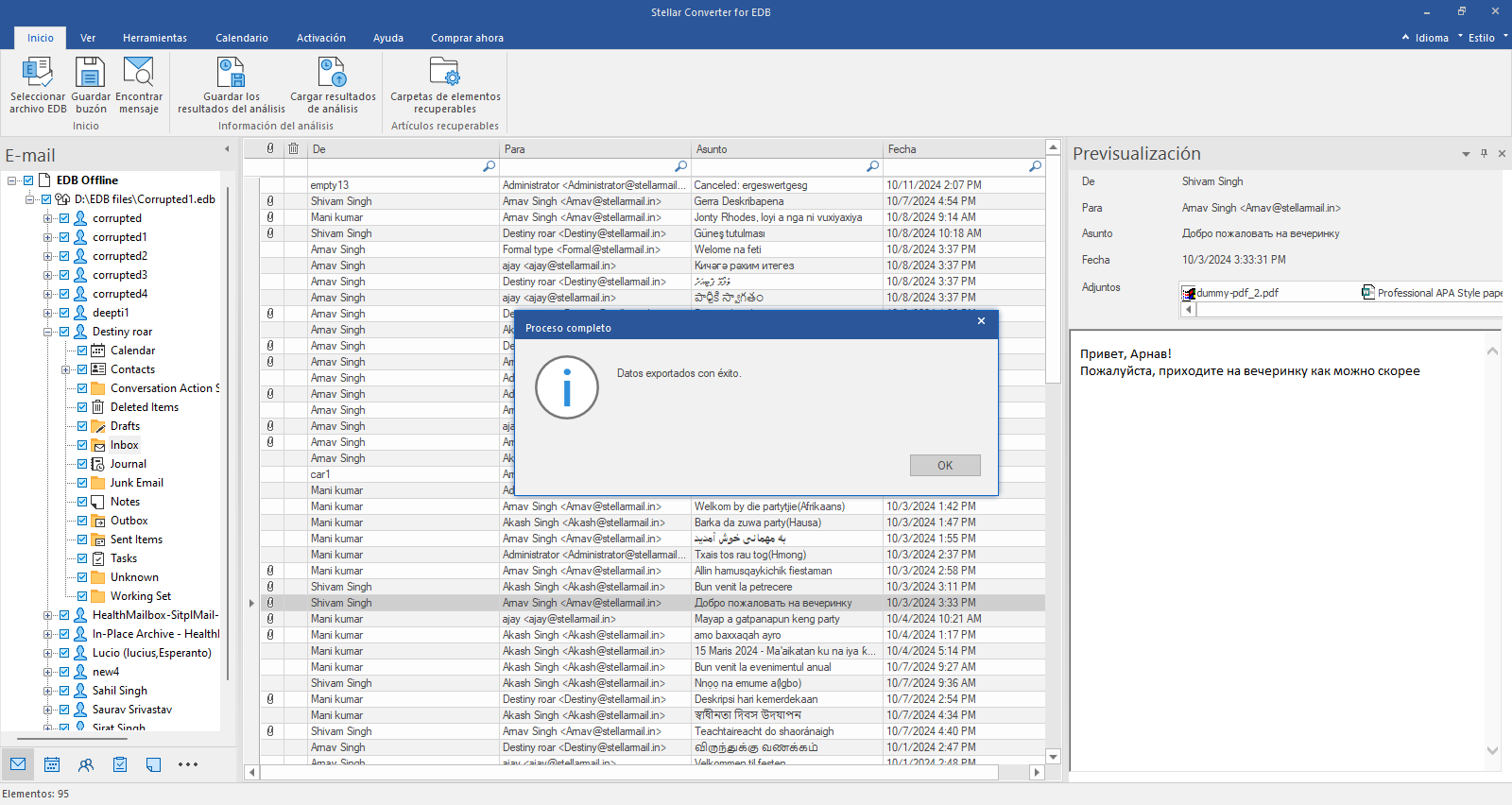
Proceso completado
Aparecerá el cuadro de diálogo «Operación completada». Haga clic en «Aceptar» para cerrarlo.
Paso 15
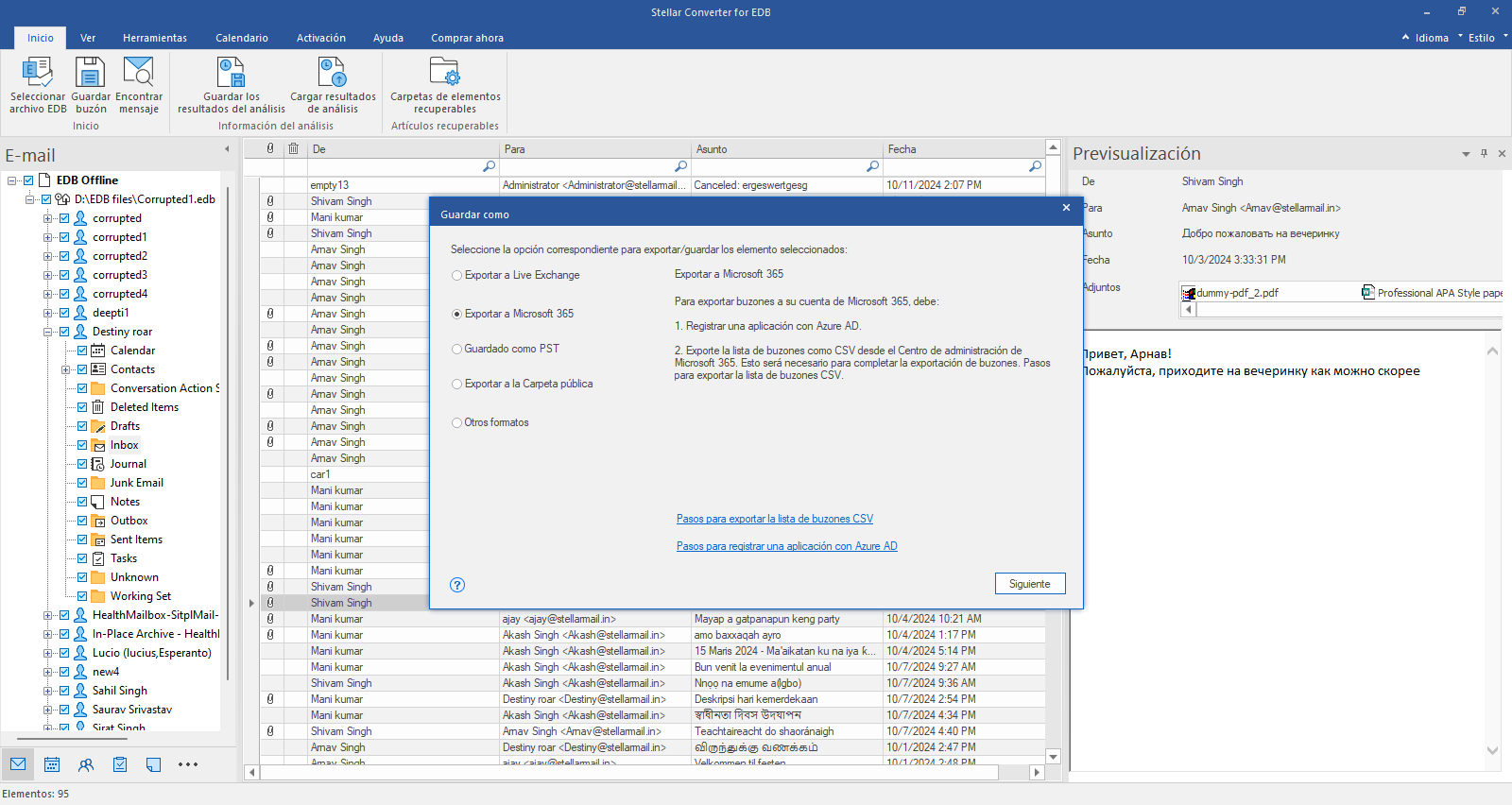
Exportar a Microsoft 365
Si desea exportar los buzones de correo a Microsoft 365, seleccione la opción «Exportar a Microsoft 365» en la ventana «Guardar como». A continuación, haga clic en «Siguiente».
Paso 16
Conectarse al destino de
Después de seleccionar Microsoft 365 como destino, puede elegir entre el registro automático y el registro manual. El registro automático automatiza el proceso de autenticación, mientras que el registro manual requiere que introduzca sus credenciales de Microsoft 365 manualmente. Seleccione «Registro manual» y haga clic en «Siguiente».
Paso 17
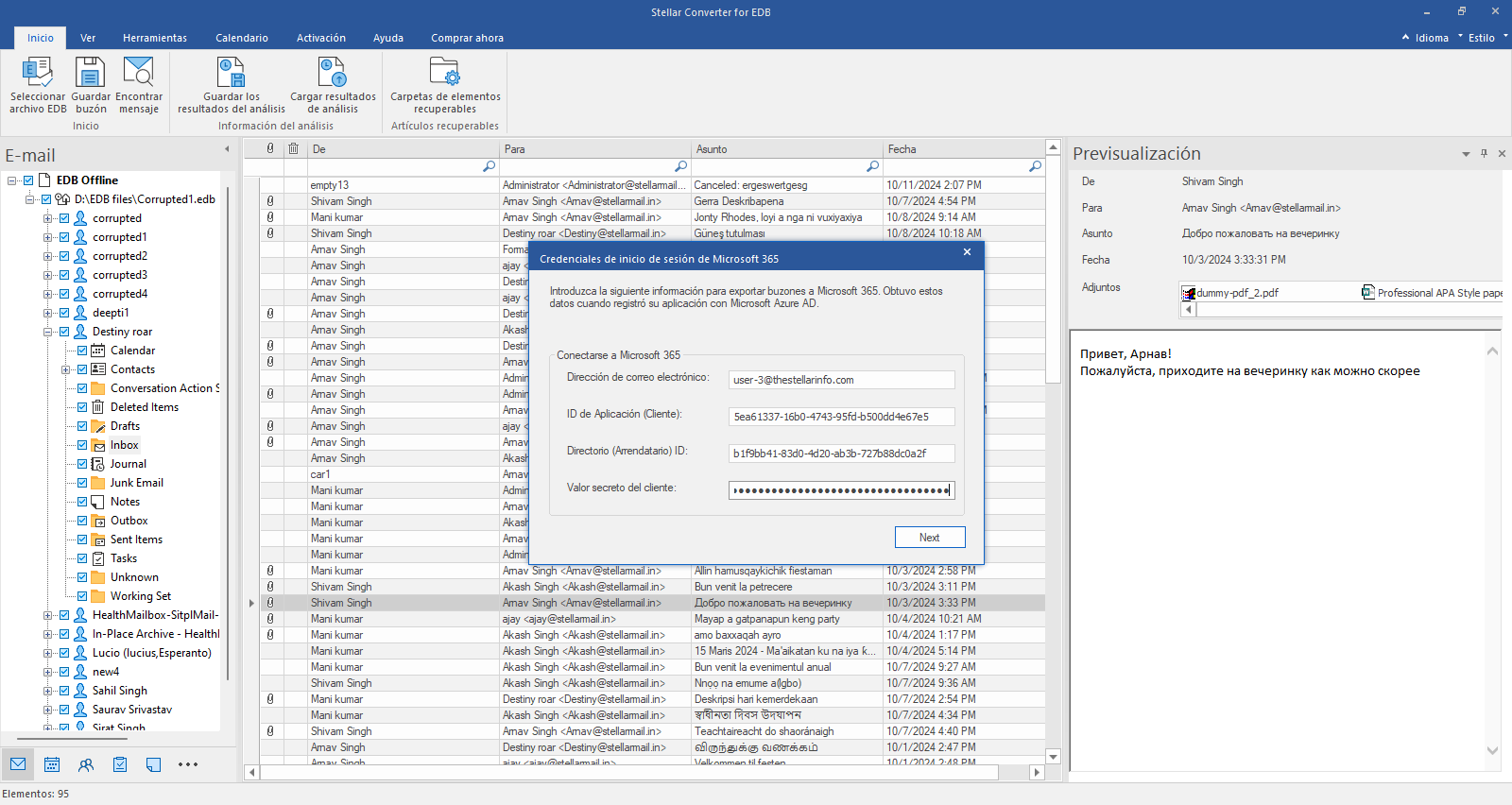
Conectarse a Microsoft 365
En el cuadro de diálogo «Credenciales de Microsoft 365», introduzca su dirección de correo electrónico, ID de aplicación (ID de cliente), ID de directorio (ID de inquilino) y clave secreta de cliente. Haga clic en «Siguiente» para continuar.
Paso 18
Cargar el archivo CSV
Aparecerá el cuadro de diálogo Cargar lista de buzones. Haga clic en el botón Examinar para seleccionar el archivo CSV que contiene la lista de usuarios de buzones. Haga clic en Aceptar.
Paso 19
Ventana Asignar buzones
El software asigna automáticamente los buzones en el servidor de Microsoft 365 y también ofrece una opción para editar la asignación de buzones. También puede cambiar la prioridad o aplicar filtros para incluir o excluir correos electrónicos en función del intervalo de fechas o la dirección de correo electrónico. Cuando haya terminado, haga clic en Exportar.
Paso 20
Guardar buzones
El software comienza a exportar los buzones de correo del archivo EDB a la cuenta de Microsoft 365.
Paso 21
Ventana «Guardado completado»
Aparecerá el cuadro de diálogo «Guardado completado». Contiene una descripción general de los buzones guardados, cancelados, eliminados y con errores. Haga clic en «Aceptar» para cerrarlo.
Paso 22
Exportar a la carpeta pública de Microsoft 365
Si desea guardar los buzones de correo en carpetas públicas de Microsoft 365, seleccione la opción «Exportar a carpetas públicas de M365» en la ventana «Guardar como» y haga clic en «Siguiente». Cuando aparezca la pantalla con el mensaje «Está intentando guardar varios buzones de correo en la carpeta pública», haga clic en «Sí».
Paso 23
Introduzca sus datos de inicio de sesión de M365
En la ventana «Credenciales de Microsoft 365», introduzca la dirección de correo electrónico, el ID de la aplicación (ID de cliente), el ID del directorio (ID de inquilino) y la clave secreta del cliente. A continuación, haga clic en «Siguiente». Los buzones se exportan directamente a las carpetas públicas de M365.
Paso 24
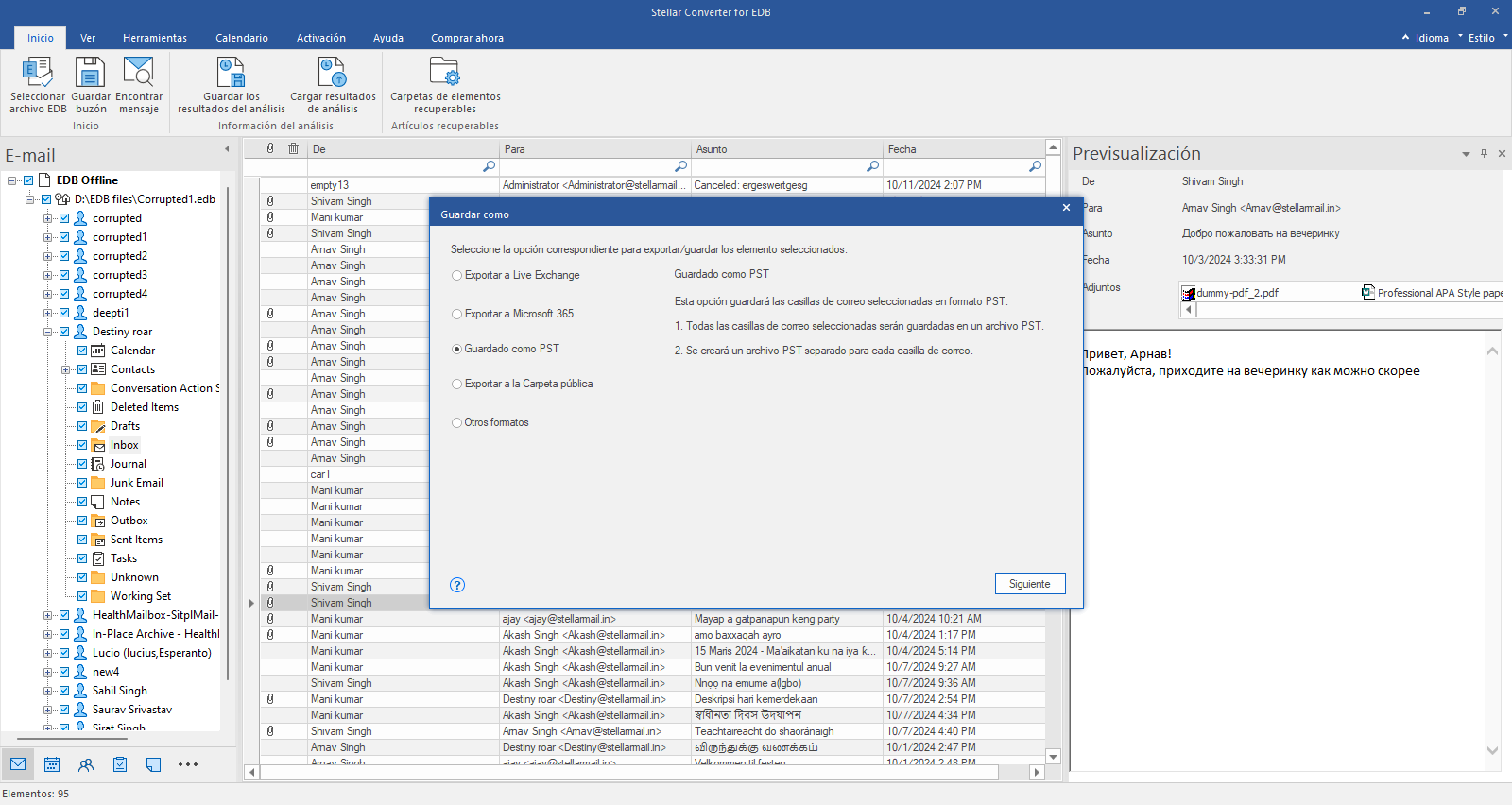
Exportar a archivo PST
Si desea convertir los buzones de correo a PST, seleccione la opción «Guardar como PST» en la ventana «Guardar como» y, a continuación, haga clic en «Siguiente».
Paso 25
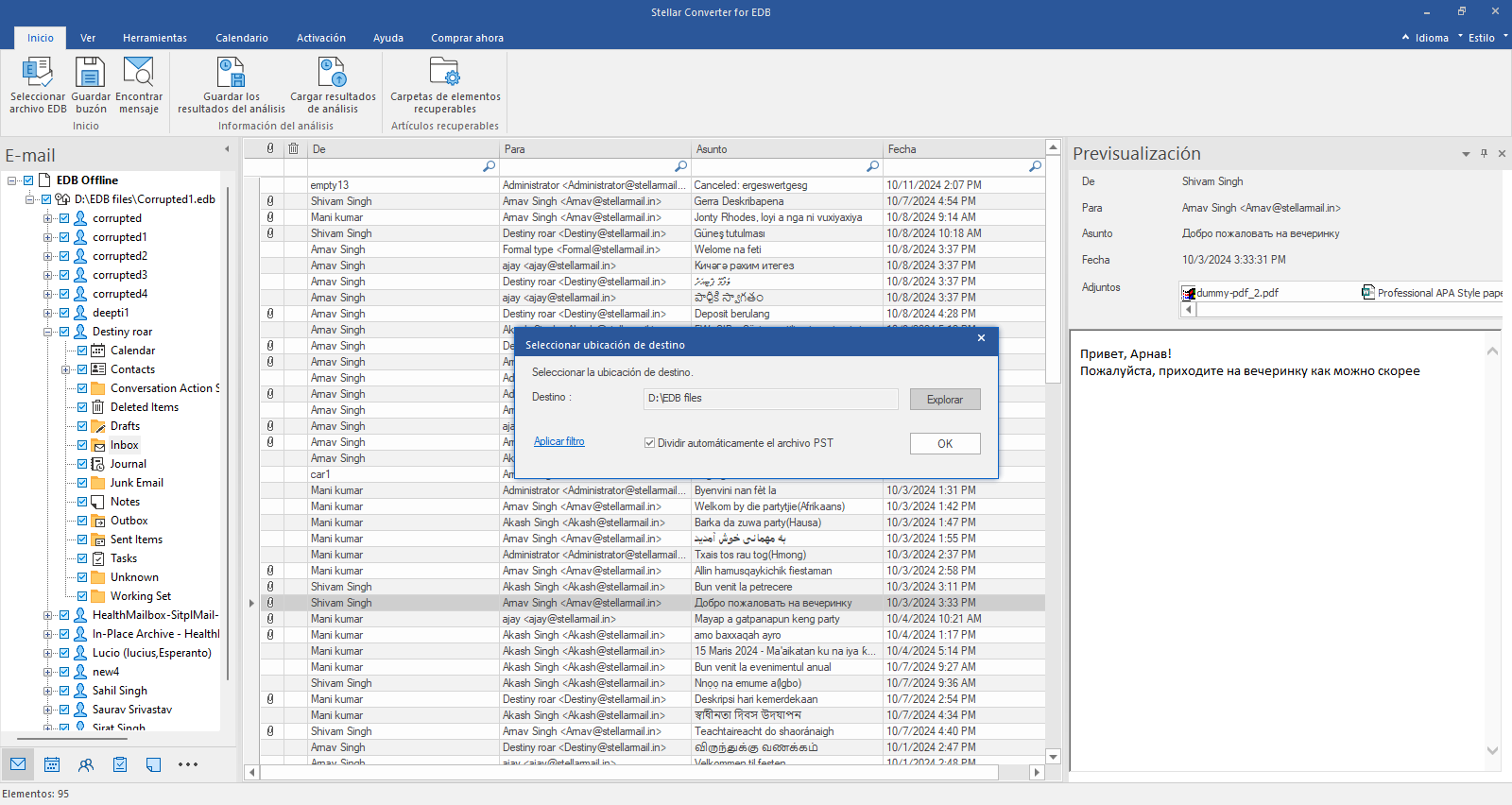
Seleccione la ubicación de almacenamiento para el archivo PST
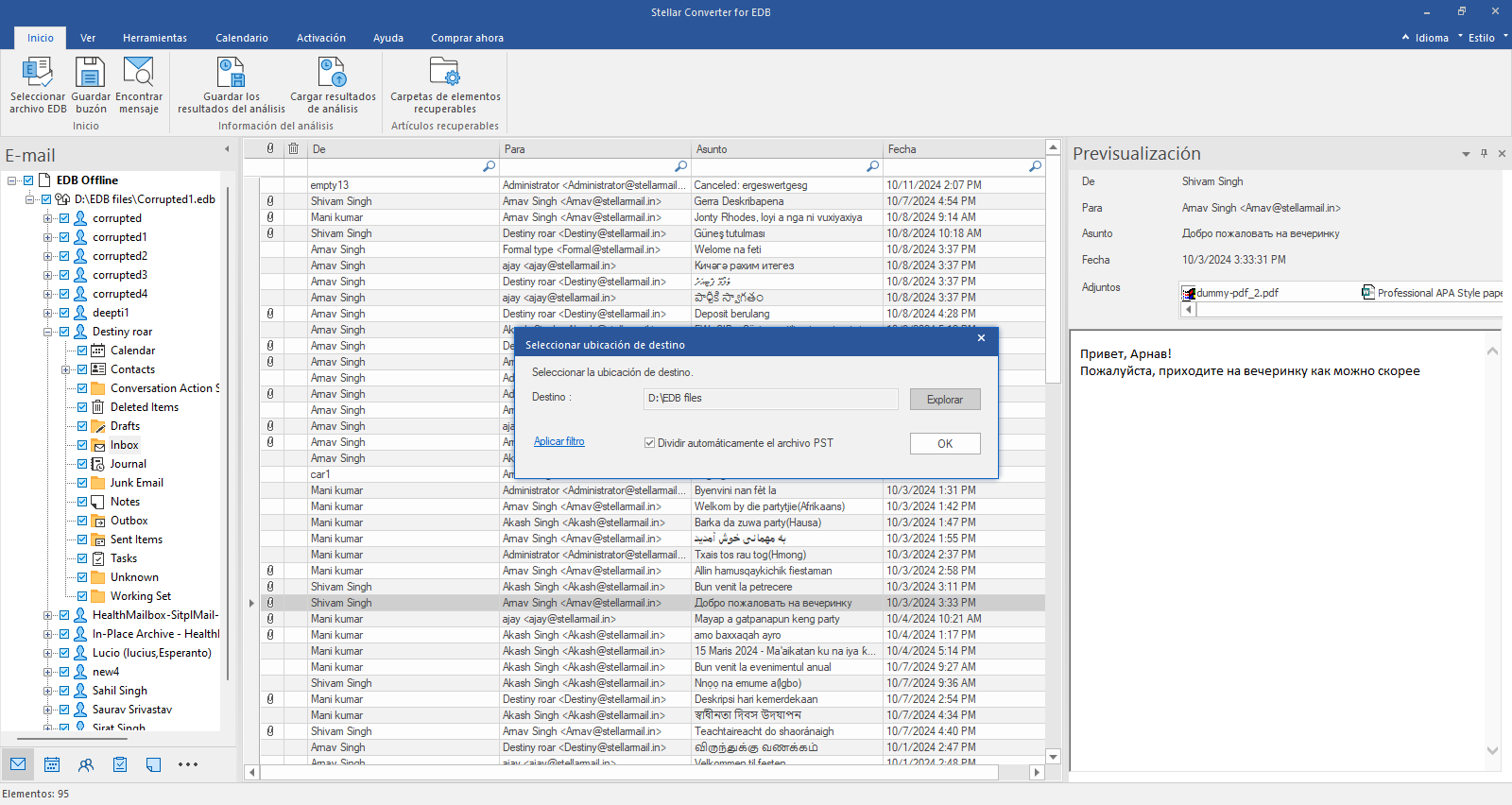
Haga clic en «Examinar» para seleccionar una ubicación para el archivo PST y, a continuación, haga clic en «Aceptar».
Paso 26
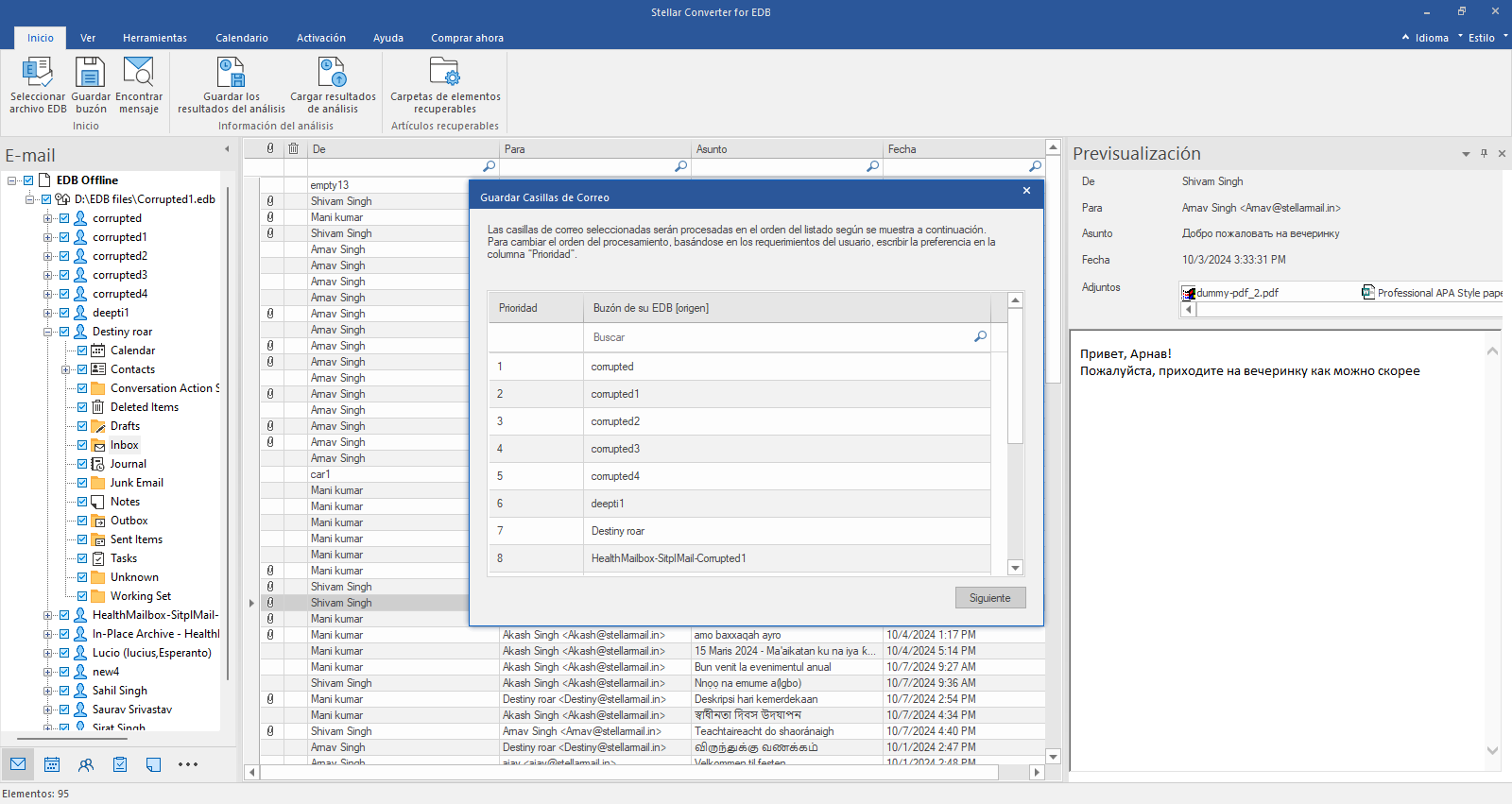
Ventana Guardar buzones
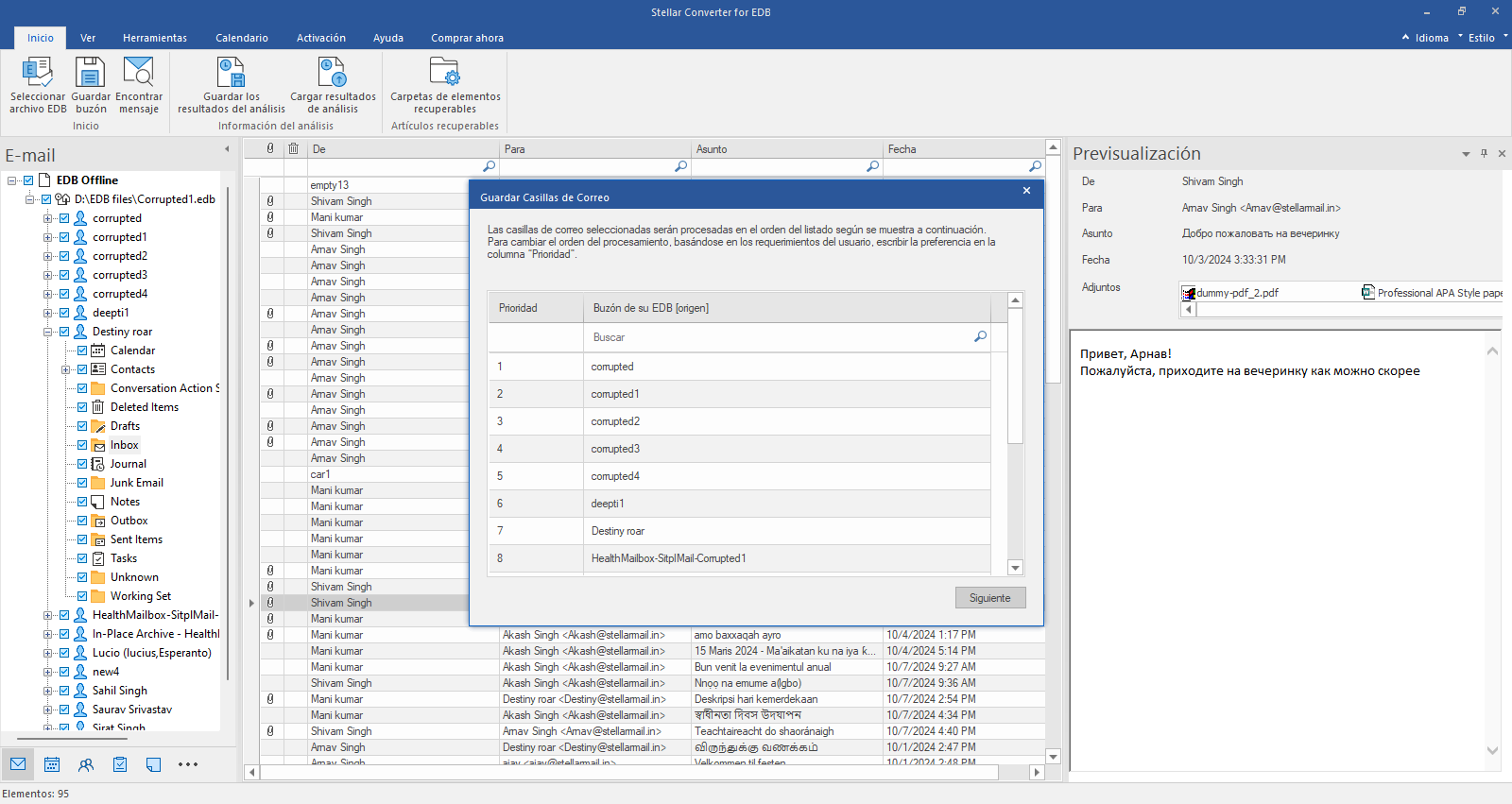
En la ventana «Guardar buzones», puede cambiar la prioridad de exportación de los buzones para que los buzones importantes se exporten primero. A continuación, haga clic en «Siguiente».
Paso 27
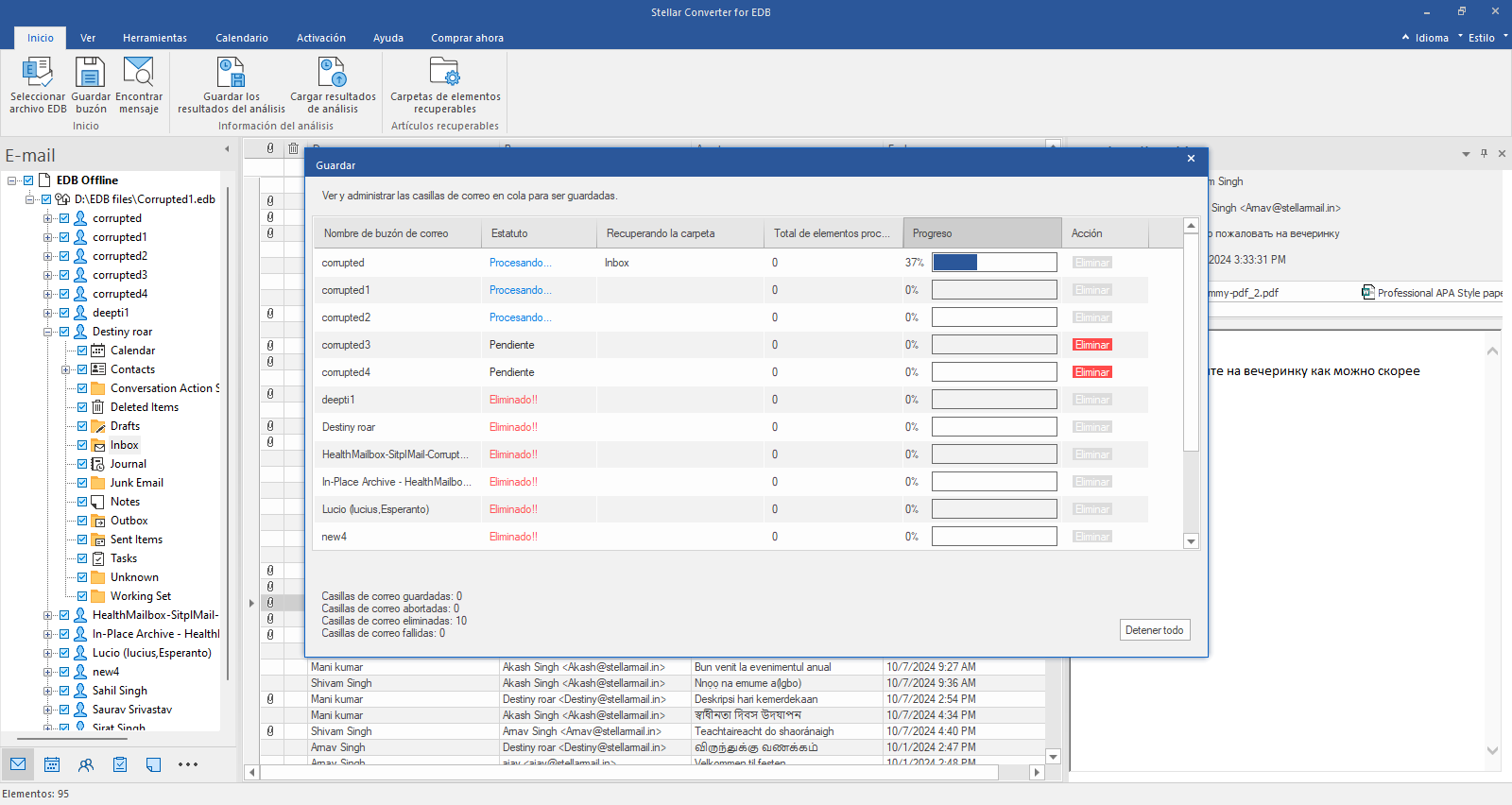
Estado de almacenamiento del buzón
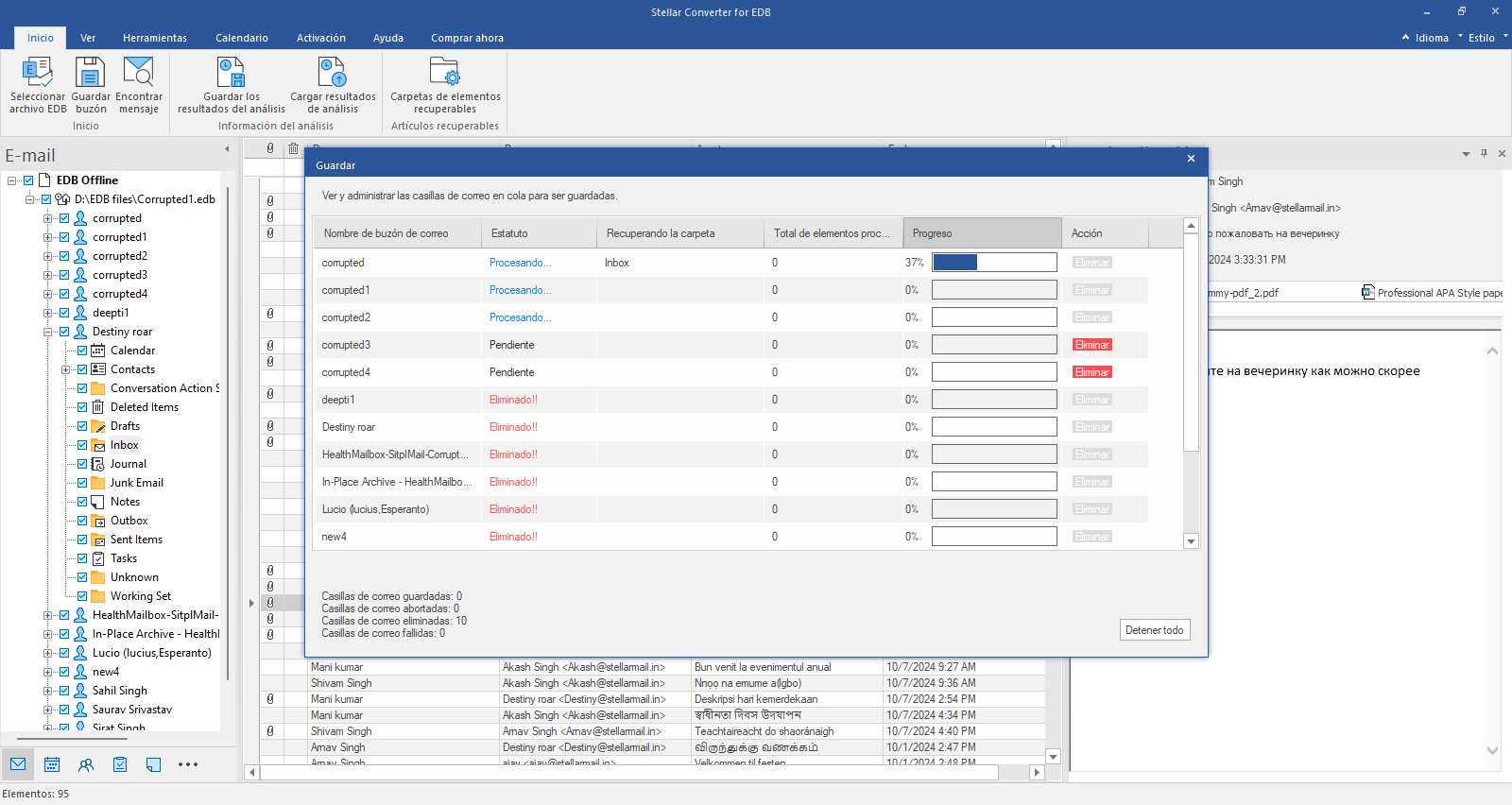
El software comenzará a exportar los buzones seleccionados a formato PST a la ubicación que haya especificado. También puede eliminar los buzones con el estado «Pendiente» de la lista haciendo clic en el botón «Eliminar», o detener todo el proceso de guardado de los buzones haciendo clic en el botón «Detener todo».
Paso 28
Ventana Guardado completado
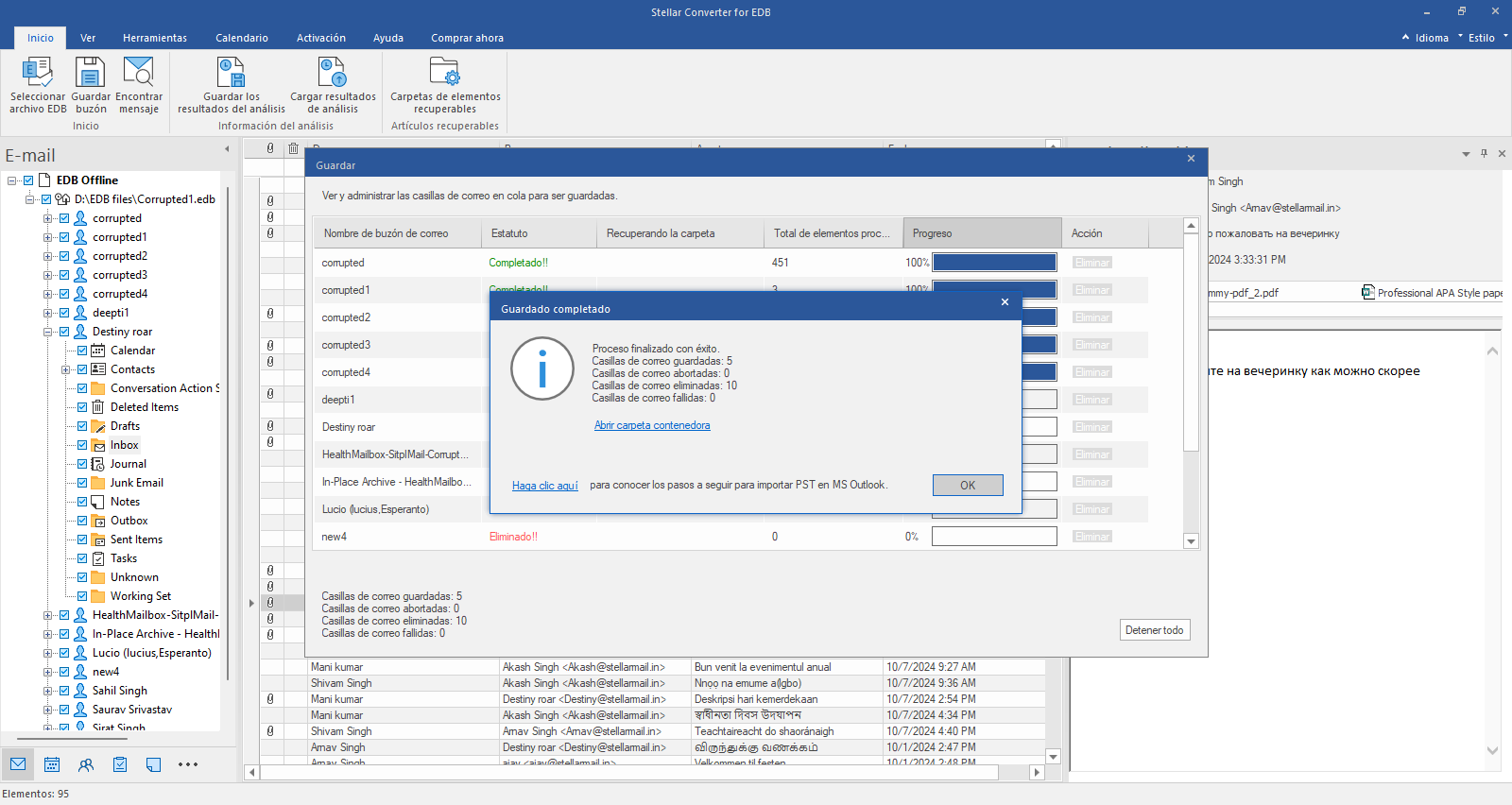
Aparecerá un mensaje cuando se complete el proceso de exportación. Haga clic en «Abrir carpeta contenida» para ver los archivos PST exportados.
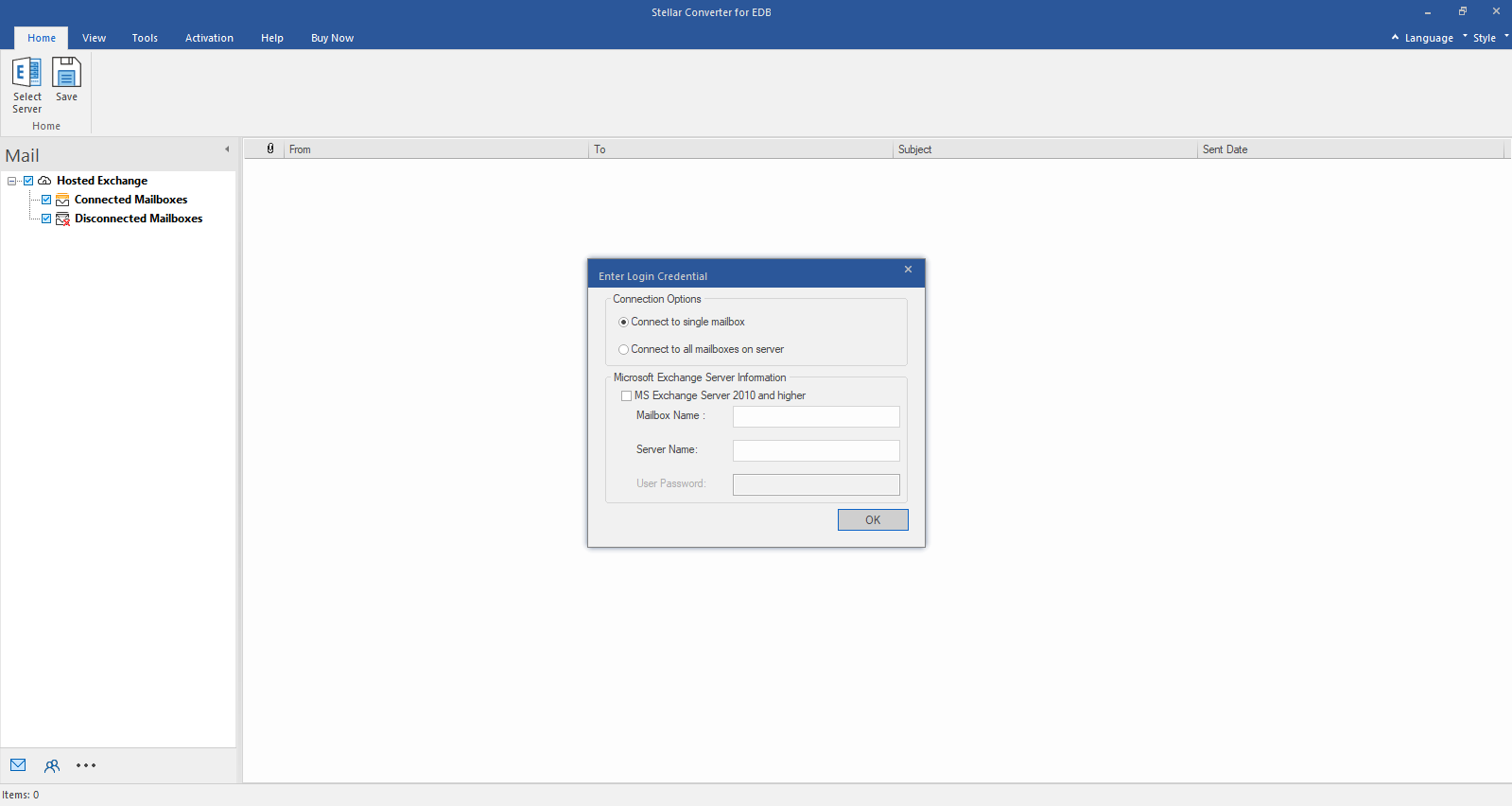
Select Hosted Exchange to export mailboxes from an online EDB file. Select Connect to Single Mailbox or Connect to Single Mailbox from Connection Options
Step 2
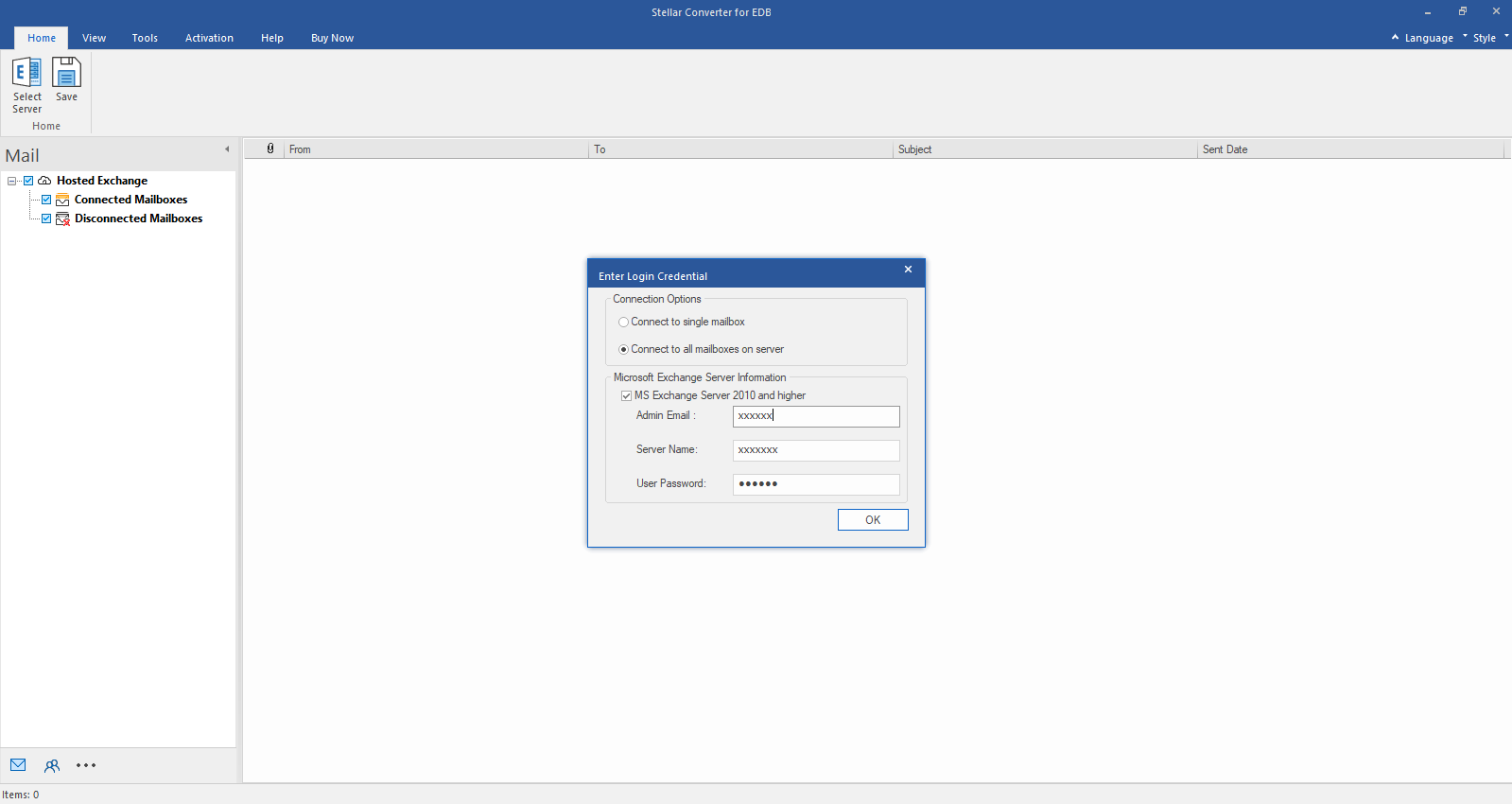
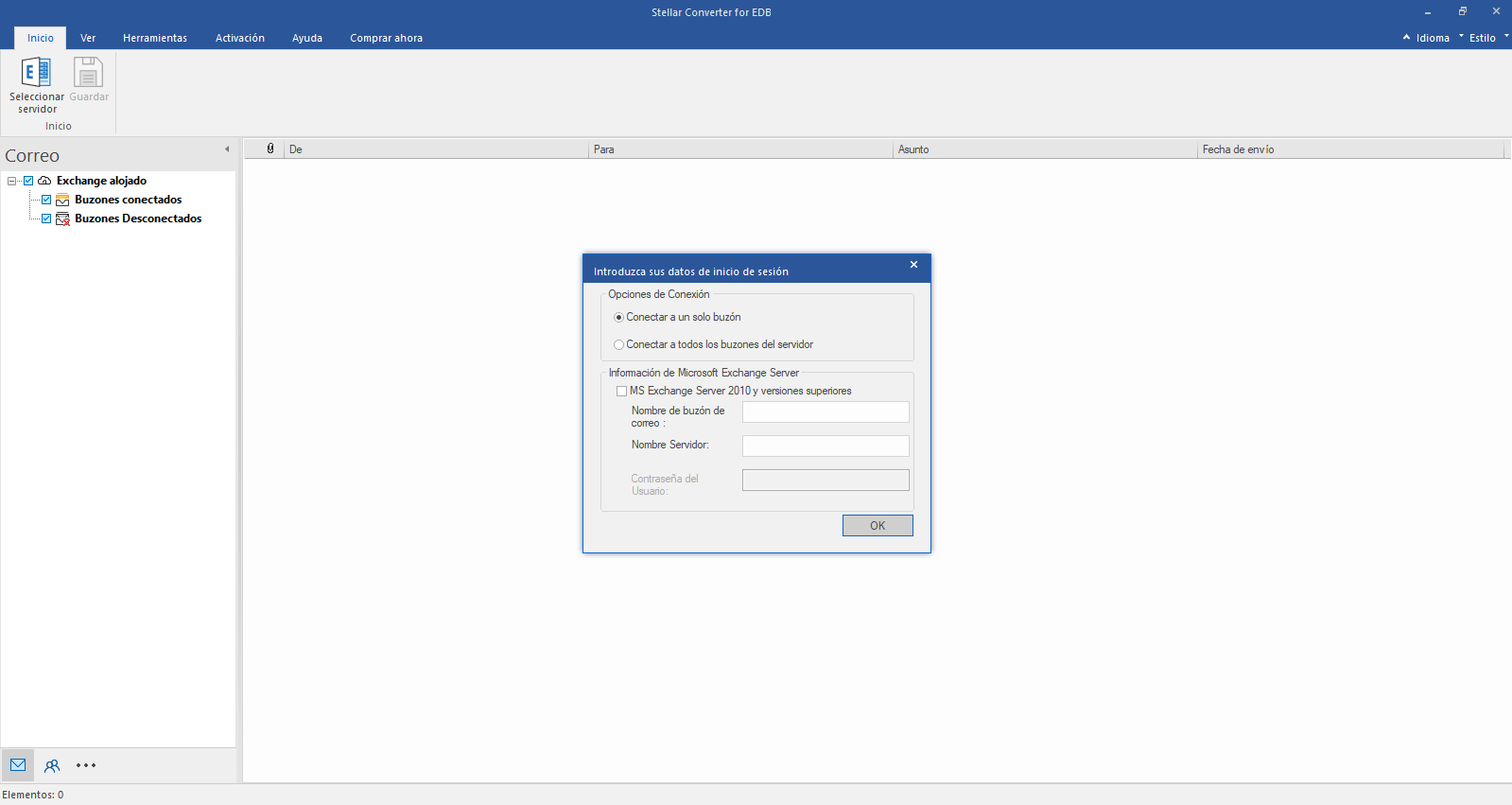
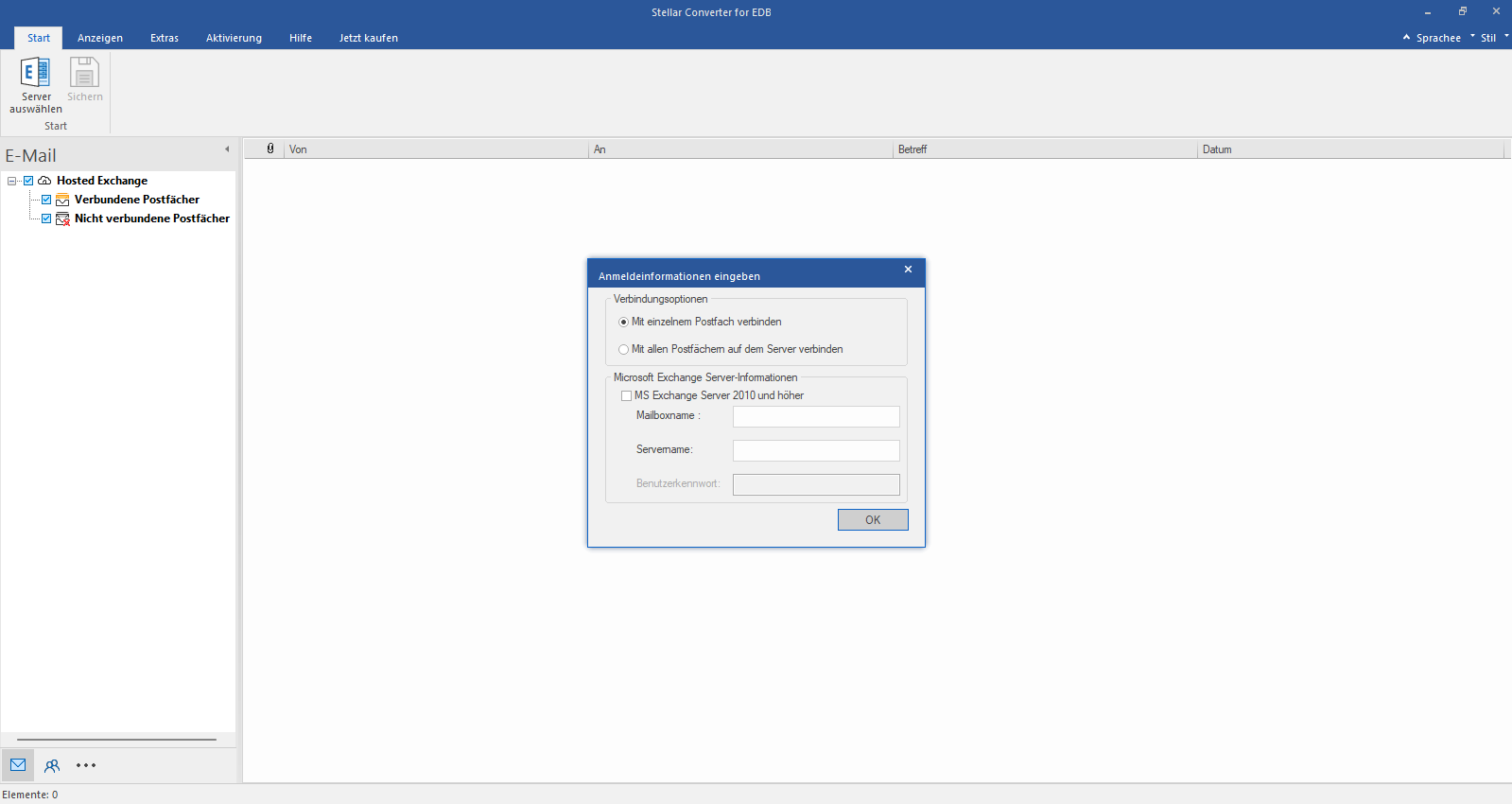
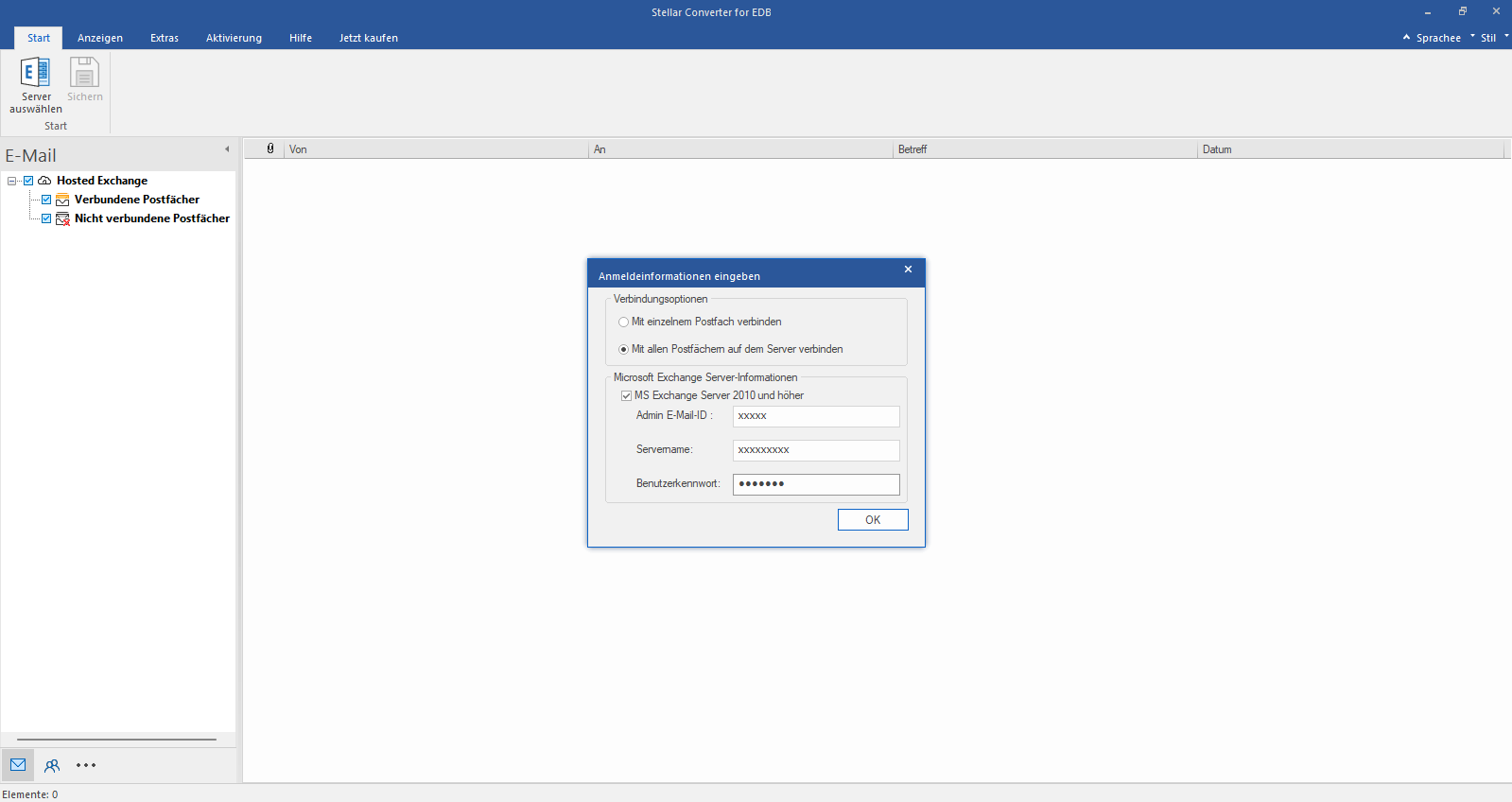
Enter Admin Email and Server Name
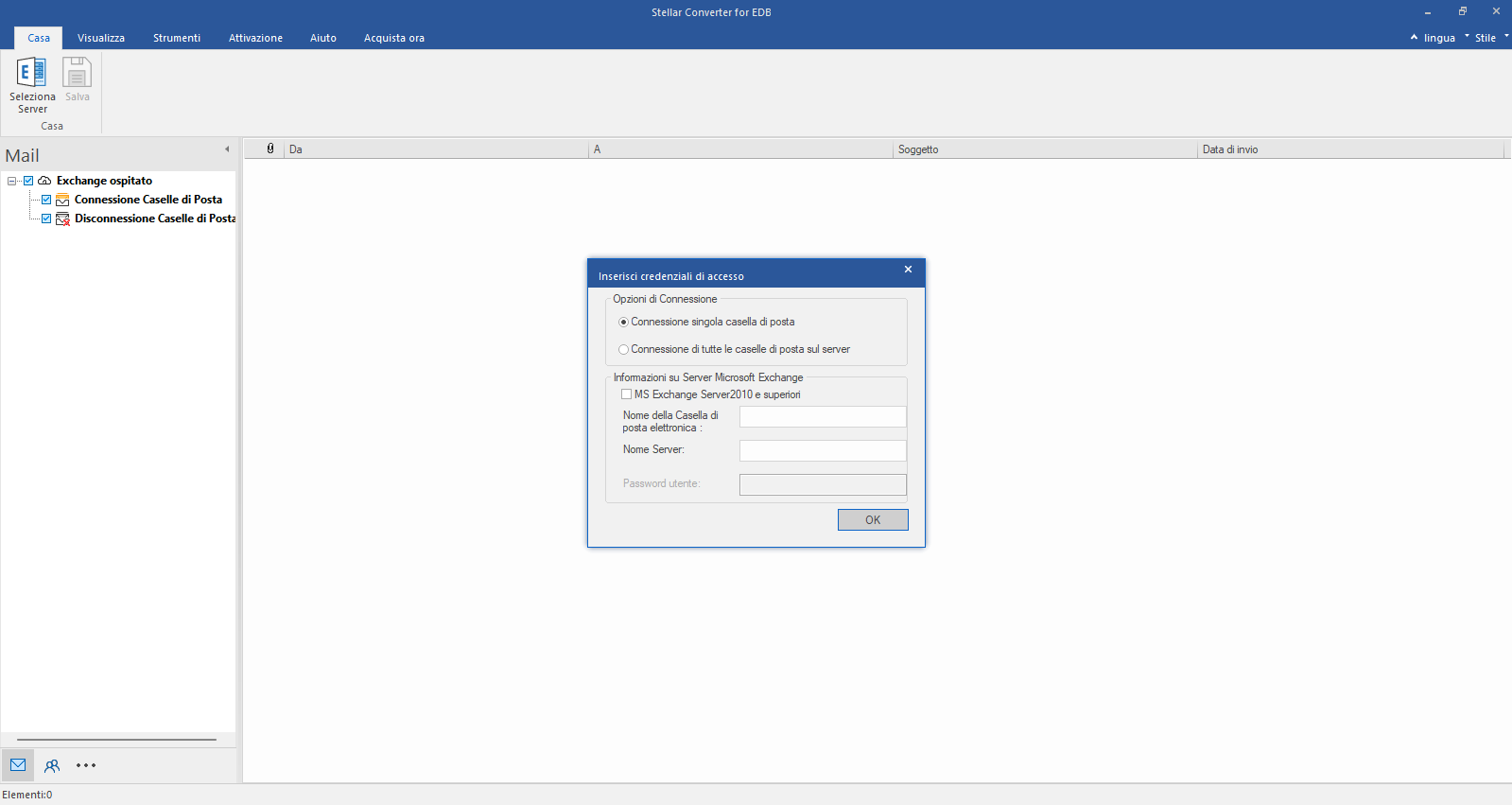
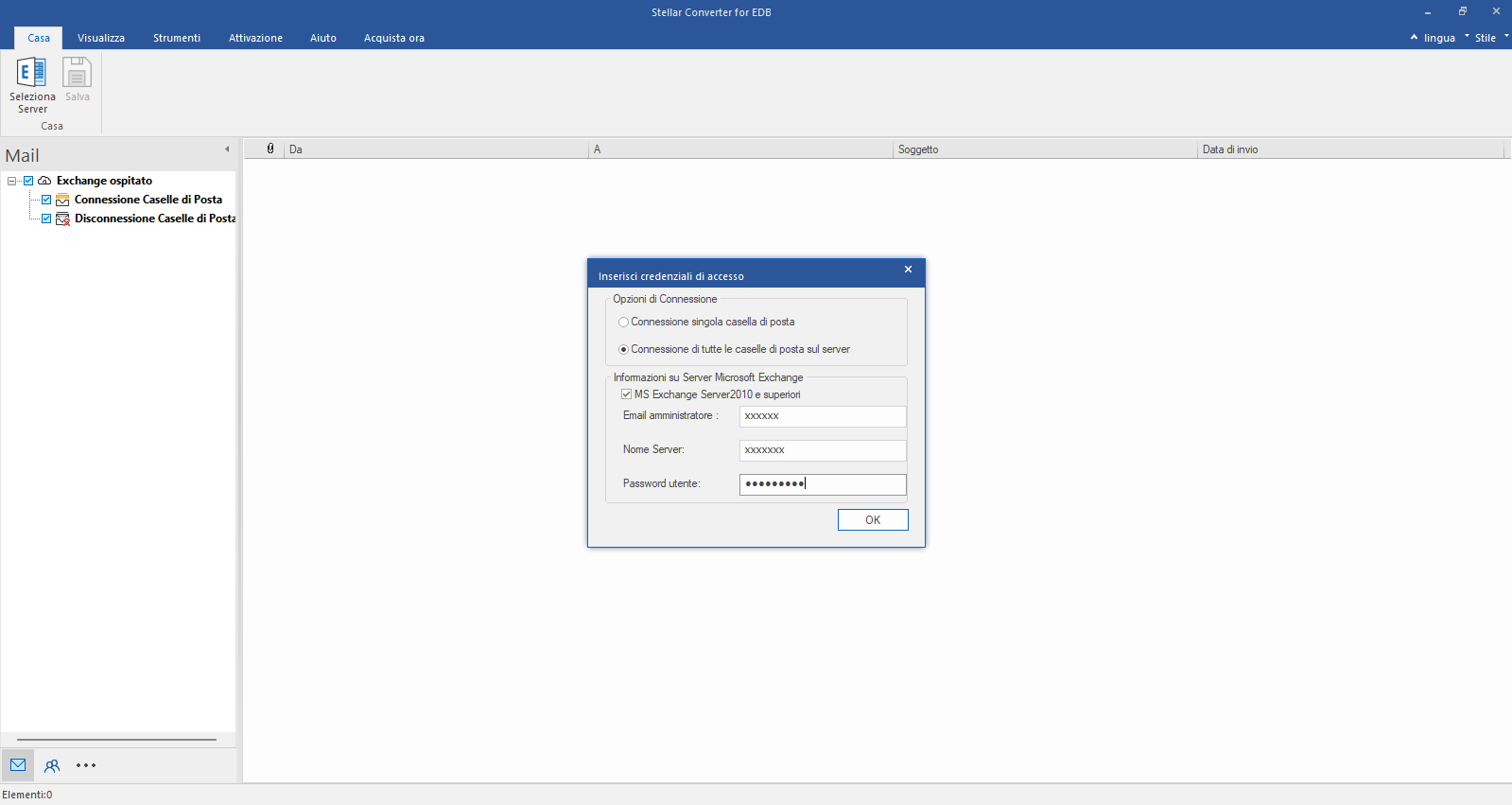
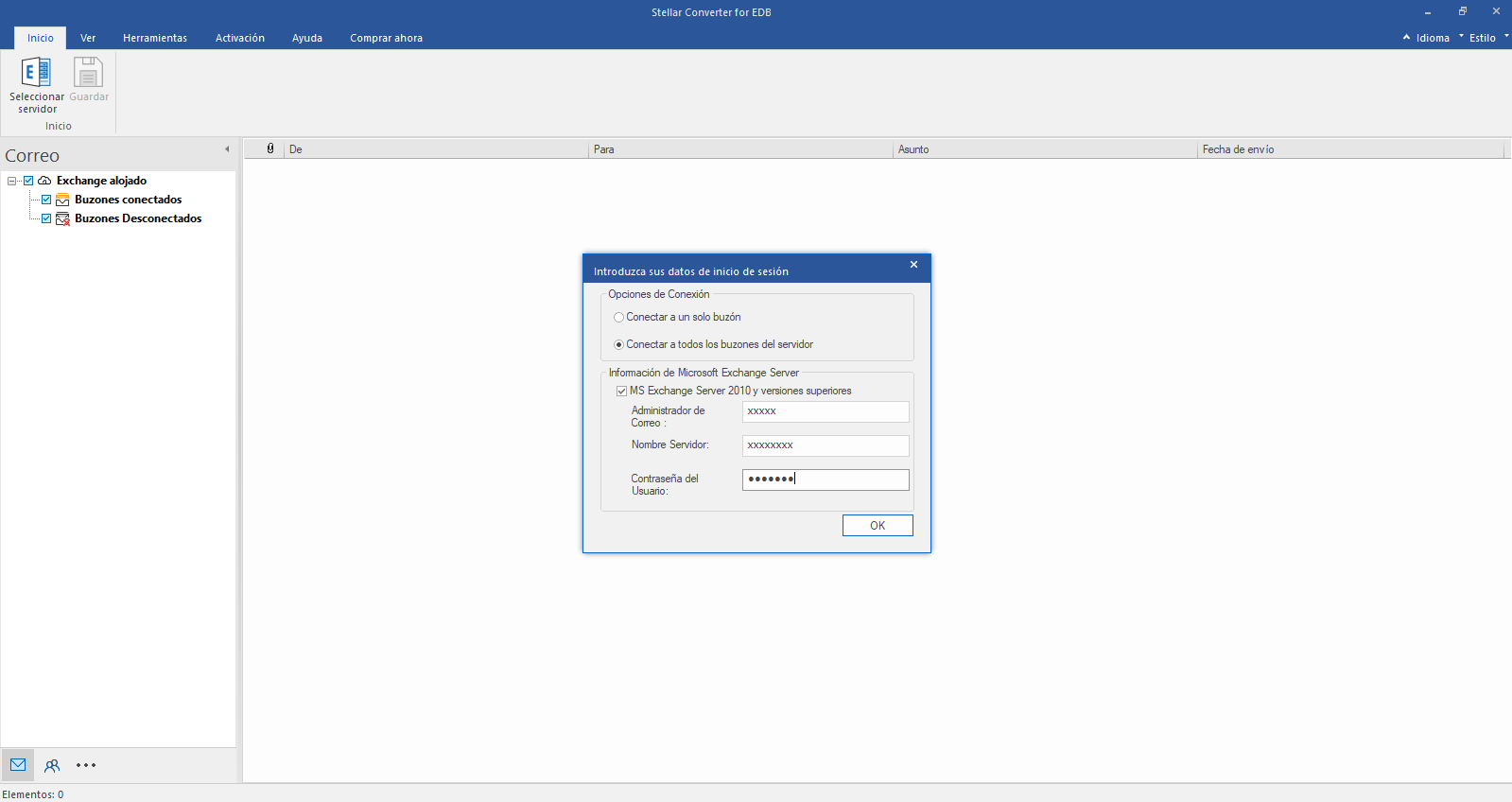
Enter Admin and Server Name (for Exchange 5.5, 2000, 2003, 2007) or tick "Exchange Server 2010 and higher" checkbox to enter Admin Email, Server Name and Password (for MS Exchange 2010, 2013, 2016, and 2019). Click OK.
Step 3
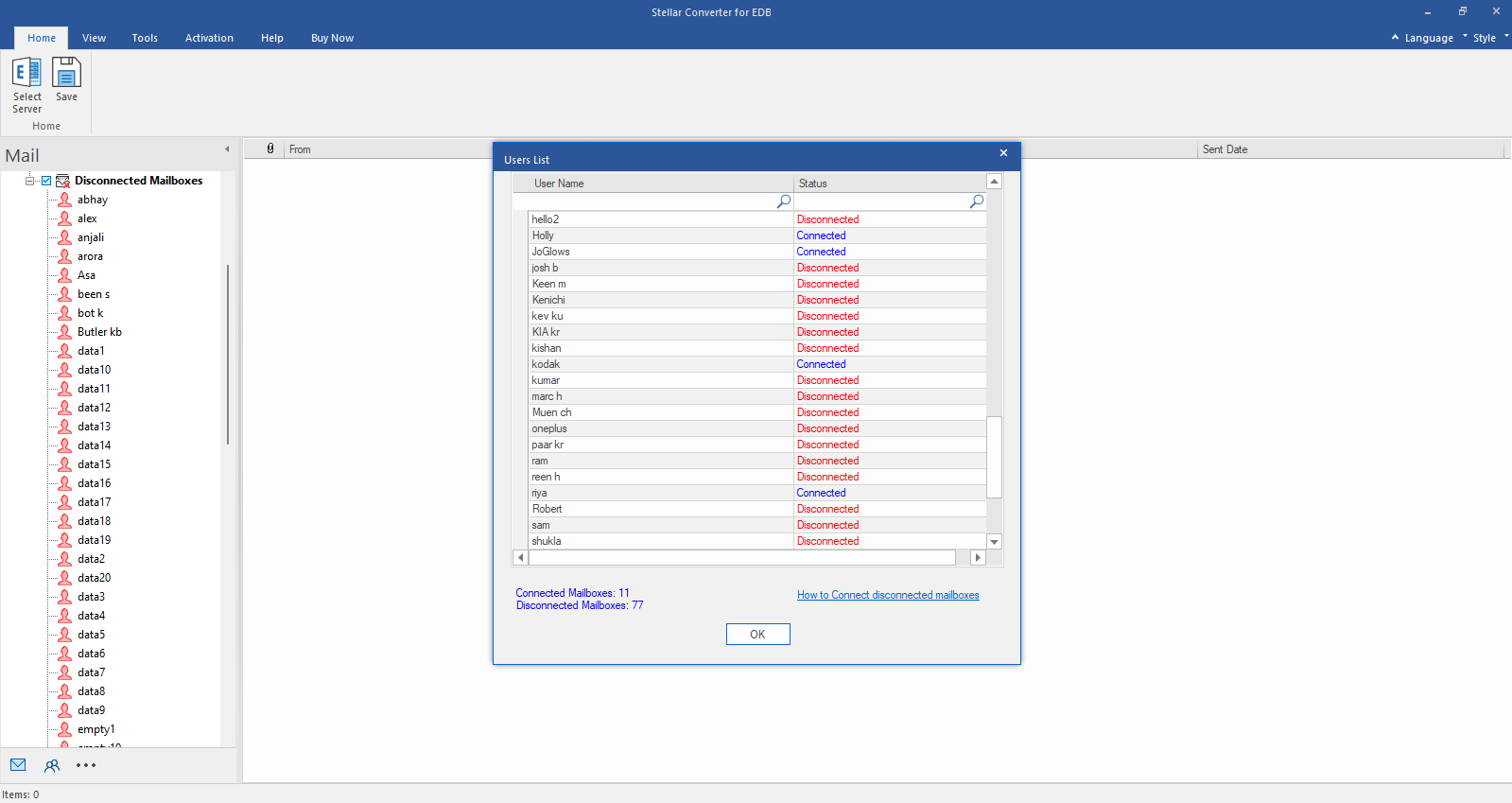
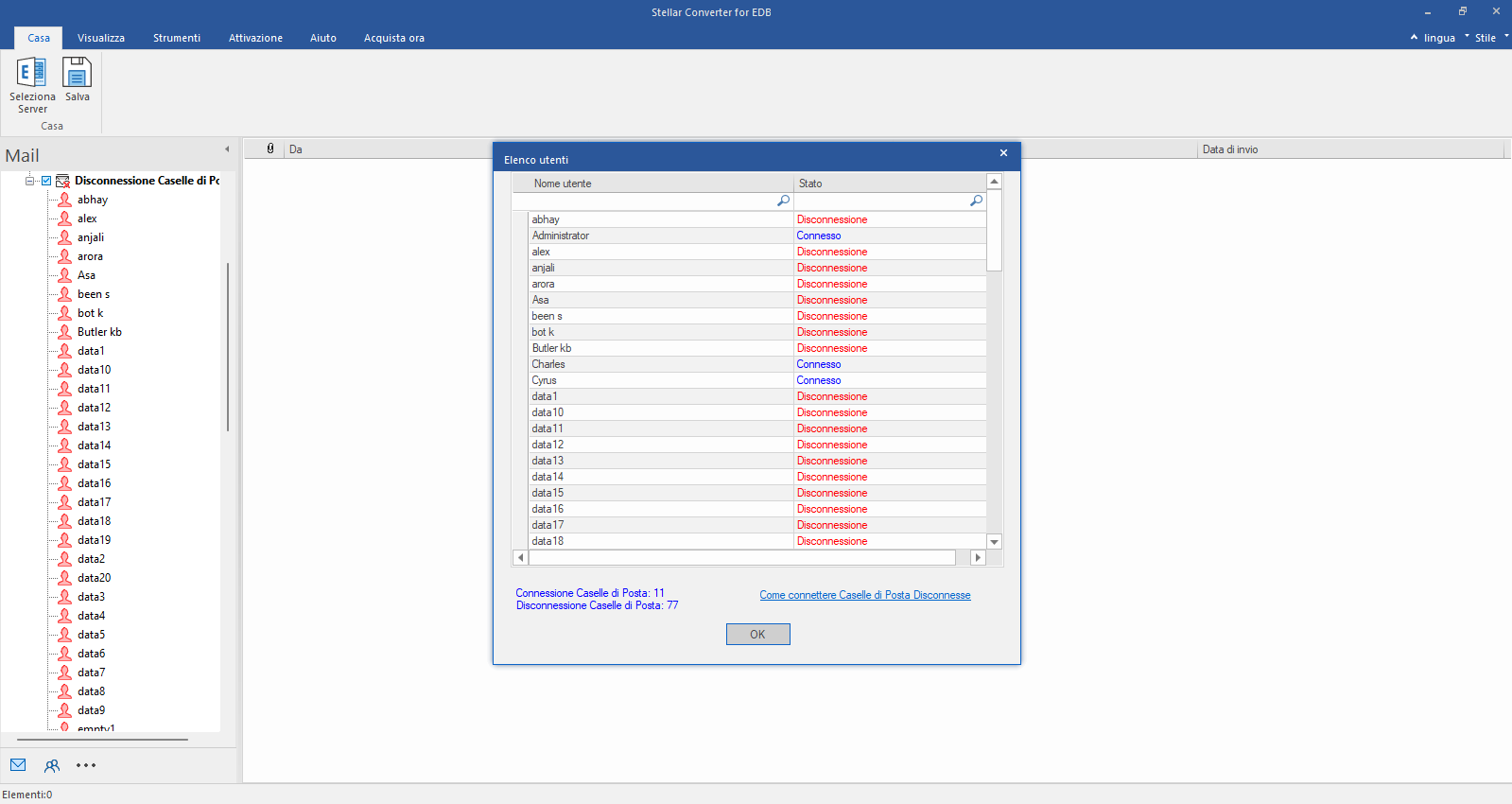
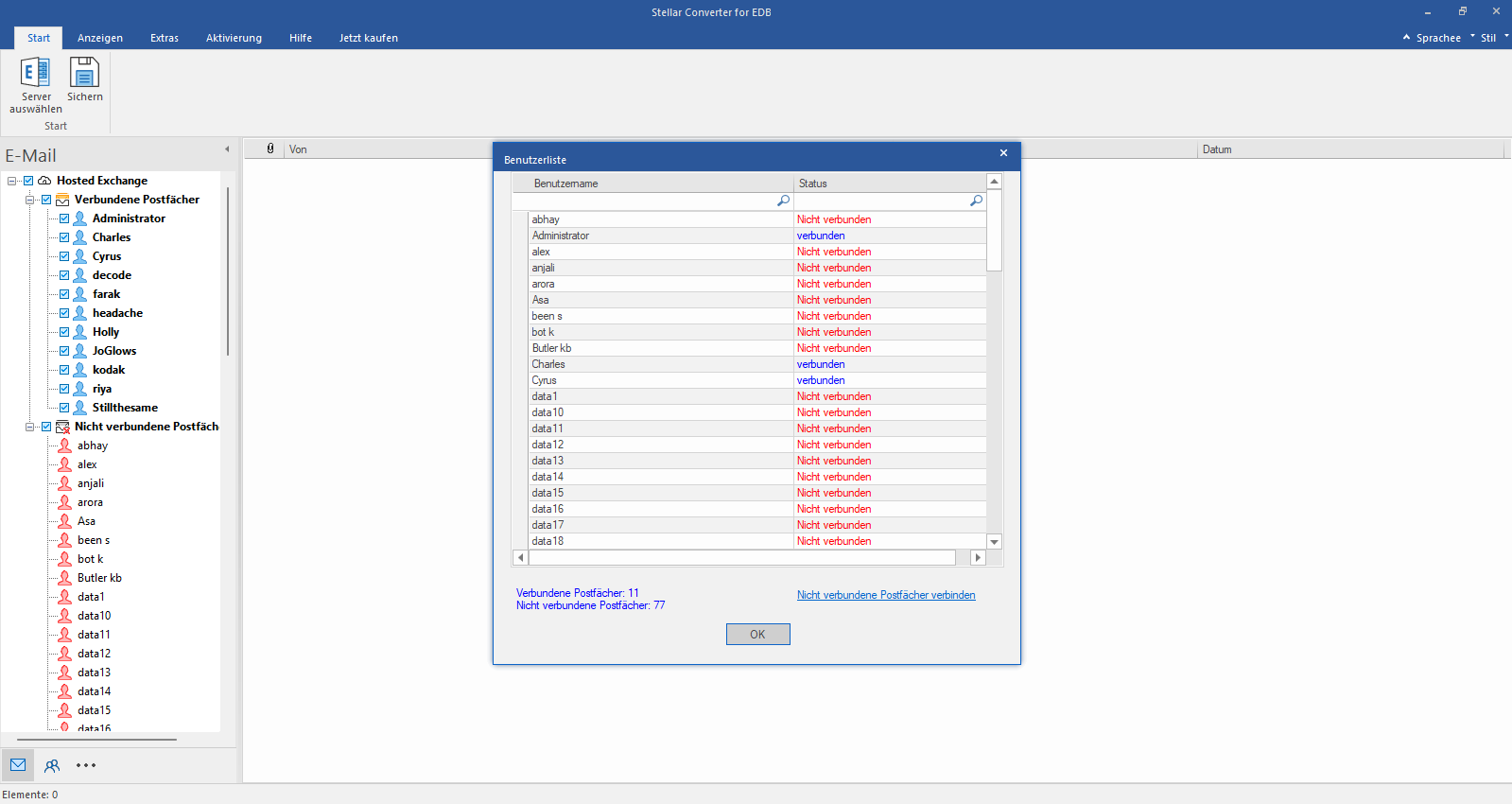
Check Connected/Disconnected Mailbox Status
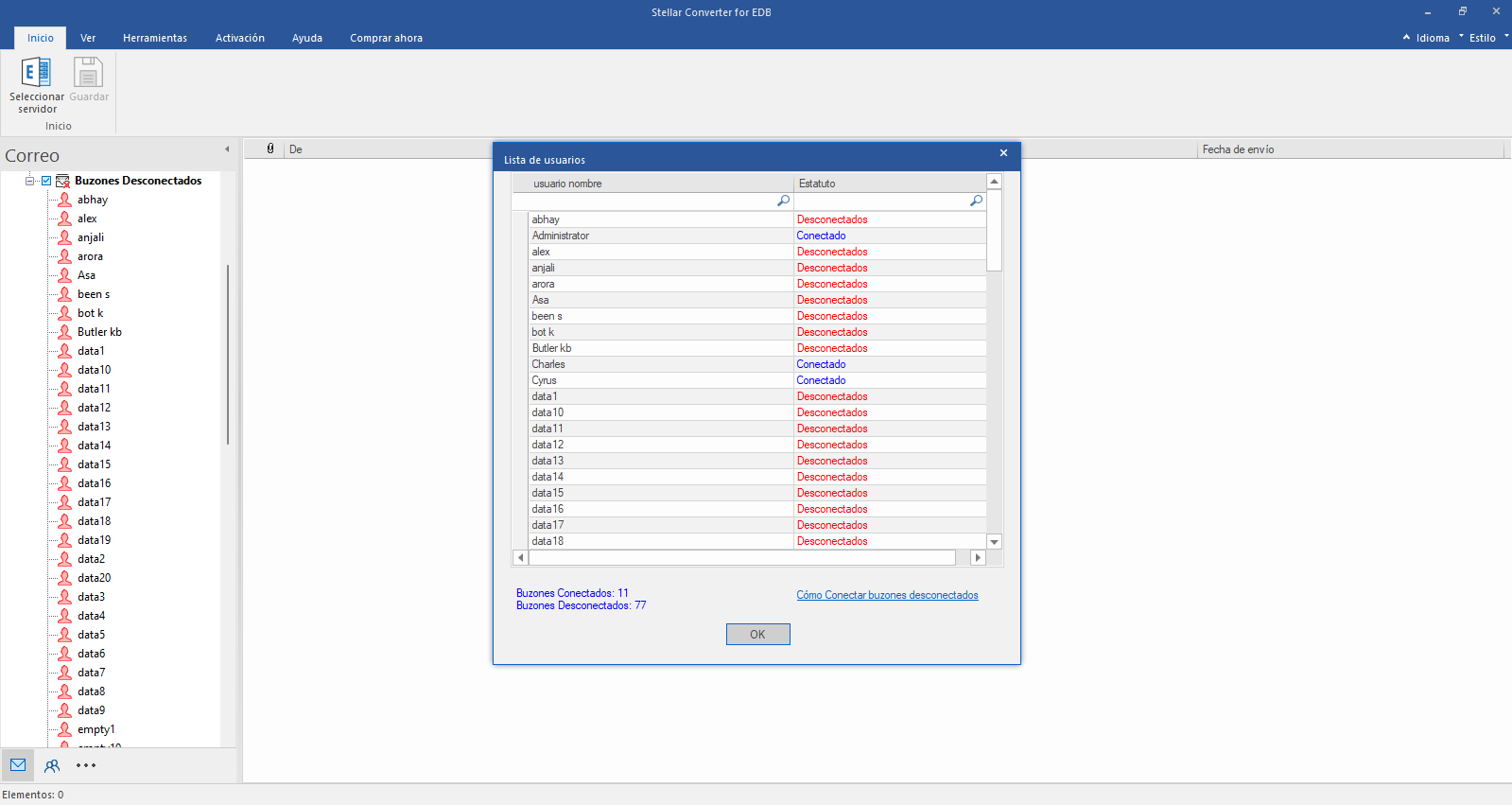
After establishing the connection with Exchange Server, Next window displays list of connected and disconnected mailboxes. Click "OK" to proceed.
Step 4
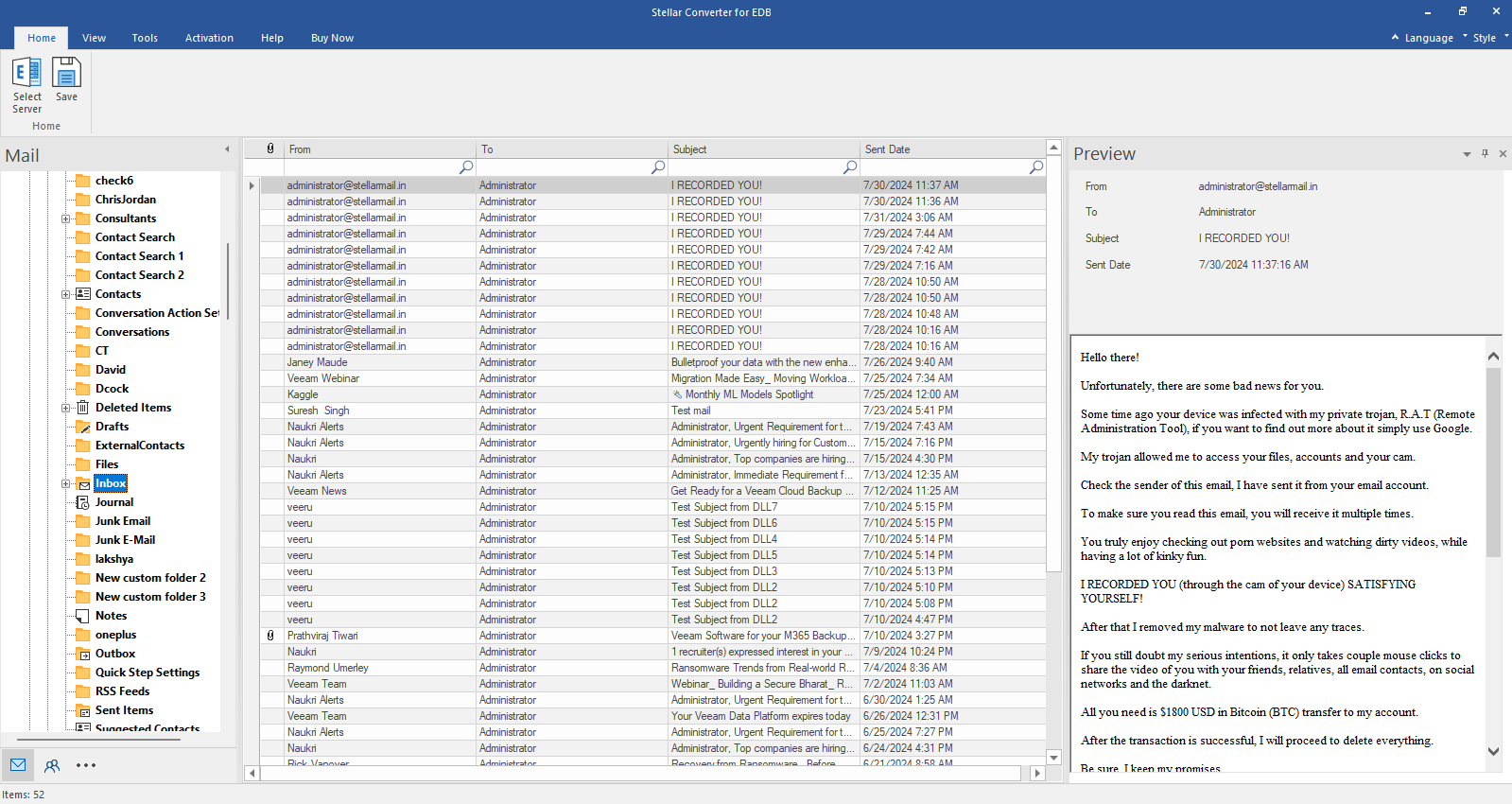
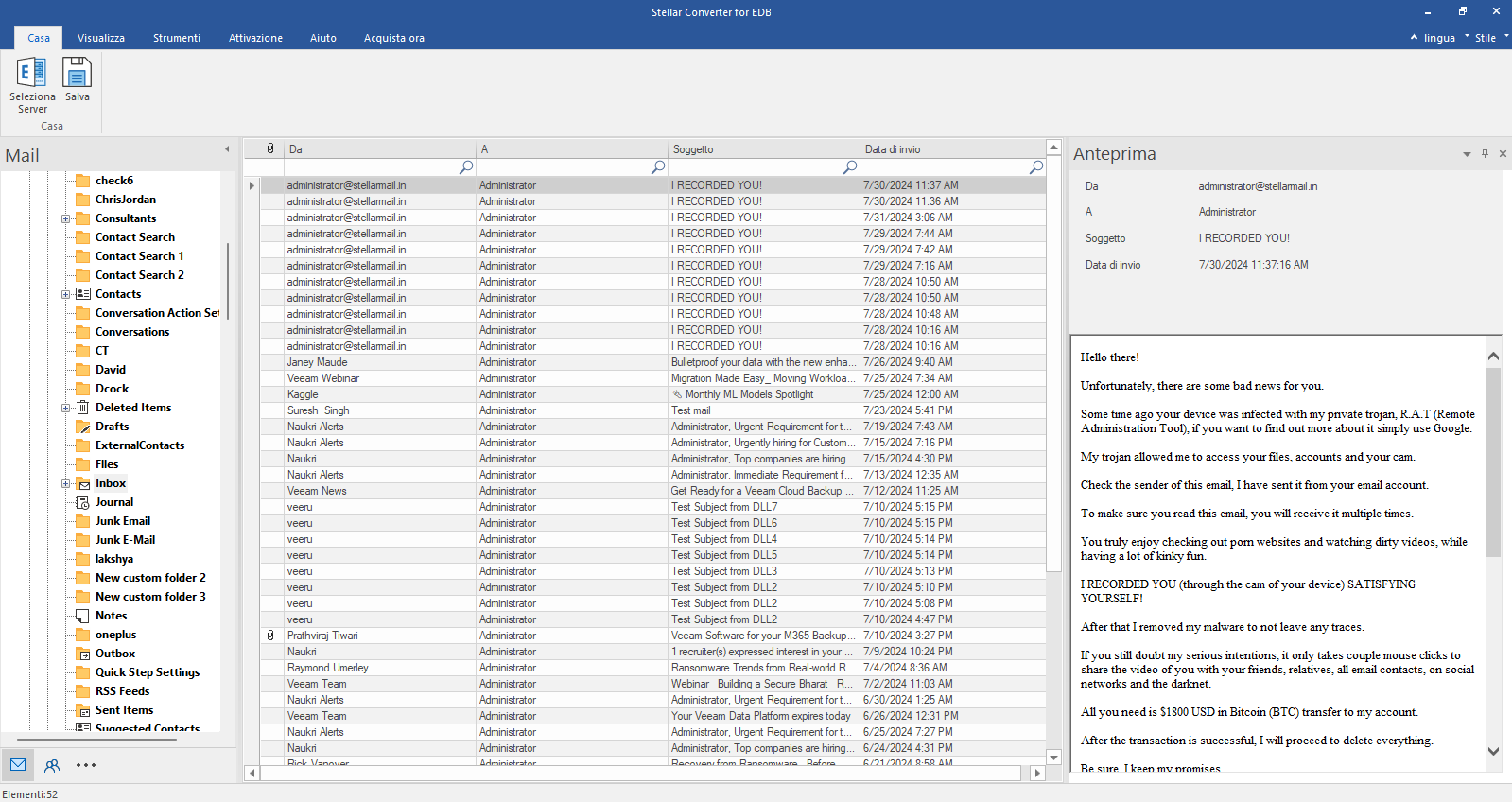
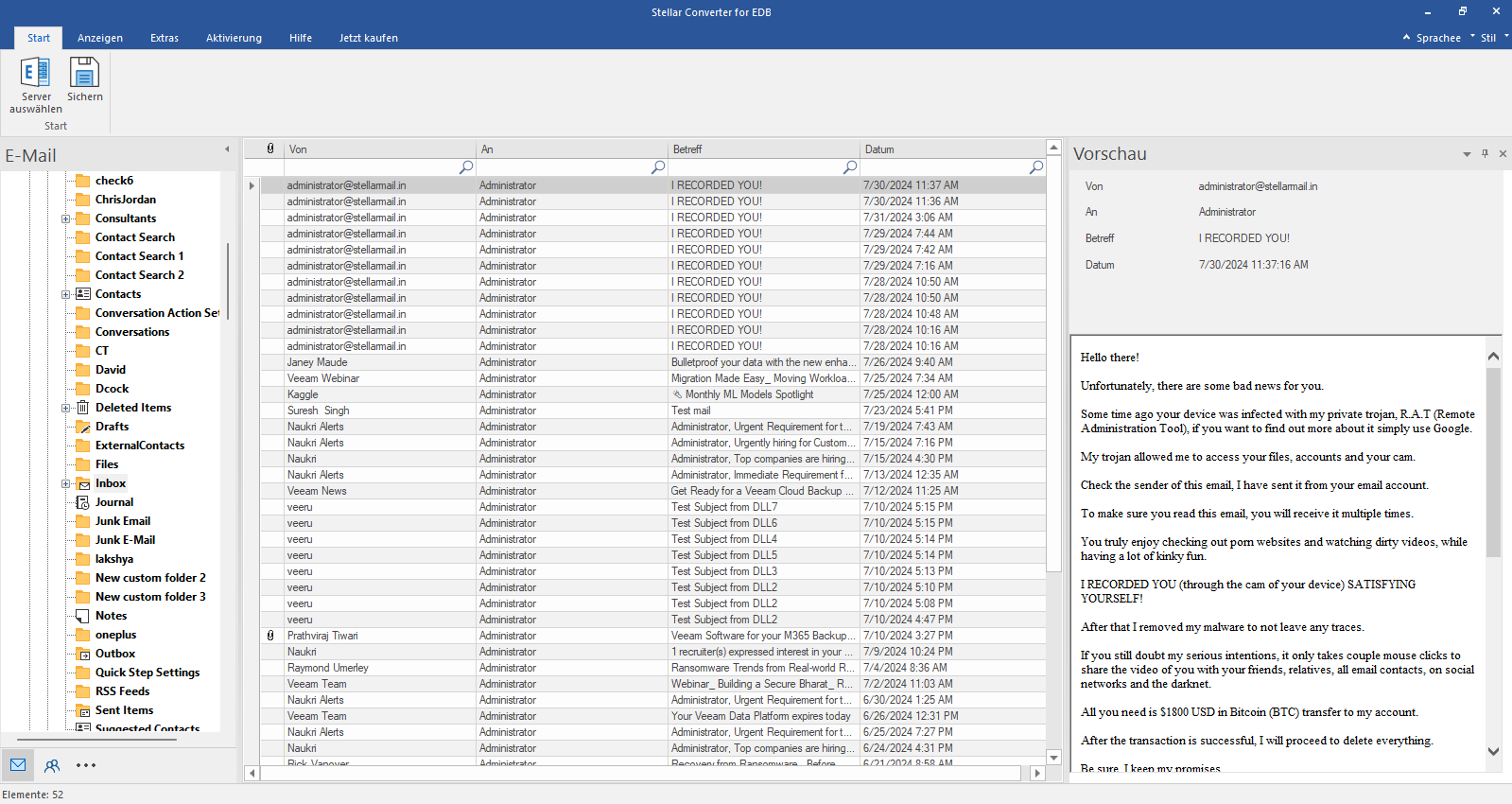
Check the Preview of all Mailboxes
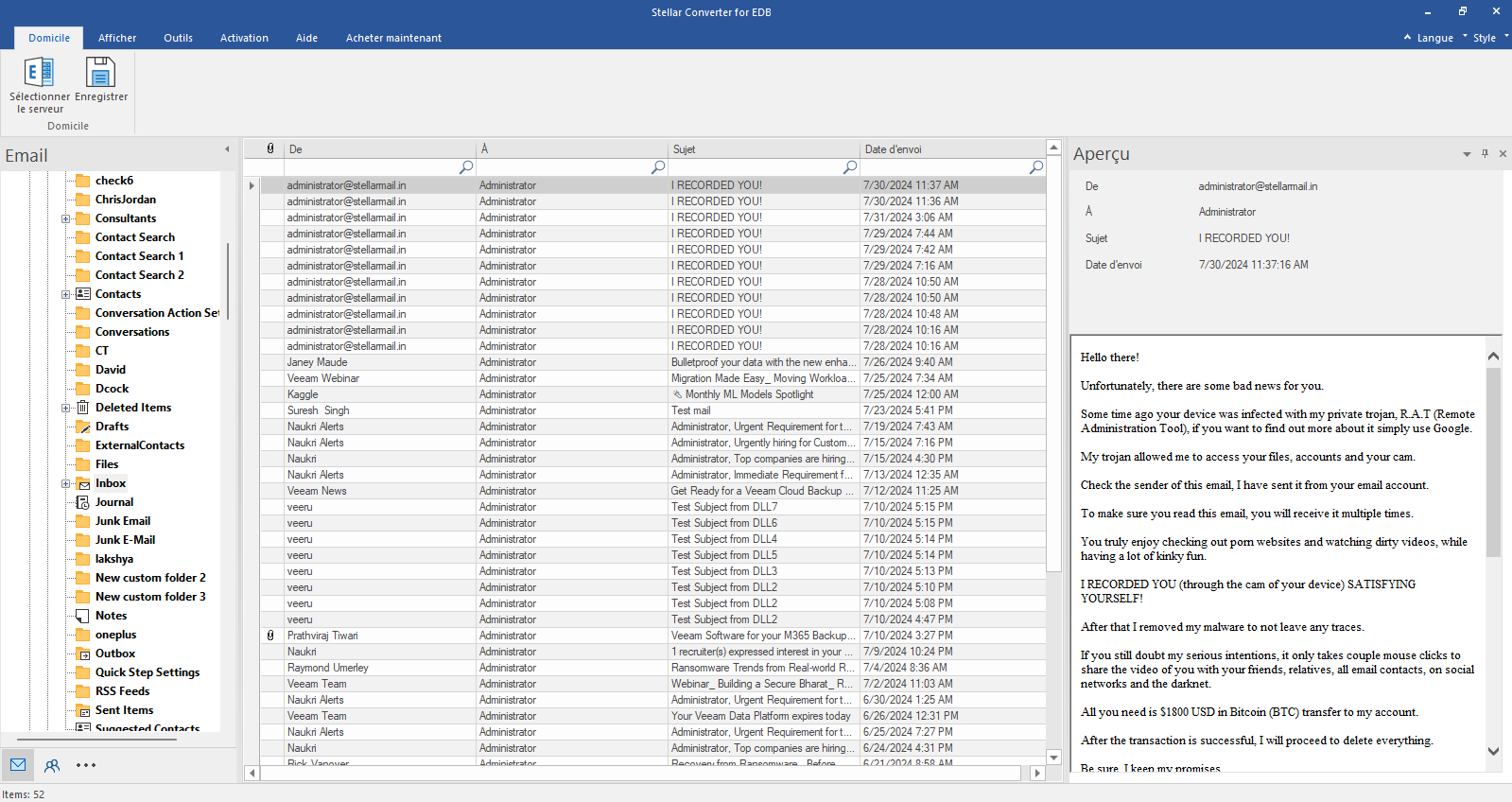
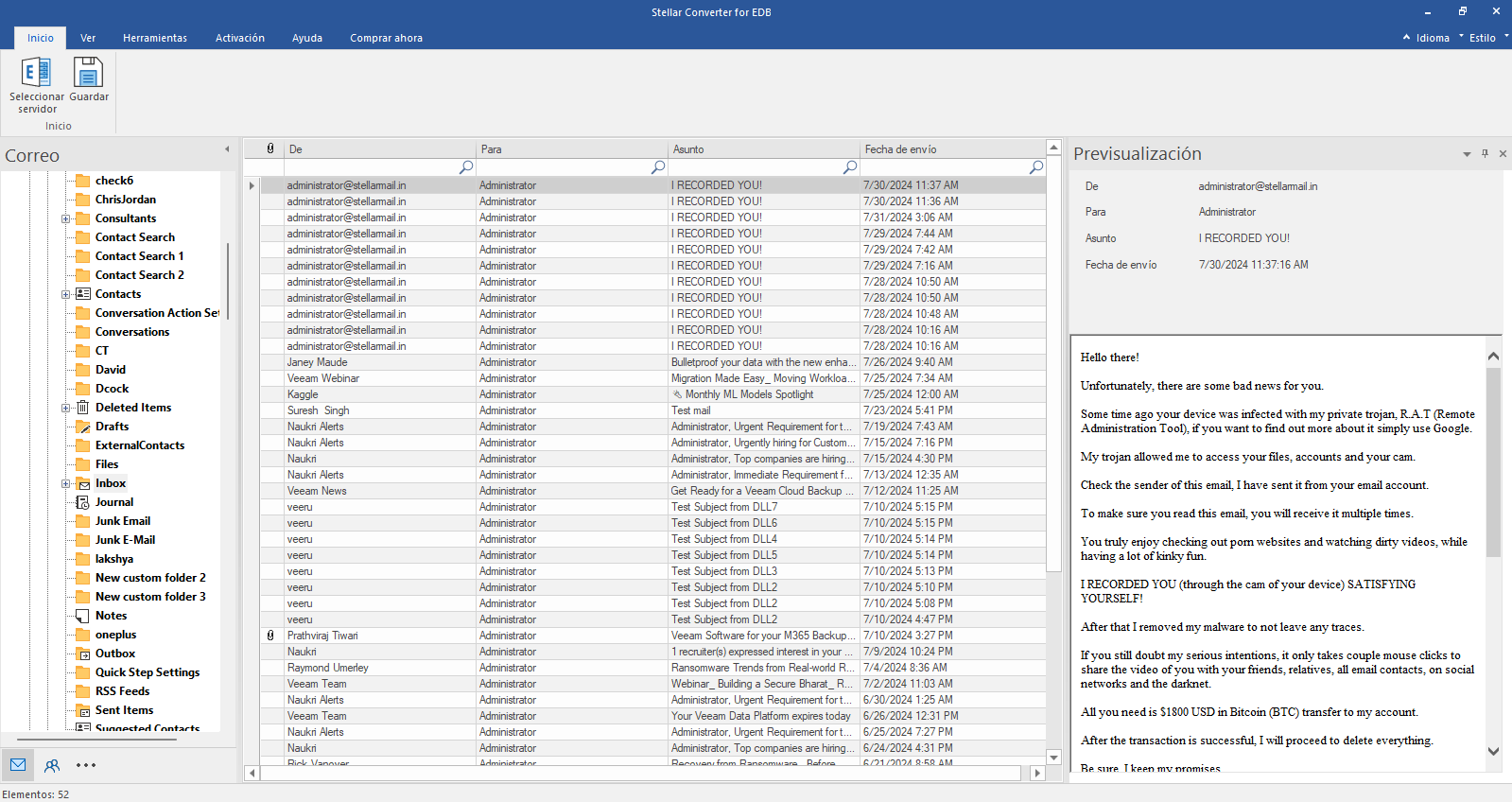
Check the preview of all mailbox items- Emails, Calendars, Contacts etc.
Step 5
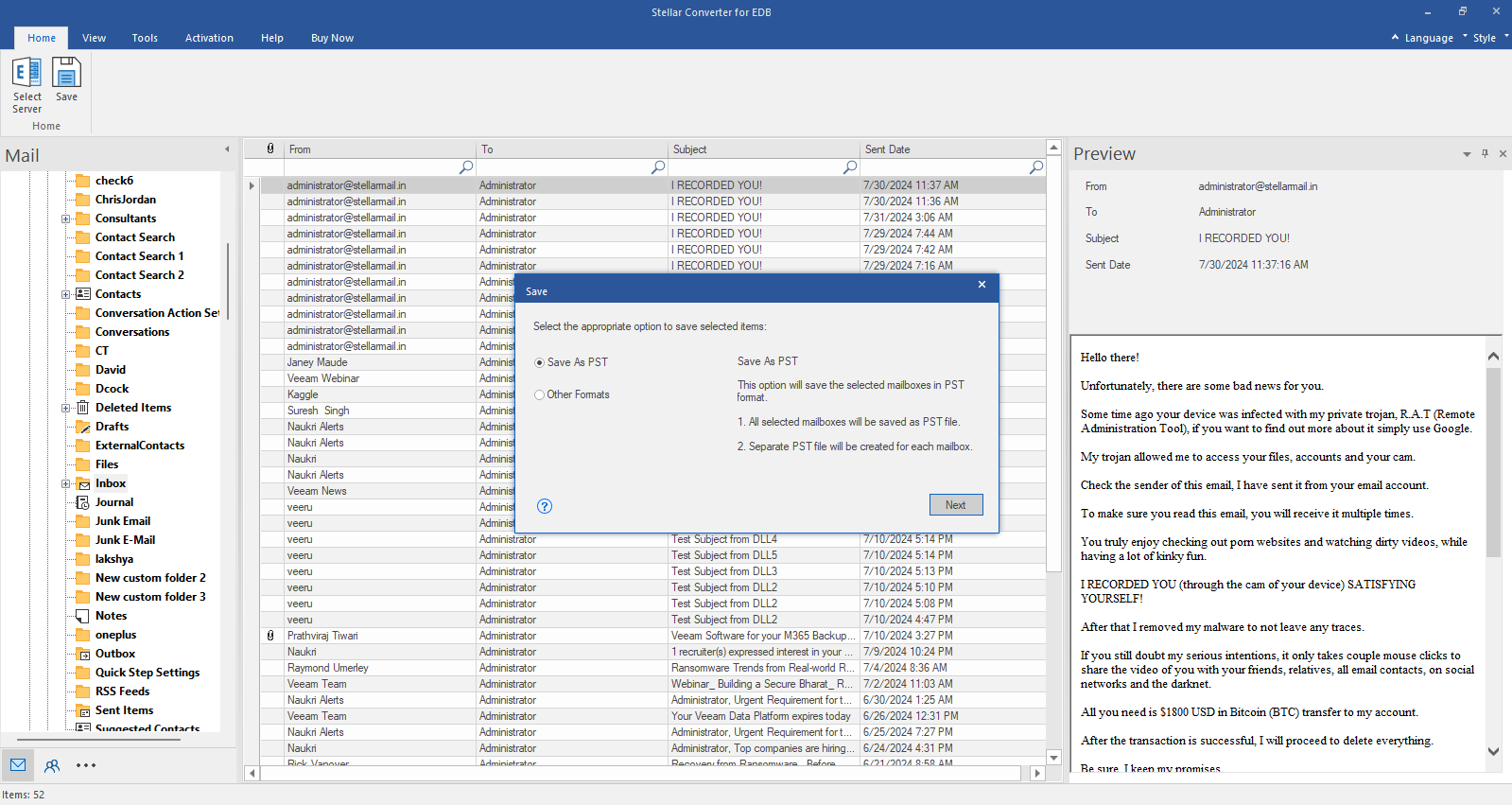
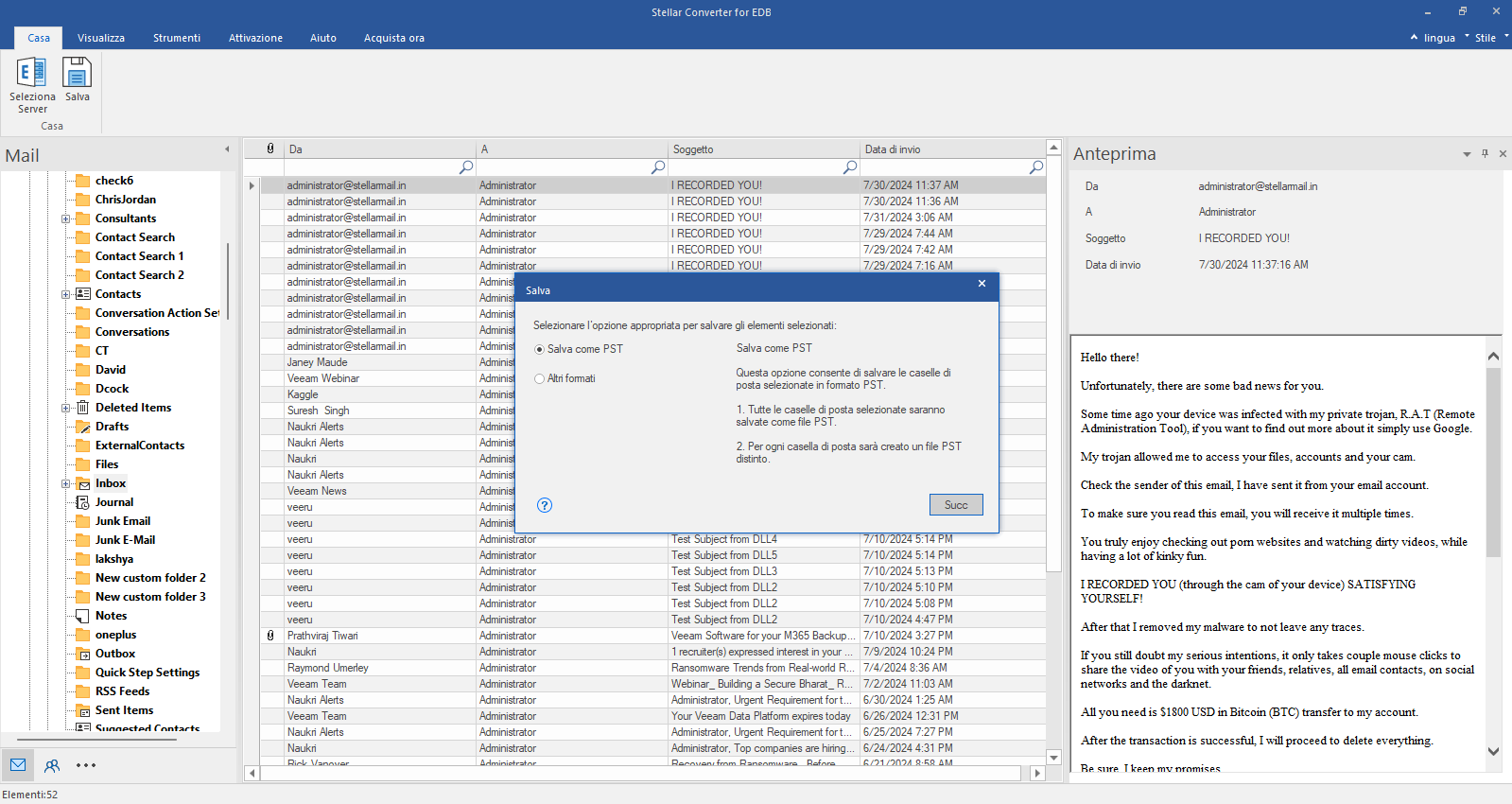
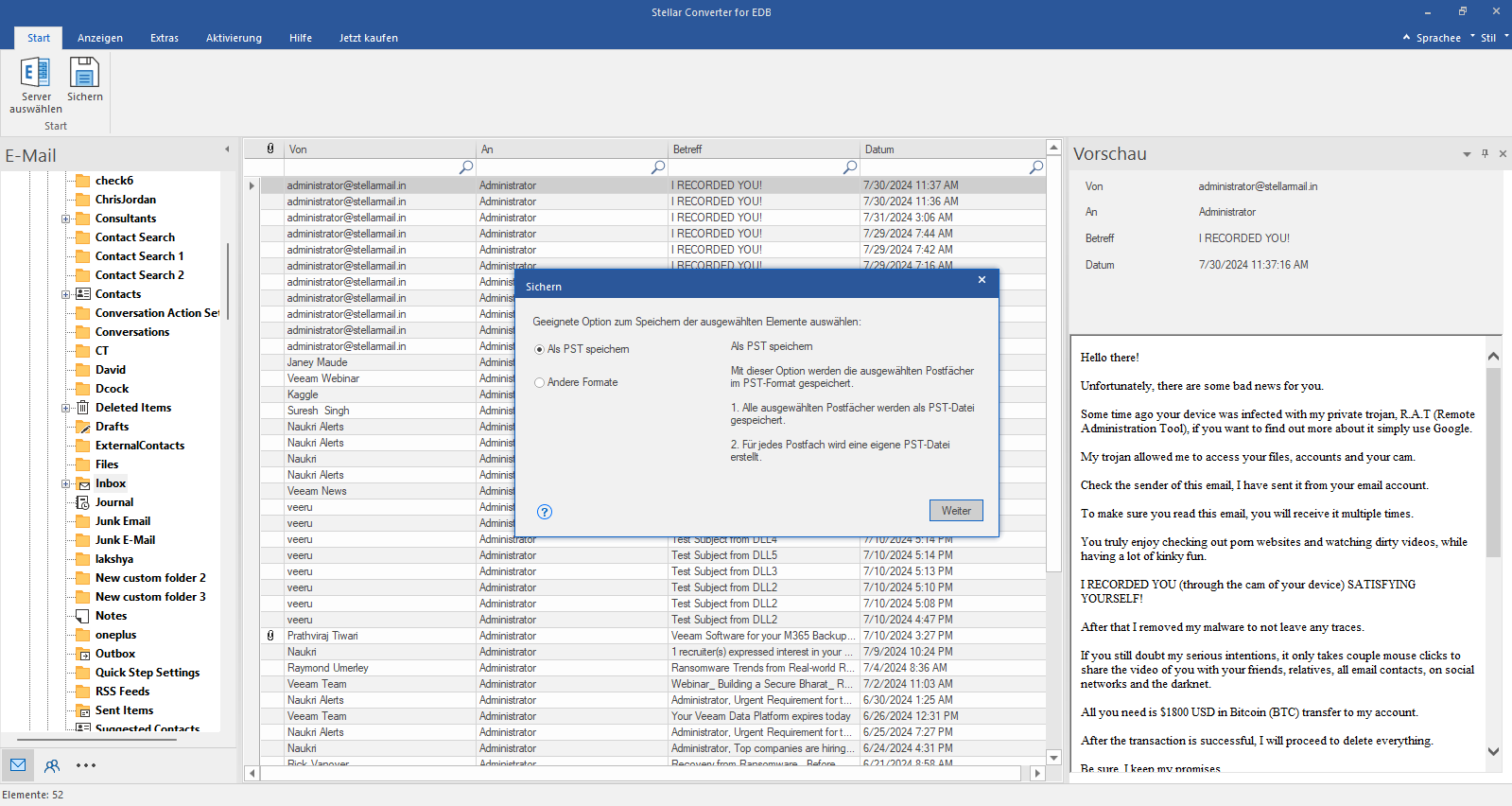
Select “Save as PST”
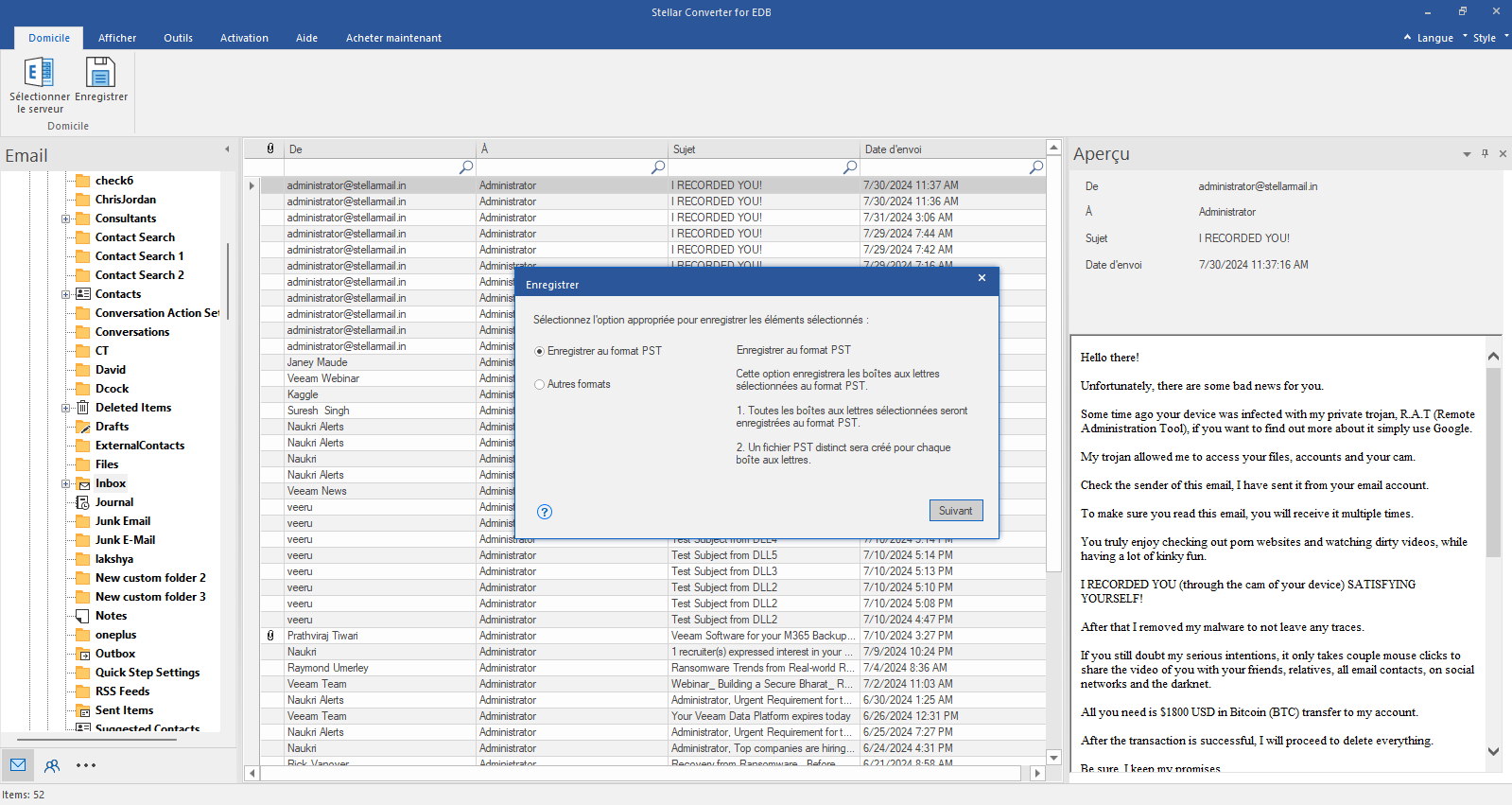
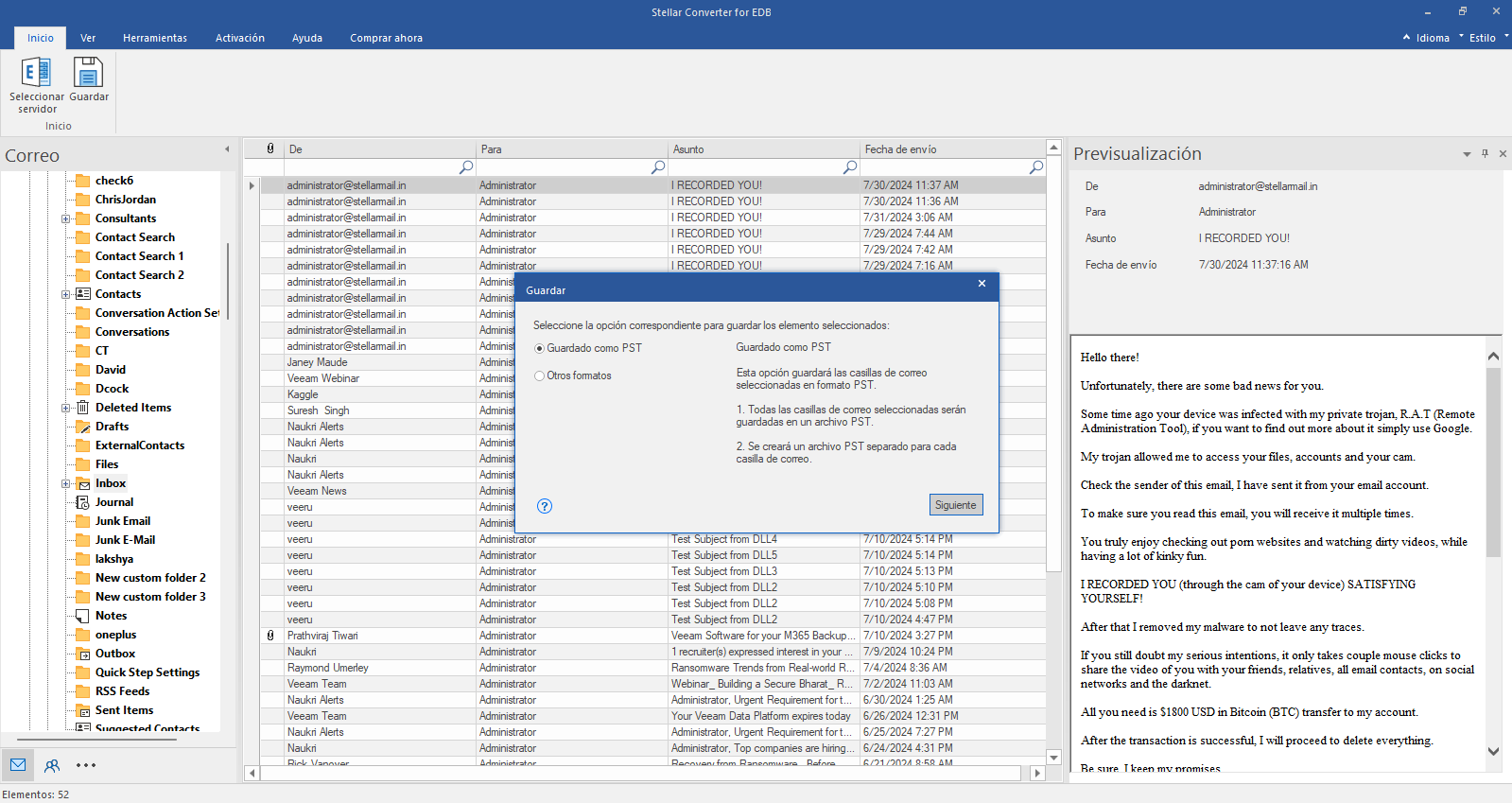
Click Save from Home Ribbon and Select Save as PST option. Click "Next" to proceed.
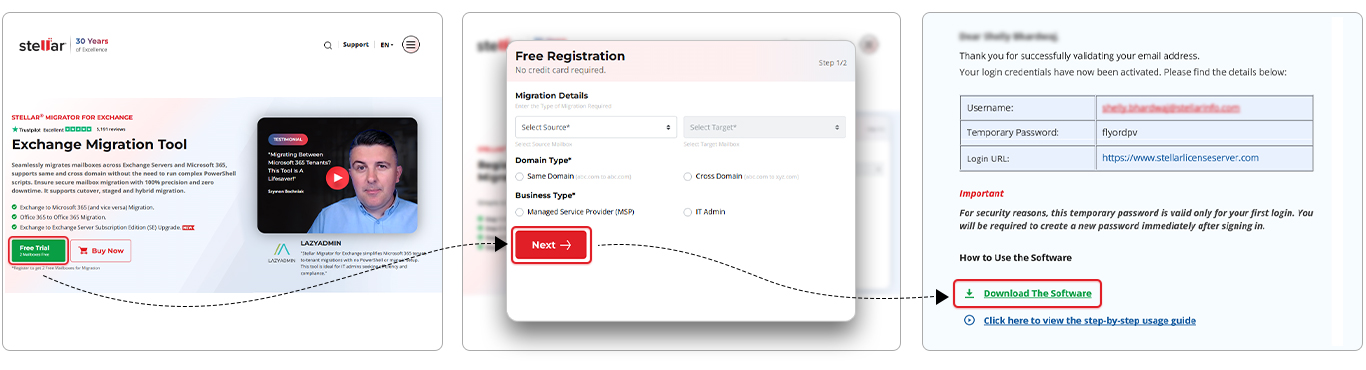
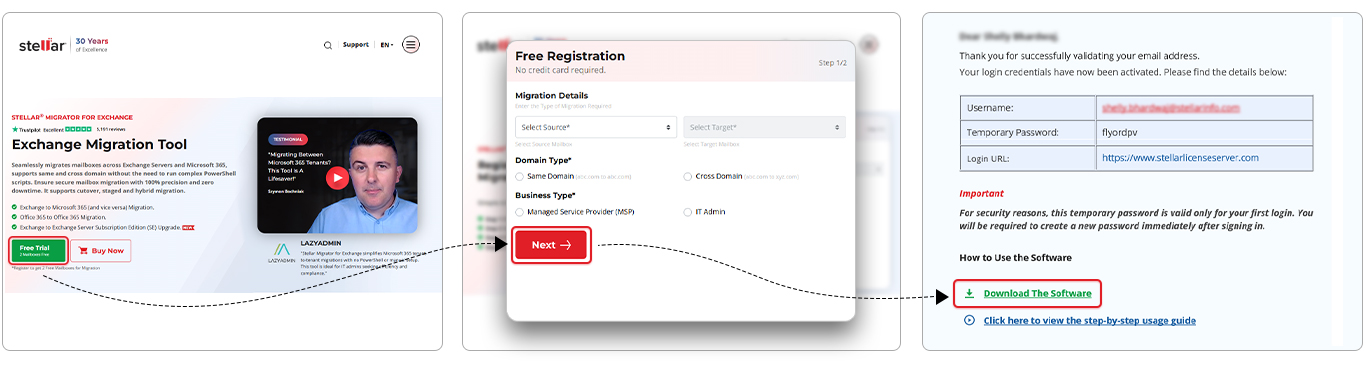
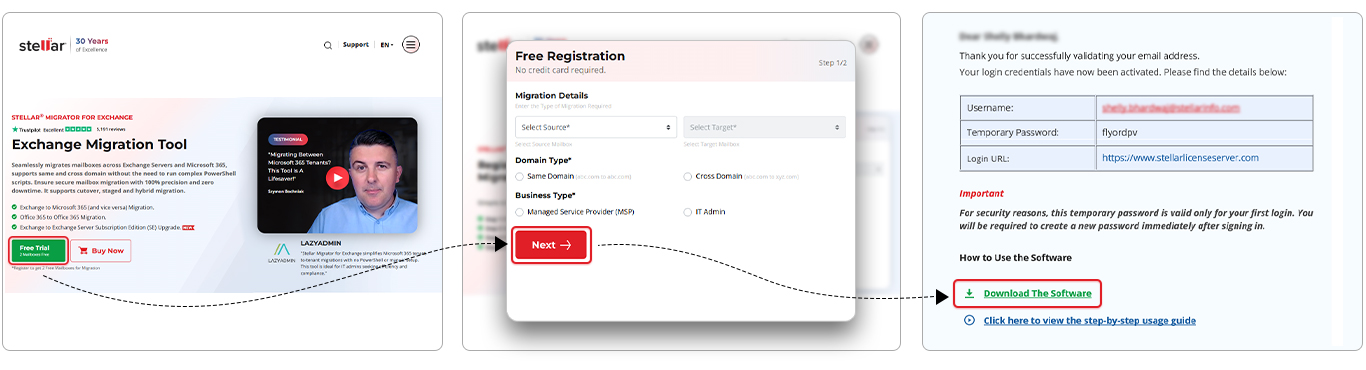
Welcome! If you're here, you've likely registered through the Stellar Migrator for Exchange website and received an email containing your login credentials. This email includes a download link for the Stellar Migrator for Exchange software (EXE) and access details for the Licensing Portal (stellarlicenseserver.com). To get started, click on the download link provided in the email or access it directly from the Licensing Portal.
Step 2
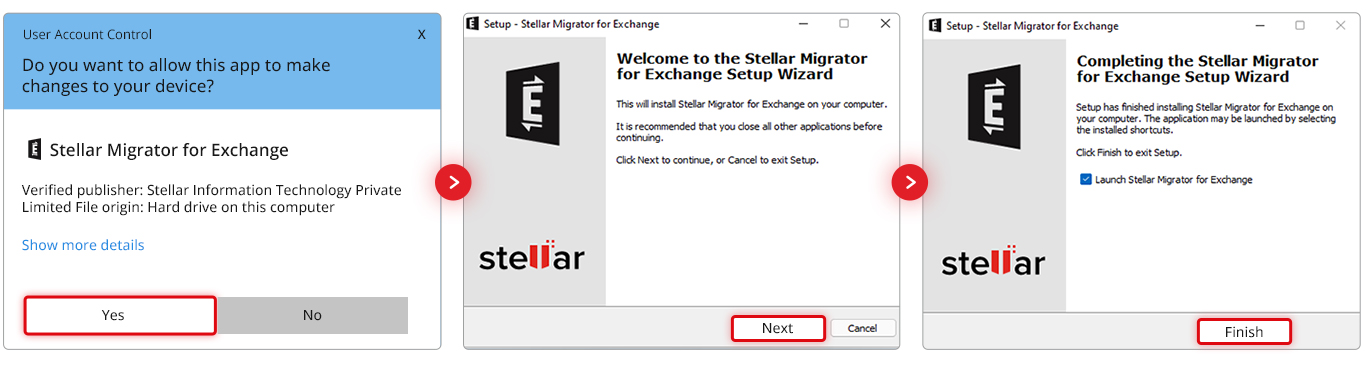
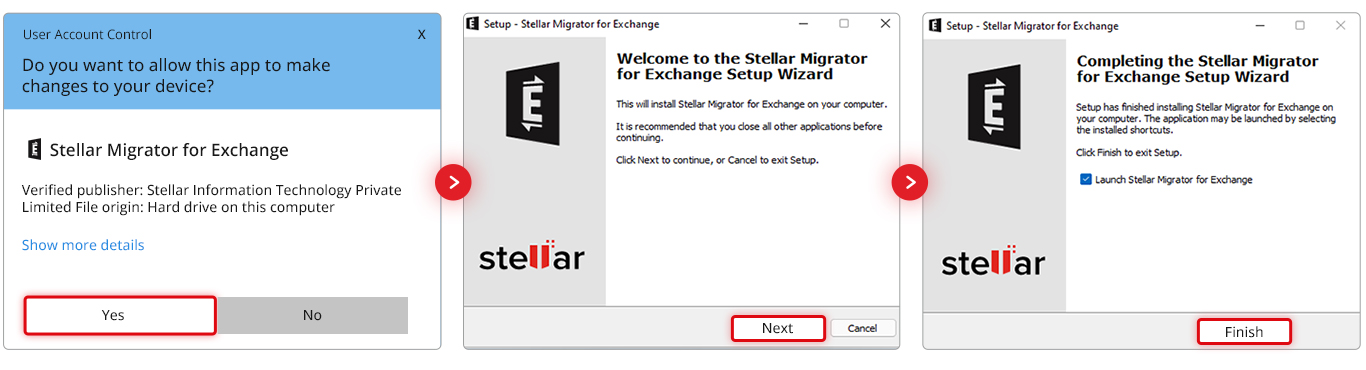
Install the software
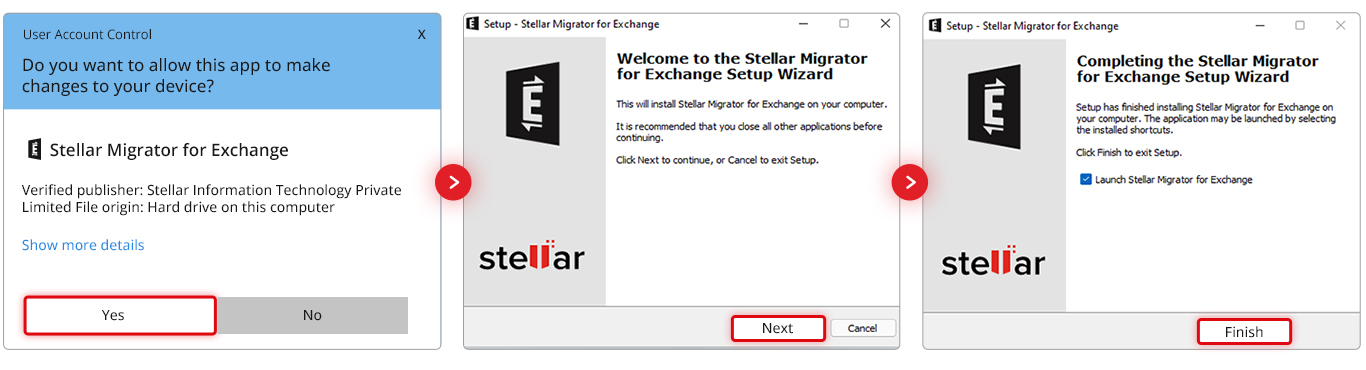
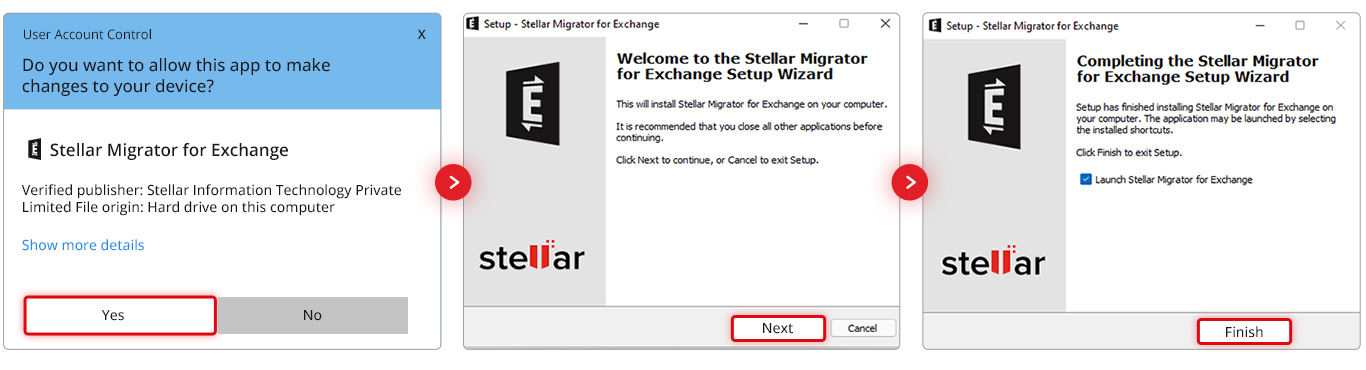
After downloading the Stellar Migrator for Exchange setup file, run the installer and follow the on-screen instructions to complete the installation. Once installed, launch the software — no additional configuration is required. You're now ready to start your test migration using the 2 free mailbox credits included. The next step is to create your first migration job.
Step 3
Welcome Screen
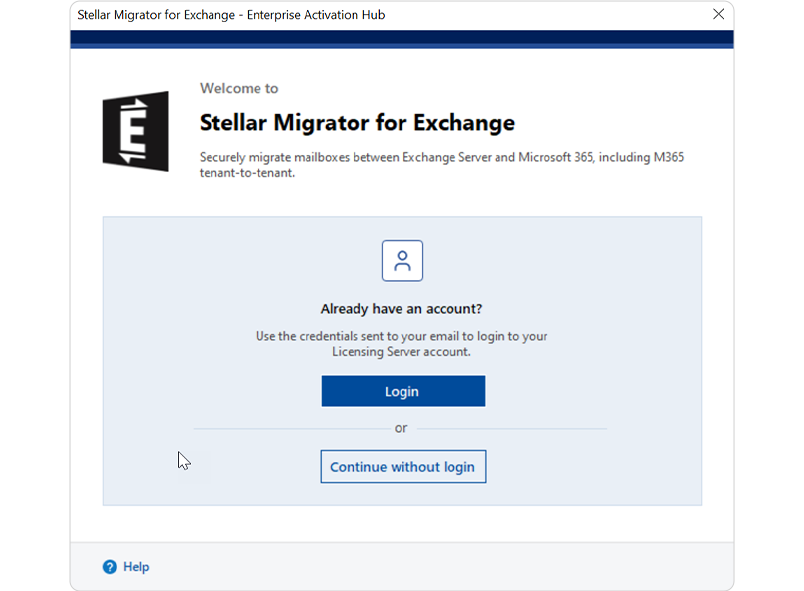
The first screen welcomes you to Stellar Migrator for Exchange, which lets you securely migrate mailboxes between Exchange Server and Microsoft 365, including M365 tenant-to-tenant. If you already have an account, click ‘Login’ to sign in with the credentials sent to your email. If you want to explore the software first, click ‘Continue without login’ instead. Use the ‘Help’ option at the bottom if you need assistance.
Step 4
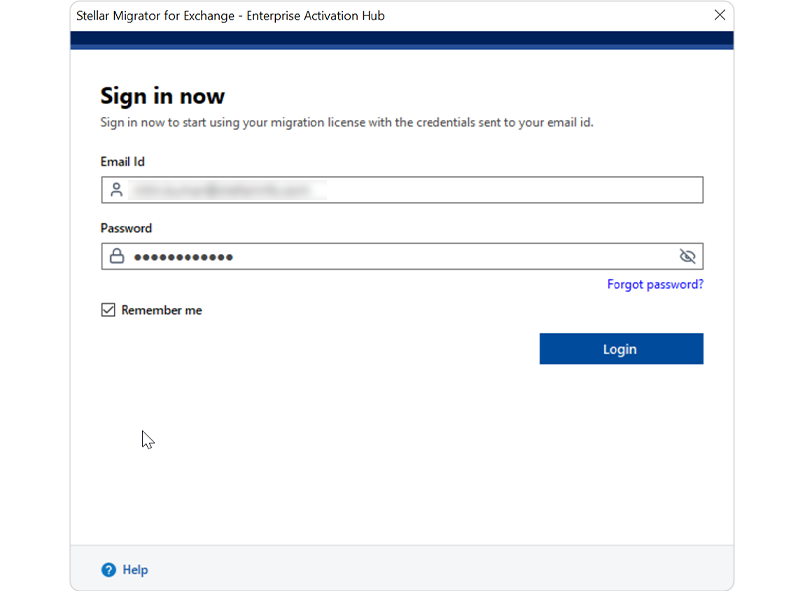
Sign In to Licensing Server
The next screen prompts you to sign in to your Licensing Server account. Enter the email ID and password sent to your registered email address, then click ‘Login’. Select ‘Remember me’ if you want the software to save your credentials for future sessions. If you cannot recall your password, use the ‘Forgot password?’ link to reset it.
Step 5
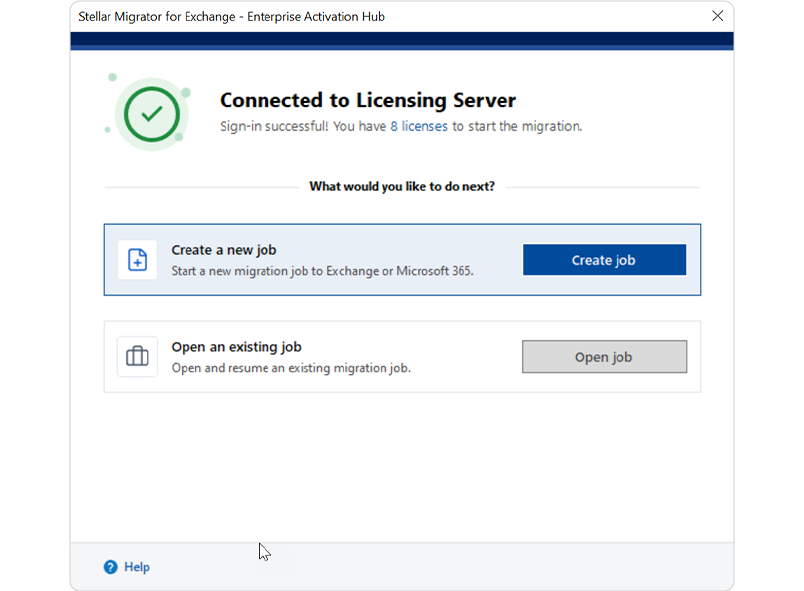
Connected to Licensing Server
The next screen confirms that you are connected to the Licensing Server and shows the number of licenses available for migration. Click ‘Create job’ to start a new migration job to Exchange or Microsoft 365. If you have a migration job in progress, click ‘Open job’ to resume it. Review your available licenses before starting so you can plan the number of mailboxes to migrate.
Step 6
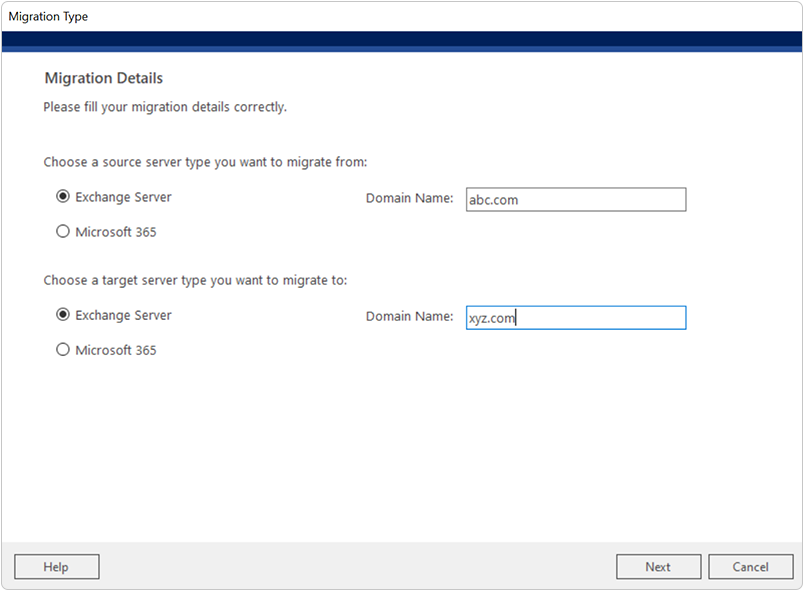
Migration Type
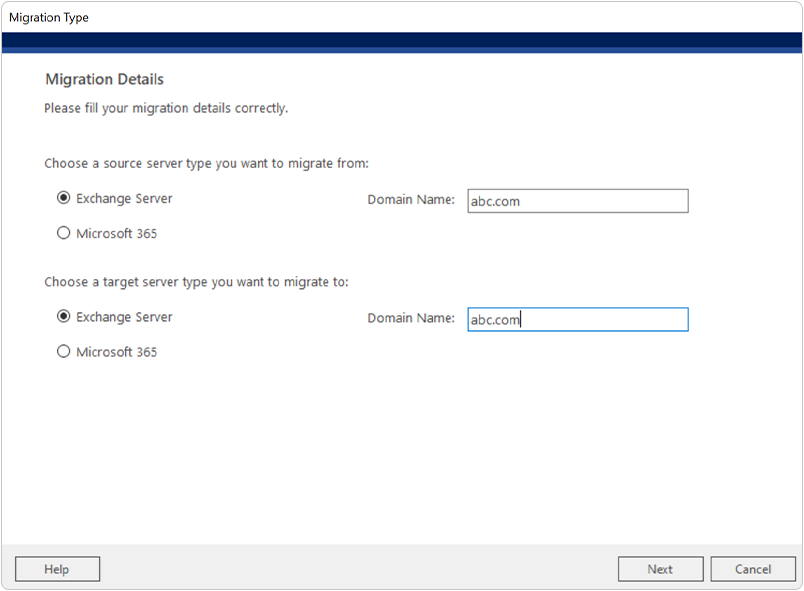
When you launch the software and create a new job, the Migration Type screen appears first. Under 'Choose a source server type you want to migrate from', select Exchange Server and enter the source Domain Name. Under 'Choose a target server type you want to migrate to', select Exchange Server and enter the target Domain Name. This configures the job as an Exchange to Exchange (server-to-server) migration. Click Next to proceed.
Step 7
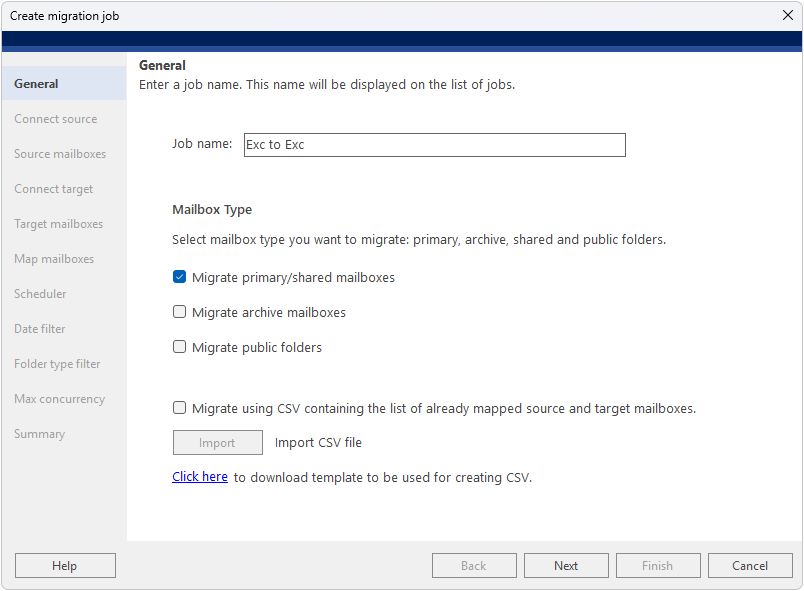
General – Create Migration Job
Provide a name for your migration job (for example, 'Exc to Exc') — this name will be displayed on the list of jobs. Then select the mailbox type(s) you want to migrate: primary/shared mailboxes, archive mailboxes, or public folders. You can also import a pre-mapped CSV file directly from this screen.
Step 8
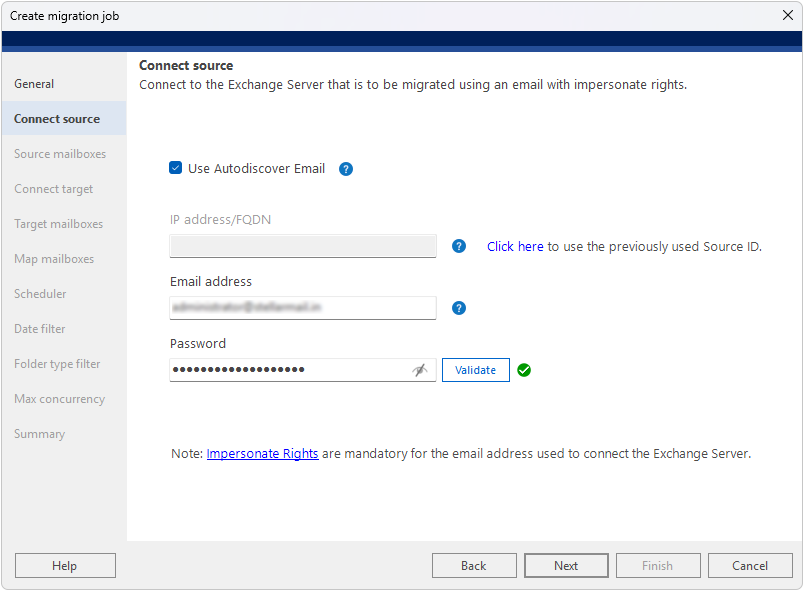
Connect Source
Connect the software to the source Exchange Server. Enable 'Use Autodiscover Email' and enter the Email address and Password — the software will automatically locate and connect to the source server. Alternatively, uncheck Autodiscover and manually enter the IP address/FQDN, Email address, and Password. You can also click 'Click here' to reuse the previously used Source ID. Click Validate to confirm the connection before proceeding. Note: Impersonate Rights are mandatory for the email address used to connect to the Exchange Server.
Step 9
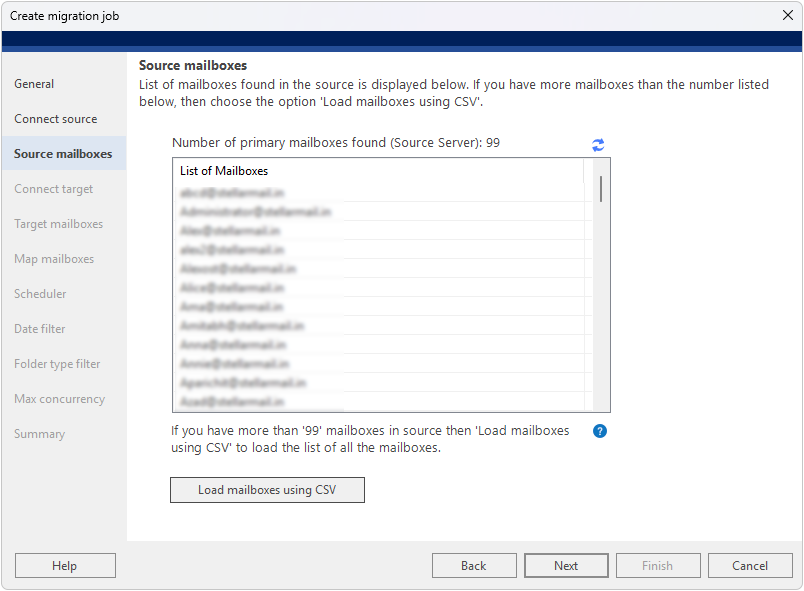
Source Mailboxes
The next screen displays the list of mailboxes found in the source Exchange Server. Review the list to confirm all required source mailboxes are present. If you have more than 99 mailboxes, use the 'Load Mailboxes Using CSV' option and upload a CSV file containing all mailbox addresses.
Step 10
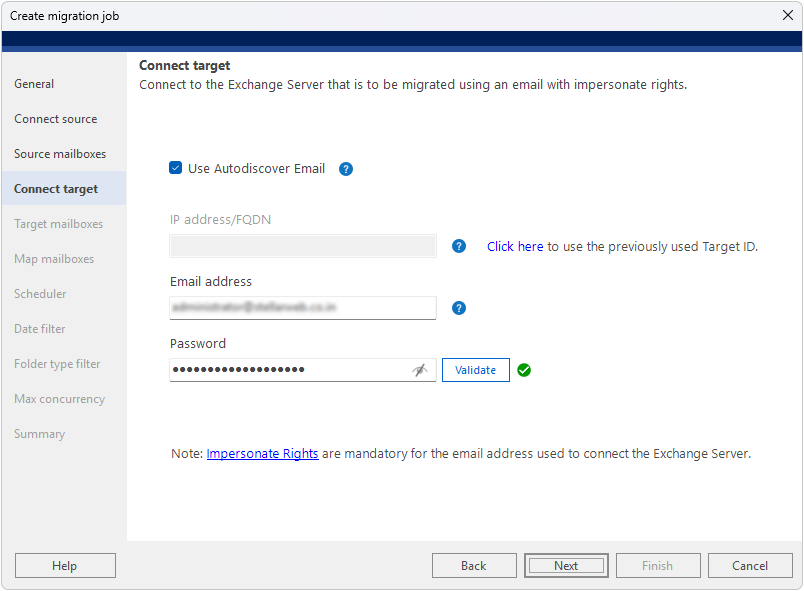
Connect Target
Connect the software to the target Exchange Server. Enable 'Use Autodiscover Email' and enter the Email address and Password — the software will automatically locate and connect to the target server. Alternatively, uncheck Autodiscover and manually enter the IP address/FQDN, Email address, and Password. You can click 'Click here' to reuse the previously used Target ID. Click Validate to confirm the connection before proceeding. Note: Impersonate Rights are mandatory for the email address used to connect to the Exchange Server.
Step 11
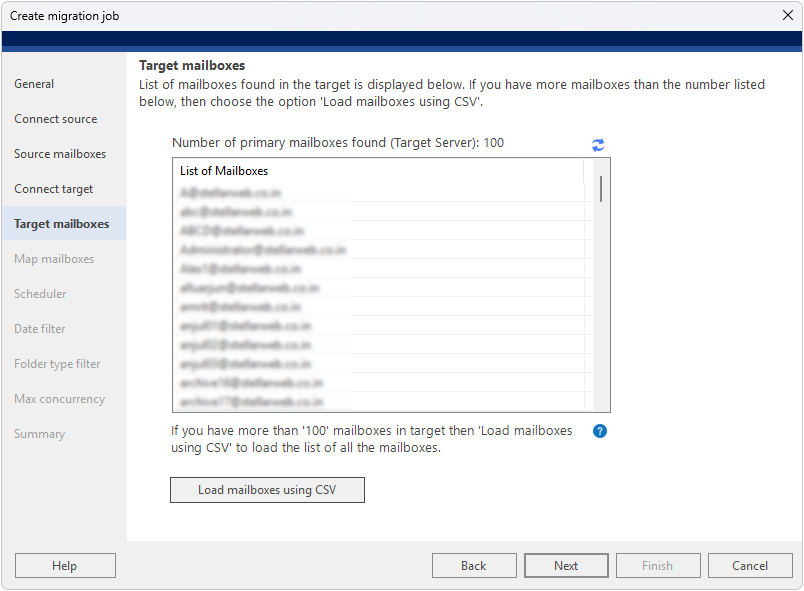
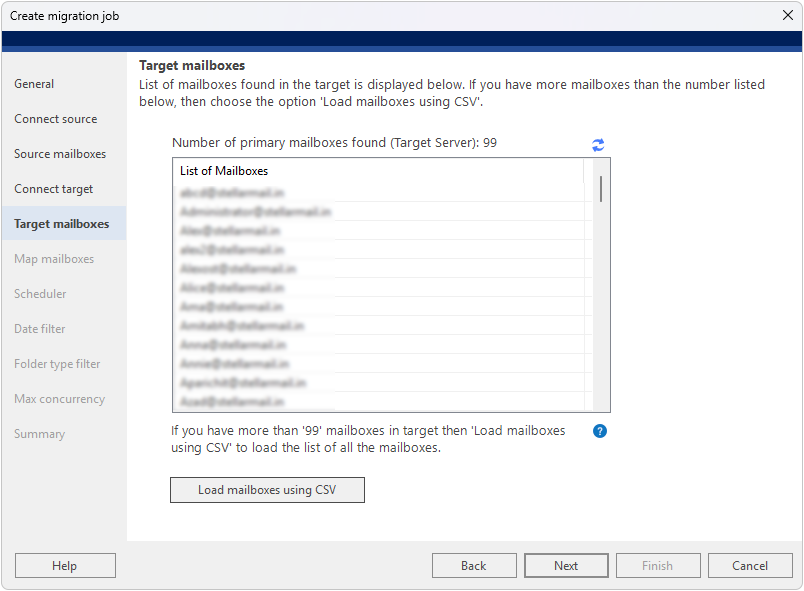
Target Mailboxes
The next screen displays the list of mailboxes found in the target Exchange Server. Review the list to ensure all destination mailboxes are available for mapping. If you have more than 100 mailboxes, use the 'Load Mailboxes Using CSV' option to load the complete list.
Step 12
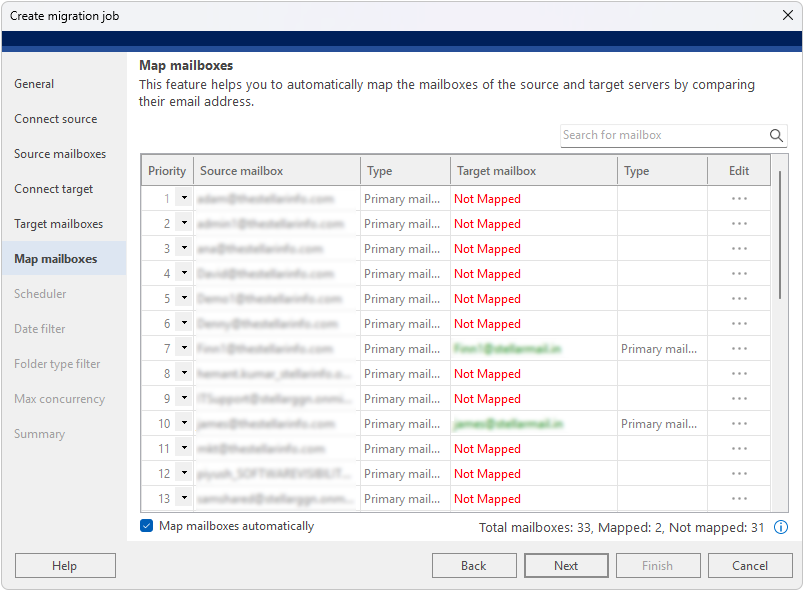
Map Mailboxes
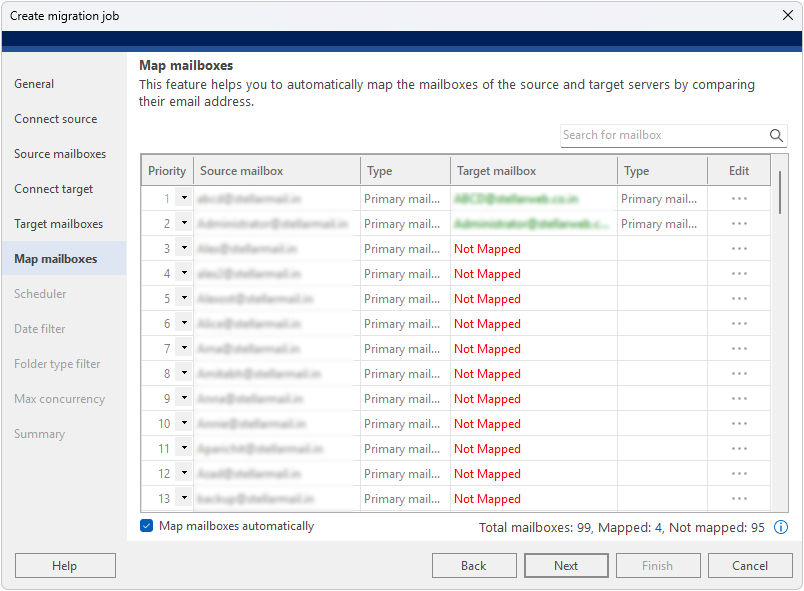
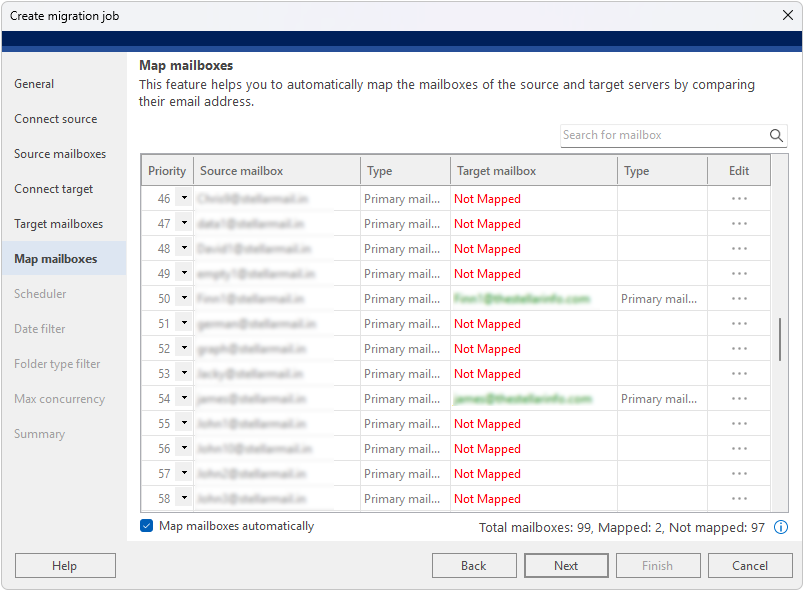
The software automatically maps source and target mailboxes by comparing their email addresses. Mailboxes that are successfully matched appear in green; unmatched mailboxes are marked 'Not Mapped' in red. Use the Edit (…) button to manually map any unmatched mailboxes. The status bar at the bottom shows Total mailboxes, Mapped count, and Not mapped count.
Step 13
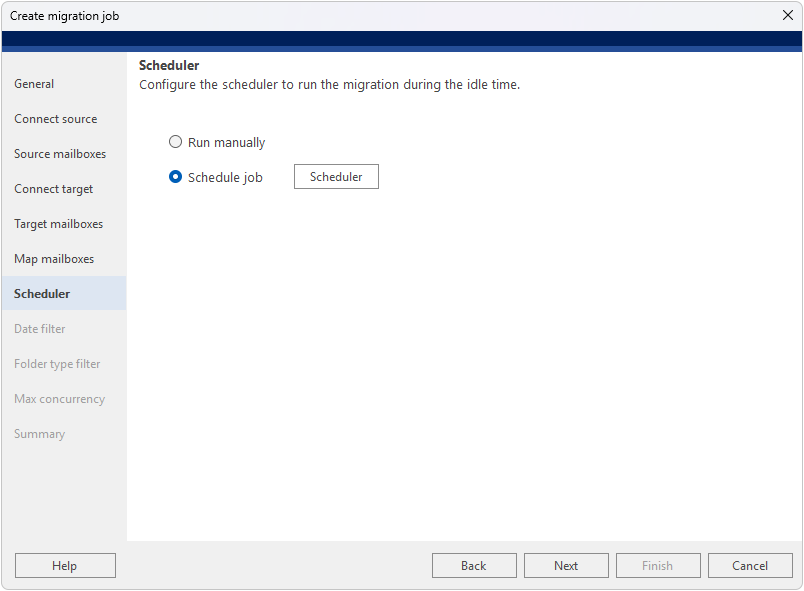
Scheduler
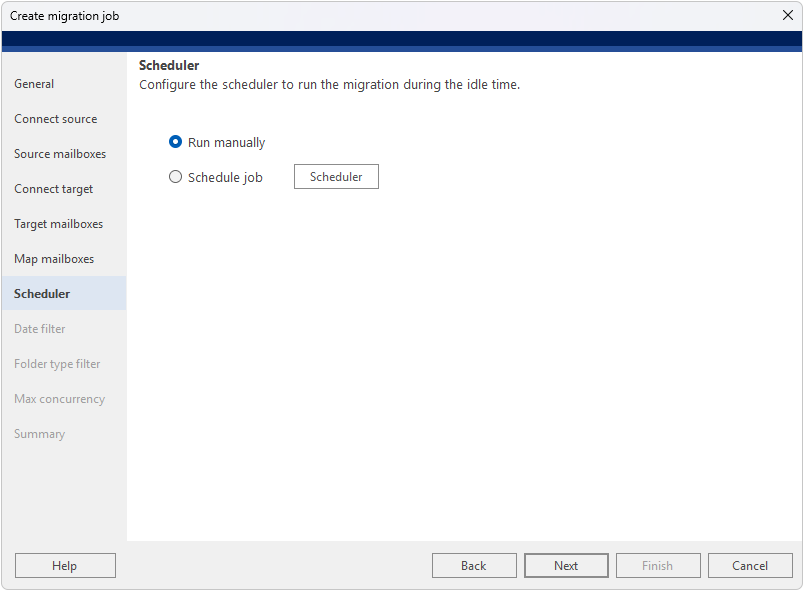
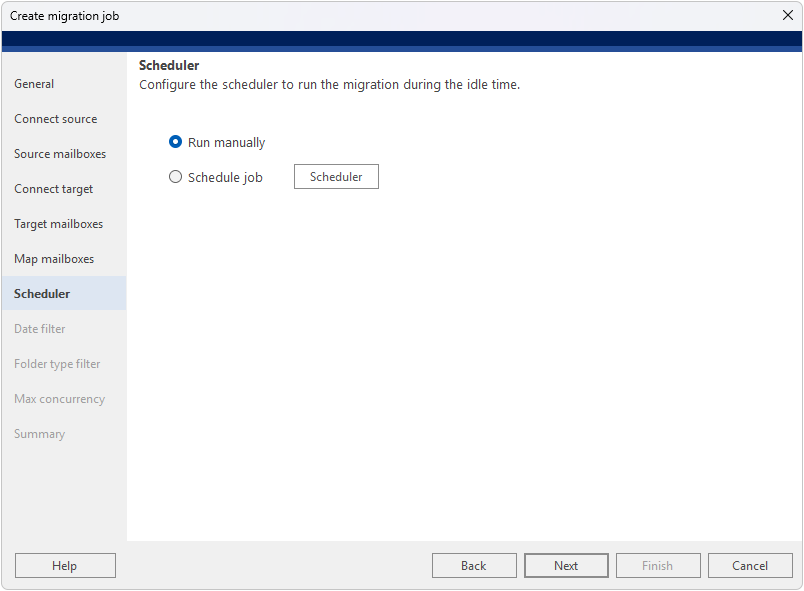
Configure when the migration job should run. Choose 'Run manually' to start migration on demand, or select 'Schedule job' and click the Scheduler button to set the frequency (Run once, Daily, Weekly, or Monthly), start and end times, and duration. The description field at the bottom previews the configured schedule. Use the Scheduler dialog to set the exact frequency, occurrence times, start date, and optional end date for the migration run.
Step 14
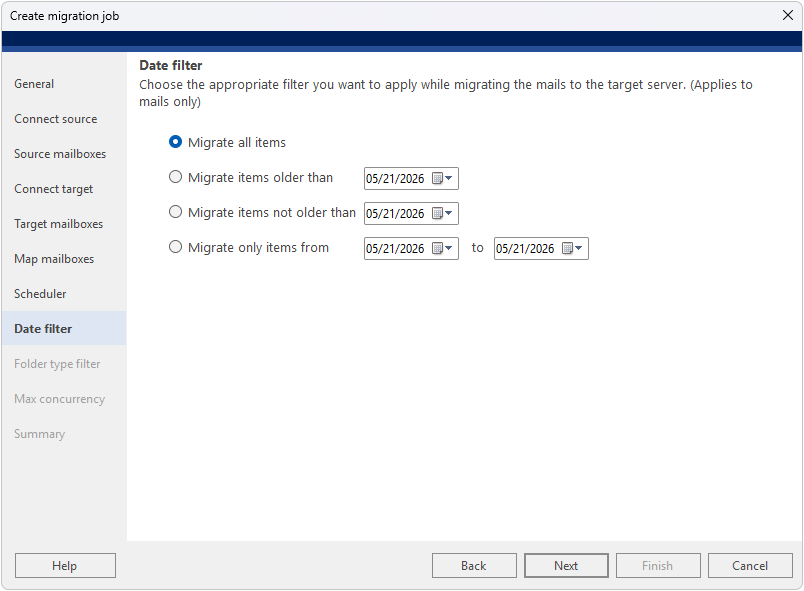
Date Filter
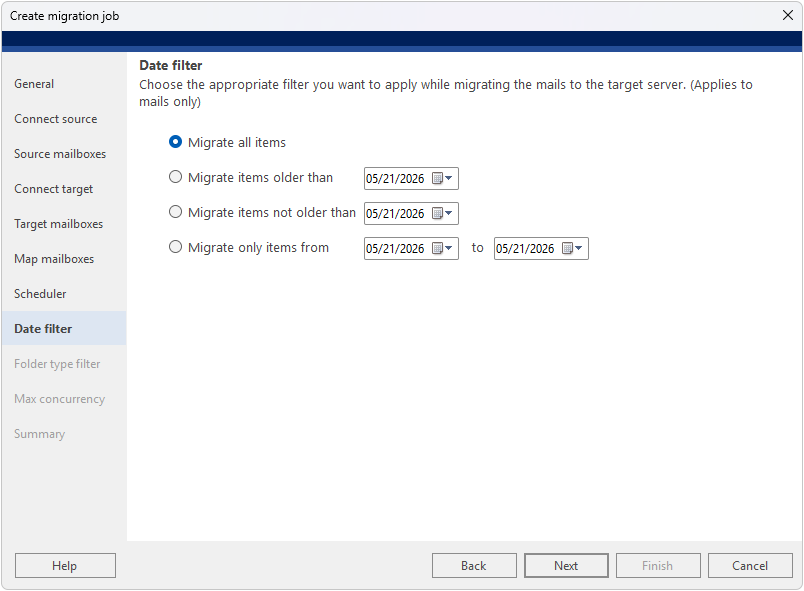
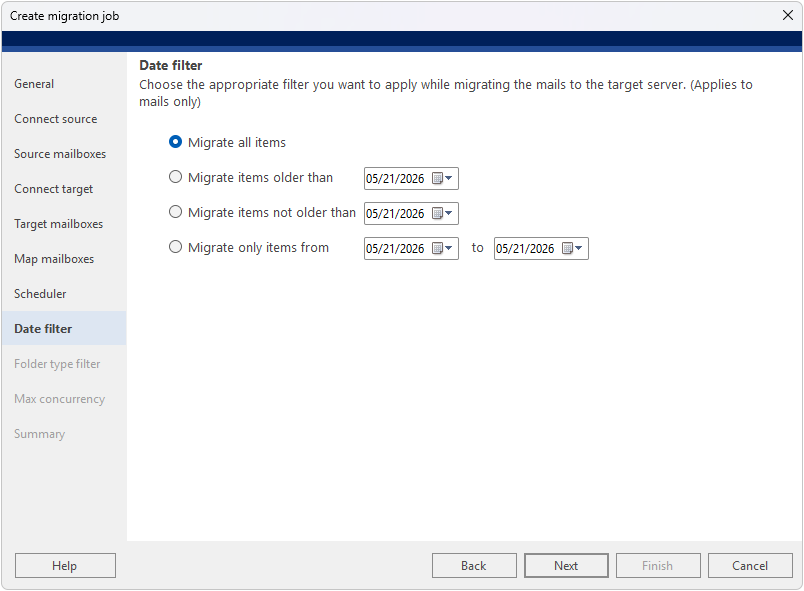
Apply a date filter to control which mail items are migrated (applies to mail items only). Options include: Migrate all items, Migrate items older than a specific date, Migrate items not older than a specific date, or Migrate only items from a specific date range. This helps reduce migration scope when needed.
Step 15
Folder Type Filter
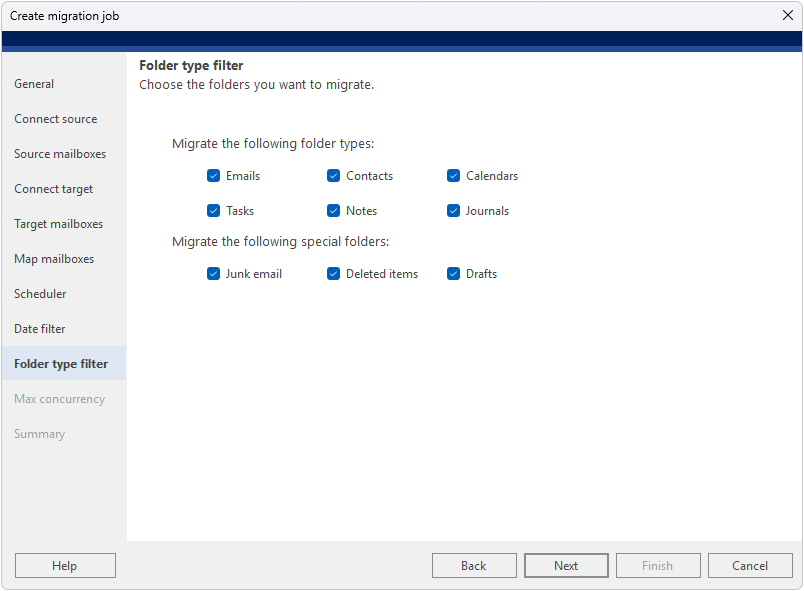
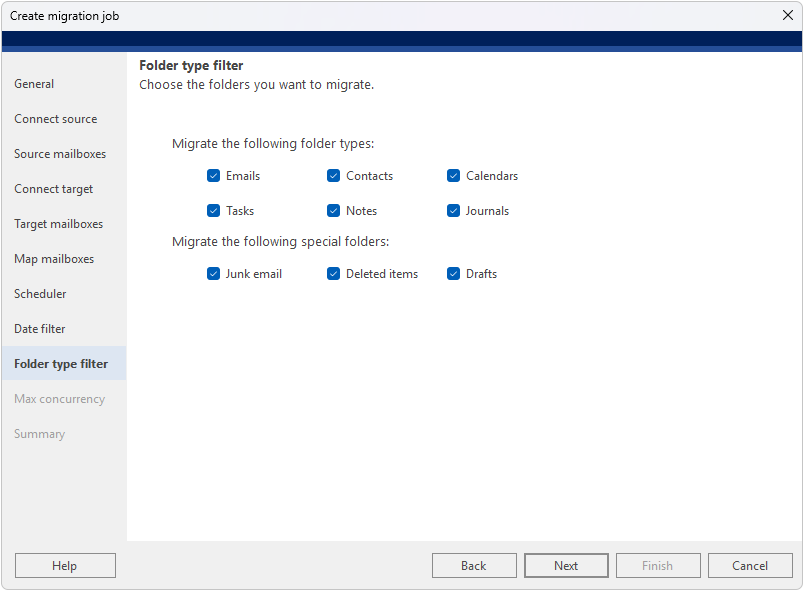
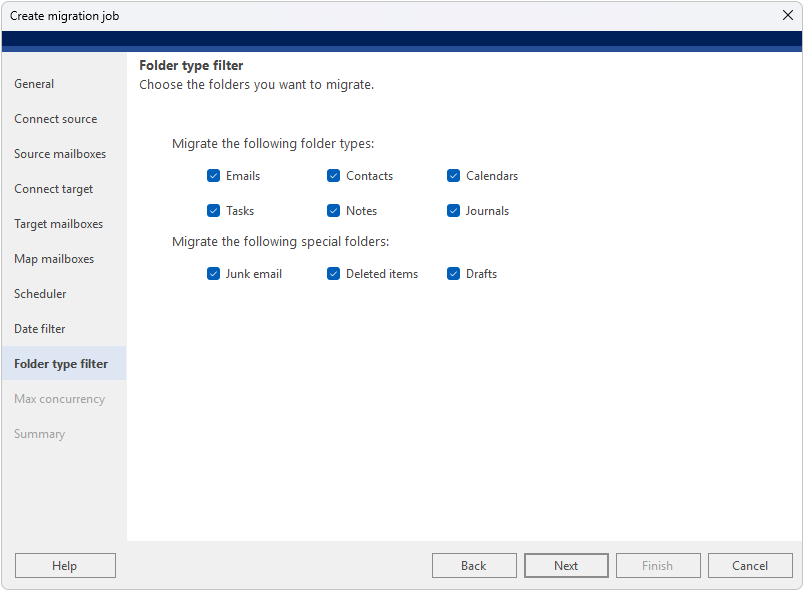
Select the folder types to include in the migration. Available folder types are: Emails, Contacts, Calendars, Tasks, Notes, and Journals. Special folders include Junk Email, Deleted Items, and Drafts. All are selected by default. Uncheck any folders you want to exclude to ensure only the required data is migrated.
Step 16
Max Concurrency
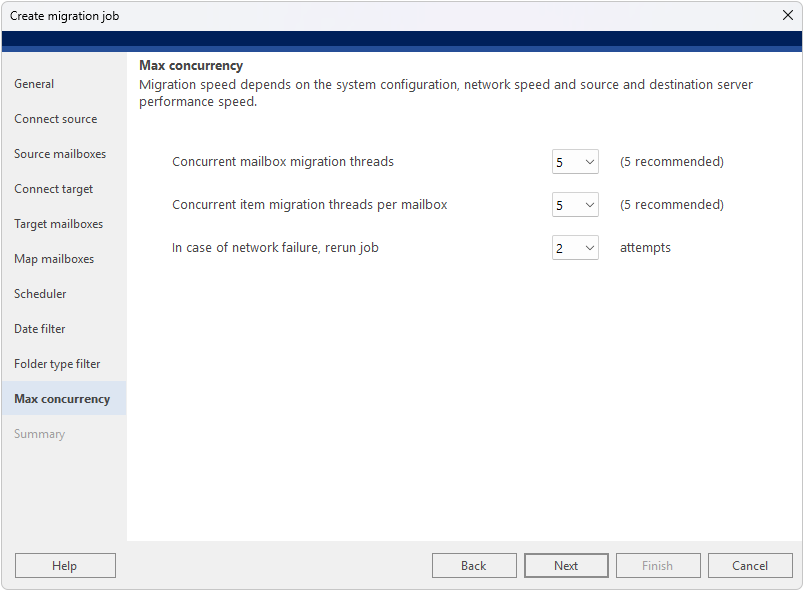
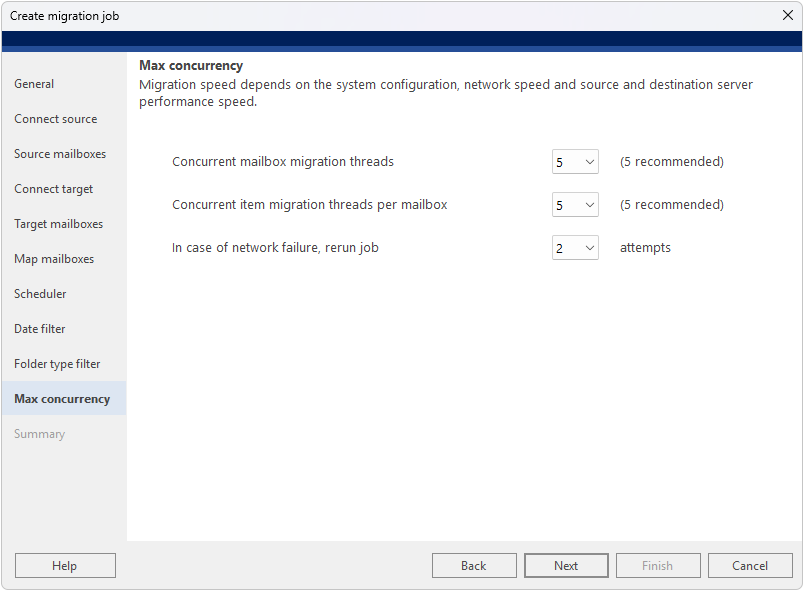
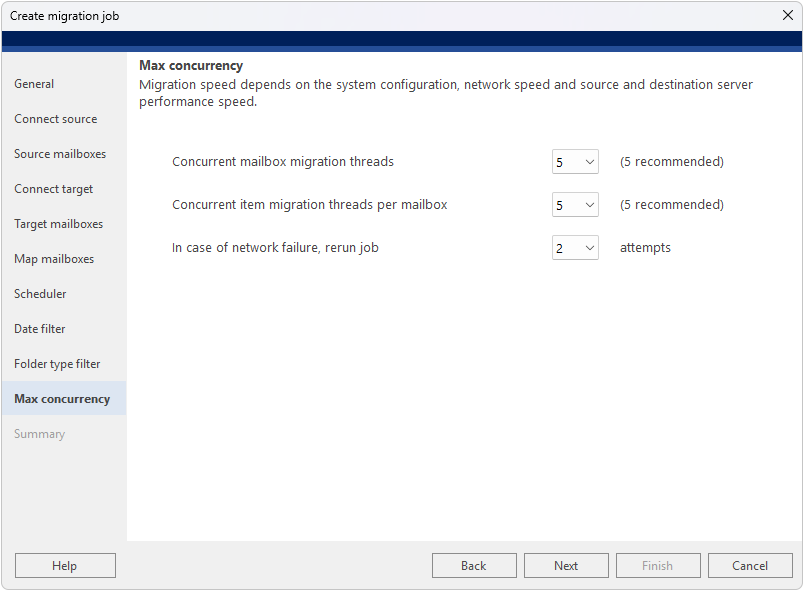
Configure migration speed and resilience. Set the number of Concurrent mailbox migration threads (5 recommended), Concurrent item migration threads per mailbox (5 recommended), and the number of retry attempts in case of network failure (default: 2). Migration speed depends on system configuration, network speed, and source and destination server performance.
Step 17
Summary
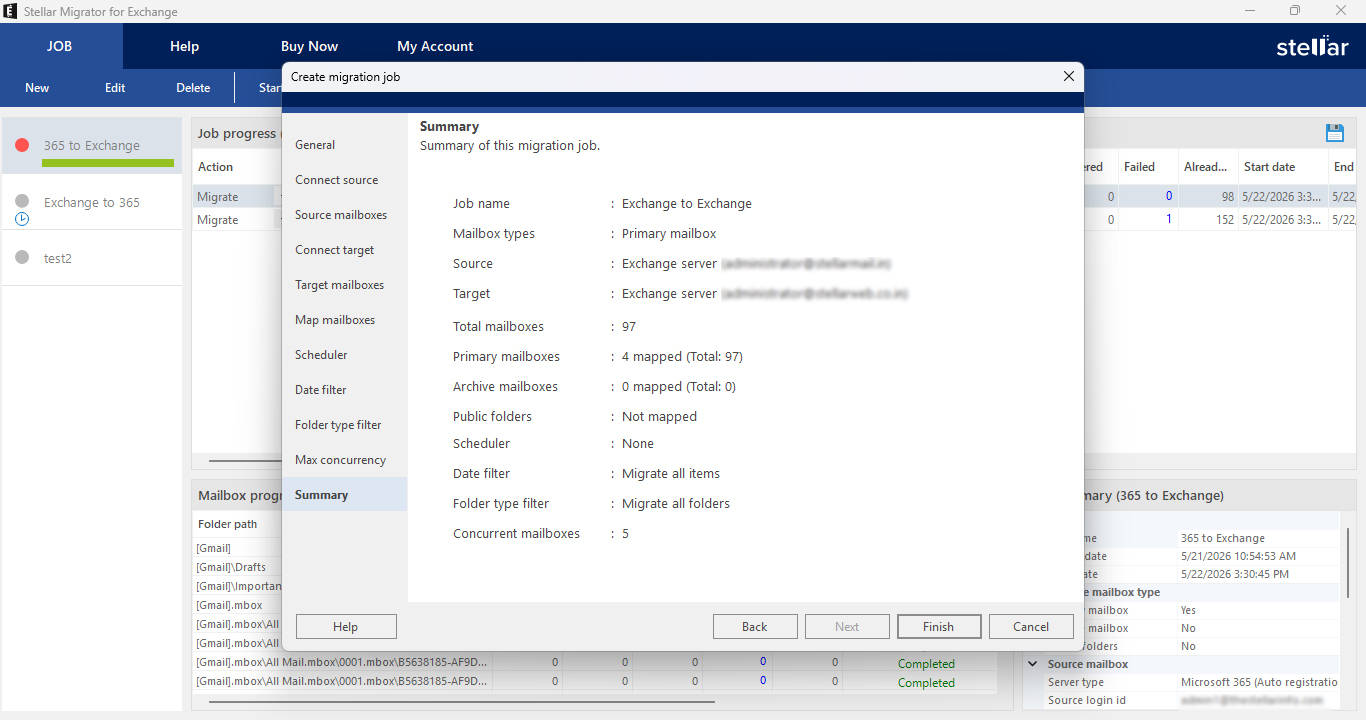
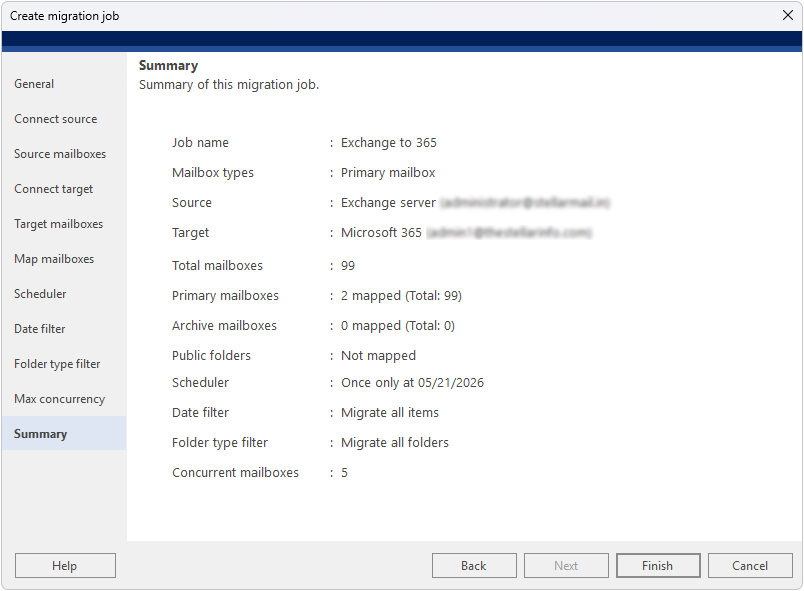
Review the complete job summary before starting migration. The summary displays: Job name, Mailbox types, Source server (Exchange Server), Target server (Exchange Server), Total mailboxes, Mapped counts for primary/archive mailboxes and public folders, Scheduler setting, Date filter, Folder type filter, and Concurrent mailboxes. If any setting needs correction, click the relevant section in the left panel to go back and edit it. Click Finish to create the migration job.
Step 18
Initiate Migration
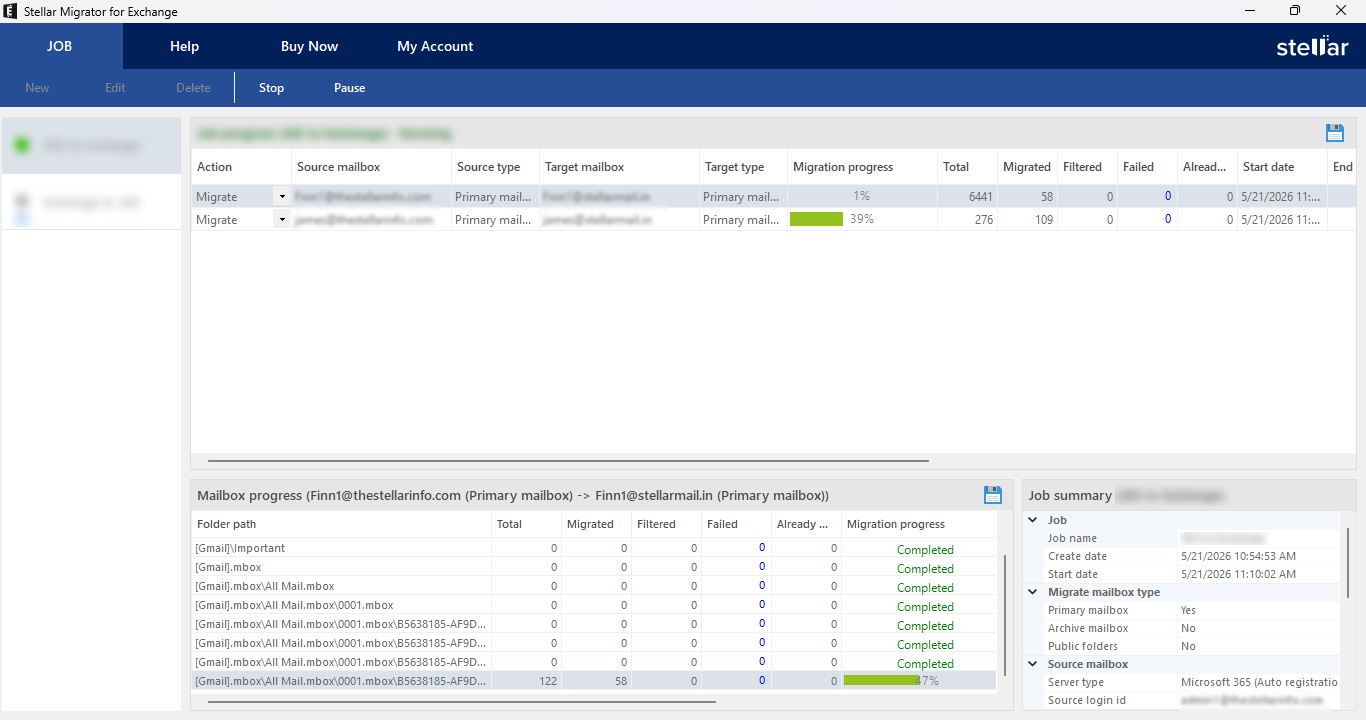
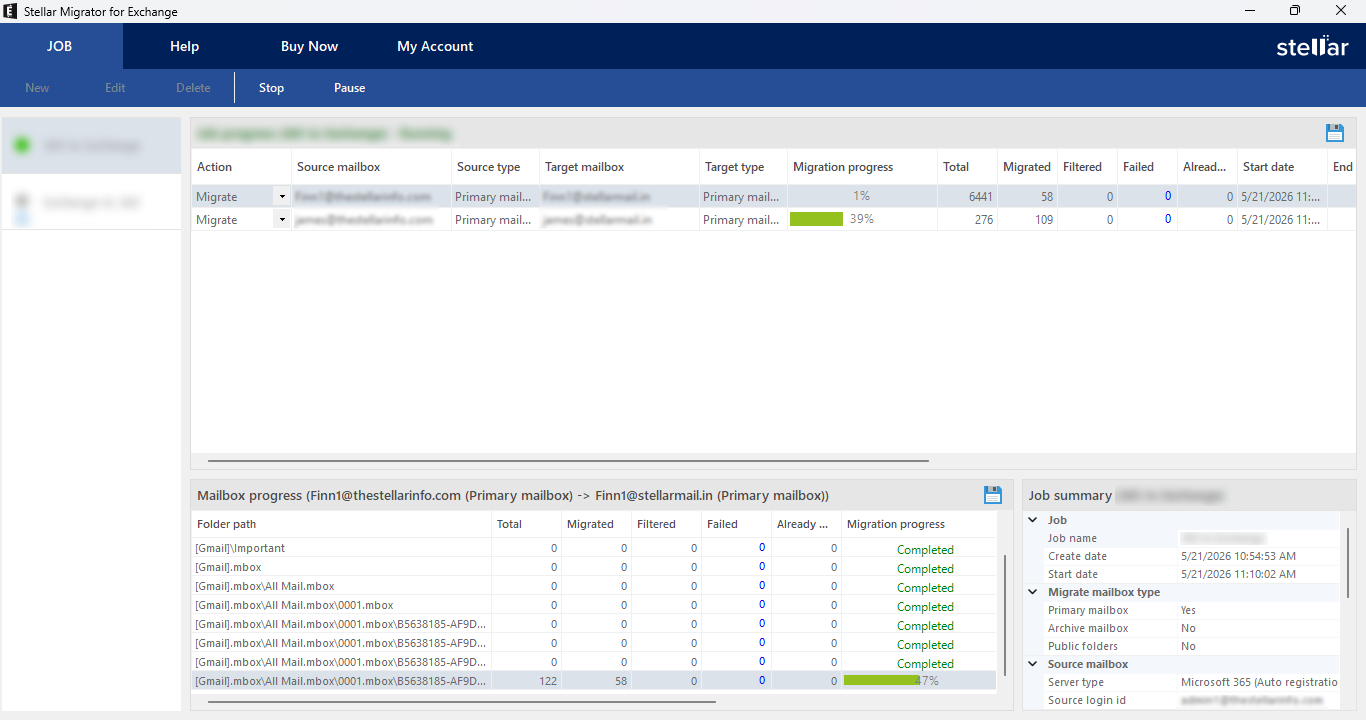
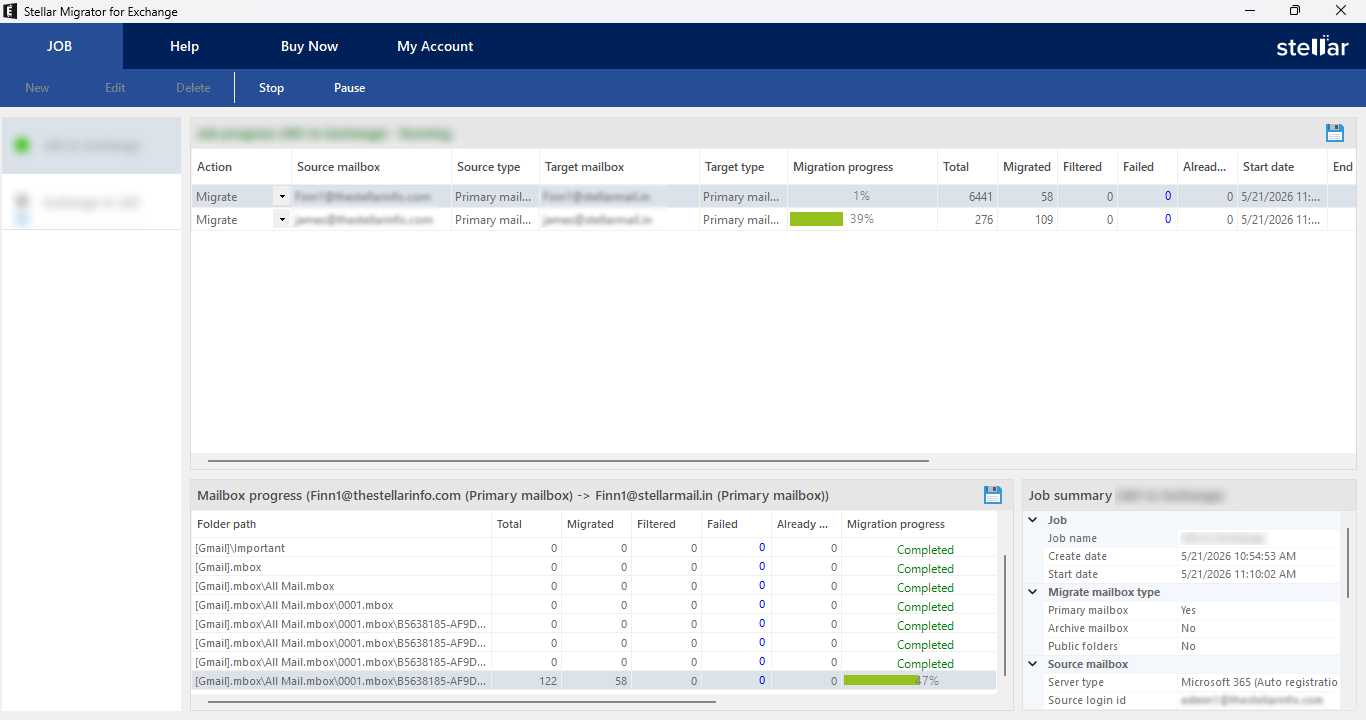
After clicking Finish to create the job, click Start in the JOB ribbon at the top to begin the migration process. The migration dashboard shows real-time Job Progress with columns for Action, Source mailbox, Target mailbox, Migration progress (%), Total items, Migrated, Filtered, Failed, and Start date. The Mailbox Progress panel at the bottom shows folder-level detail. You can Pause or Stop the migration at any time using the buttons in the JOB ribbon.
Step 19
Migration Completed
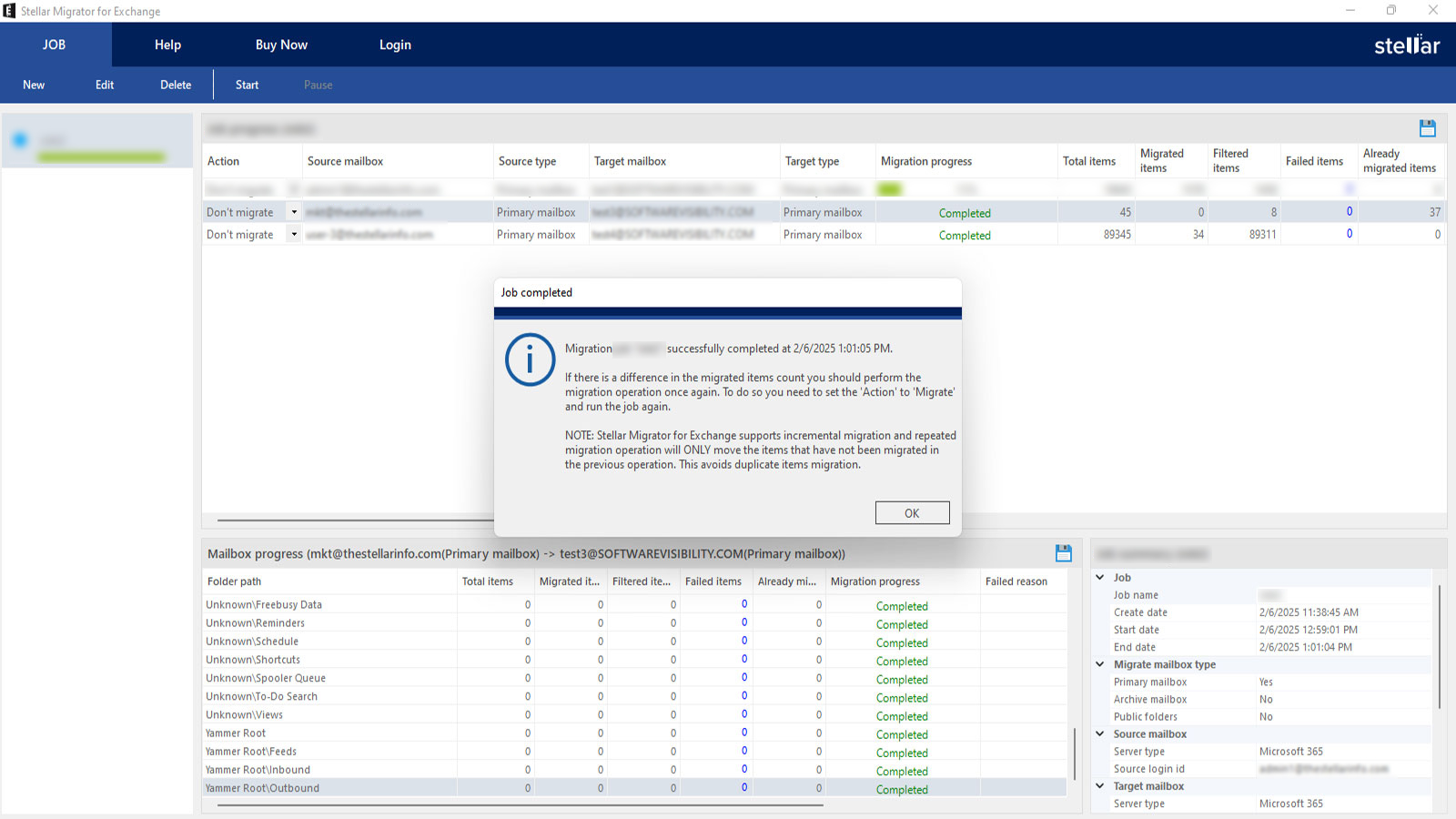
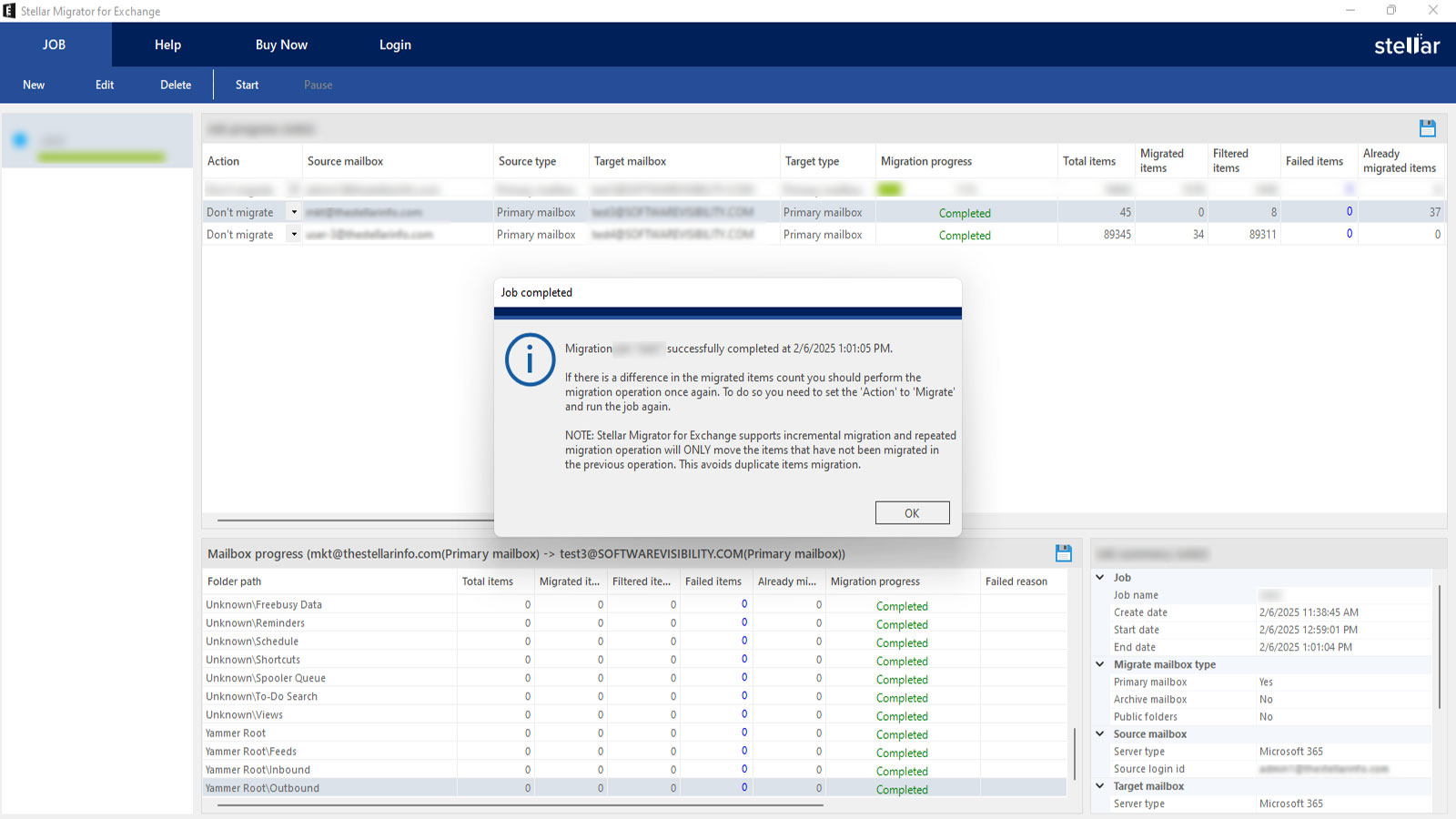
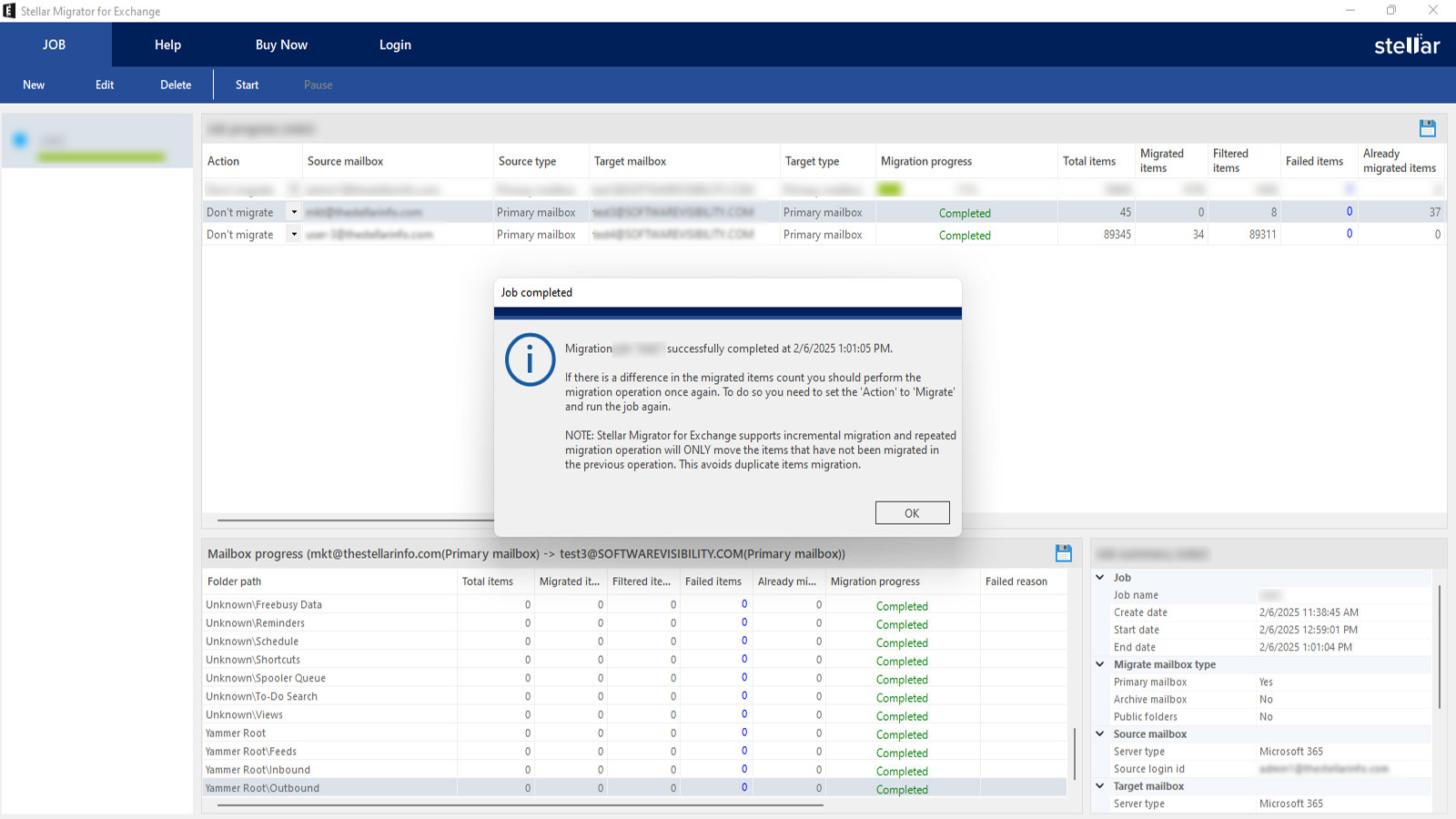
After completing the migration, the action field in the job progress section will change from Migrate to Don't Migrate. If the job fails to migrate, it will remain in the Migrate state, allowing you to attempt the migration again without making repeated changes.
Welcome! If you're here, you've likely registered through the Stellar Migrator for Exchange website and received an email containing your login credentials. This email includes a download link for the Stellar Migrator for Exchange software (EXE) and access details for the Licensing Portal (stellarlicenseserver.com). To get started, click on the download link provided in the email or access it directly from the Licensing Portal.
Step 2
Install the Software
After downloading the Stellar Migrator for Exchange setup file, run the installer and follow the on-screen instructions to complete the installation. Once installed, launch the software — no additional configuration is required. You're now ready to start your test migration using the 2 free mailbox credits included. The next step is to create your first migration job.
Step 3
Welcome Screen
The first screen welcomes you to Stellar Migrator for Exchange, which lets you securely migrate mailboxes between Exchange Server and Microsoft 365, including M365 tenant-to-tenant. If you already have an account, click ‘Login’ to sign in with the credentials sent to your email. If you want to explore the software first, click ‘Continue without login’ instead. Use the ‘Help’ option at the bottom if you need assistance.
Step 4
Sign In to Licensing Server
The next screen prompts you to sign in to your Licensing Server account. Enter the email ID and password sent to your registered email address, then click ‘Login’. Select ‘Remember me’ if you want the software to save your credentials for future sessions. If you cannot recall your password, use the ‘Forgot password?’ link to reset it.
Step 5
Connected to Licensing Server
The next screen confirms that you are connected to the Licensing Server and shows the number of licenses available for migration. Click ‘Create job’ to start a new migration job to Exchange or Microsoft 365. If you have a migration job in progress, click ‘Open job’ to resume it. Review your available licenses before starting so you can plan the number of mailboxes to migrate.
Step 6
Migration Type
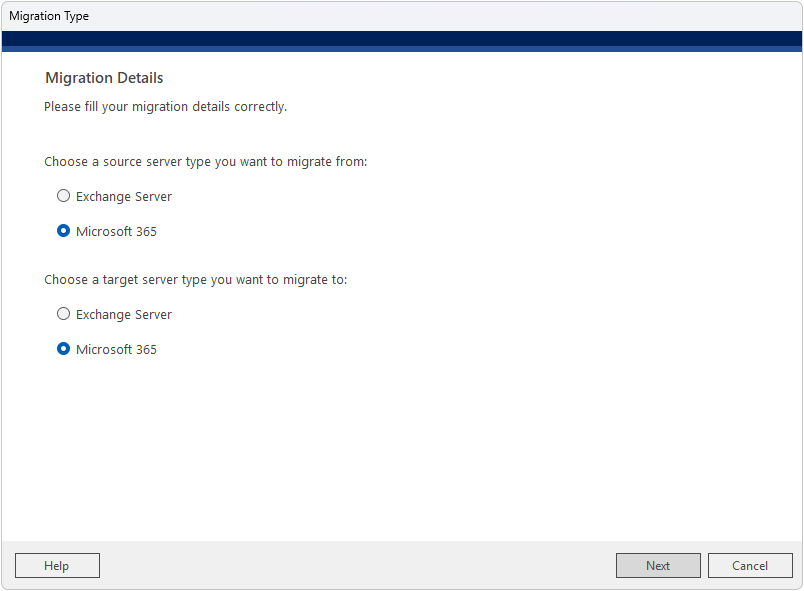
When you launch the software and create a new job, the Migration Type screen appears first. Under 'Choose a source server type you want to migrate from', select Microsoft 365. Under 'Choose a target server type you want to migrate to', also select Microsoft 365. This configures the job as an Office 365 to Office 365 (tenant-to-tenant) migration. Click Next to proceed.
Step 7
General – Create Migration Job
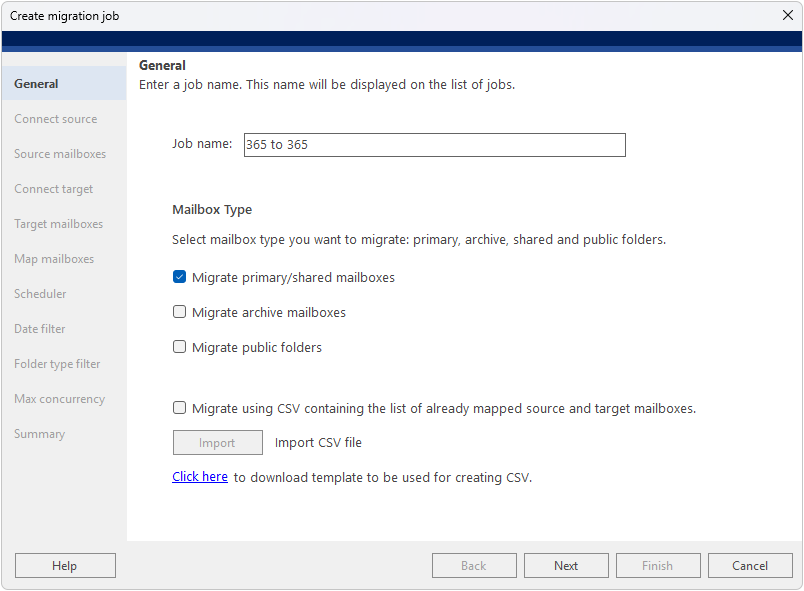
Configuring General Settings is the first step in creating a migration job. Start by providing a name for your migration job, such as “365 to 365,” which will appear in the list of migration jobs for easy identification. Next, select the mailbox type(s) you want to migrate, including primary/shared mailboxes, archive mailboxes, and public folders. If you already have a CSV file containing mapped source and target mailboxes, you can enable the option “Migrate using CSV containing the list of already mapped source and target mailboxes” and click Import to upload the file, which allows you to skip the automatic mapping process.
Step 8
Connect Source – Auto Registration
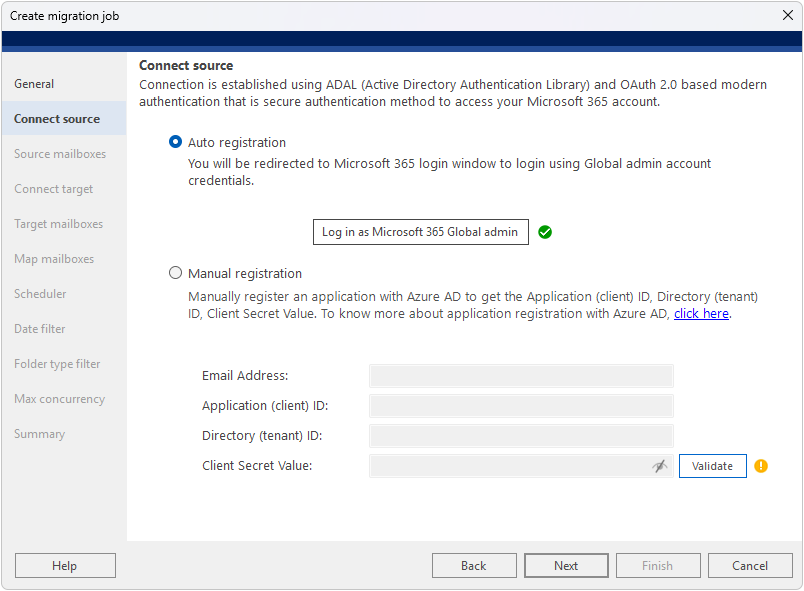
The Connect Source screen provides two registration methods for the source Microsoft 365 tenant: Auto Registration and Manual Registration. With Auto Registration, click “Log in as Microsoft 365 Global admin” to sign in through the Microsoft 365 login window, after which a green checkmark confirms the connection. For Manual Registration, register an application in Azure AD and enter the Email Address, Application (client) ID, Directory (tenant) ID, and Client Secret Value.
Step 9
Source Mailboxes
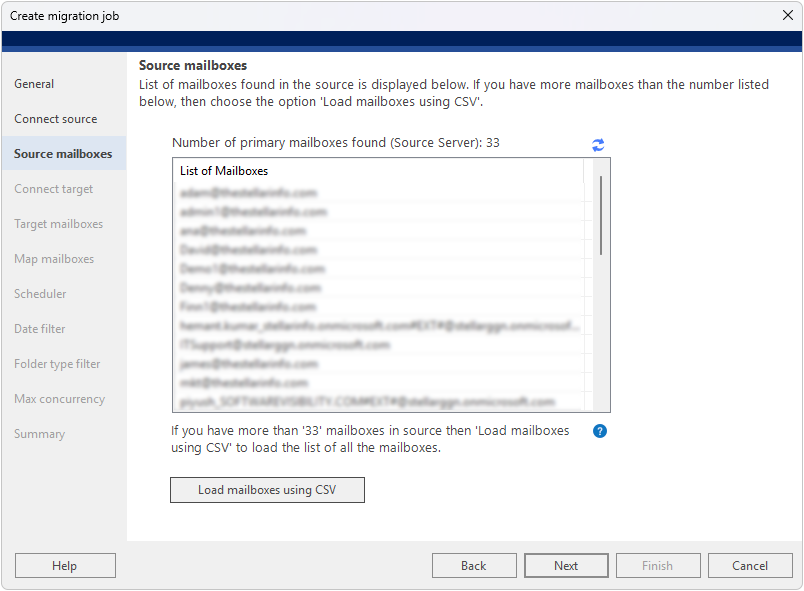
The next screen displays the list of mailboxes found in the source Microsoft 365 tenant. The total number of primary mailboxes detected is shown above the list. Review the list to confirm all required source mailboxes are present.
If you have more than the displayed mailbox limit, use the 'Load Mailboxes Using CSV' button and upload a CSV file containing all mailbox addresses to load the complete list.
Step 10
Connect Target – Auto Registration
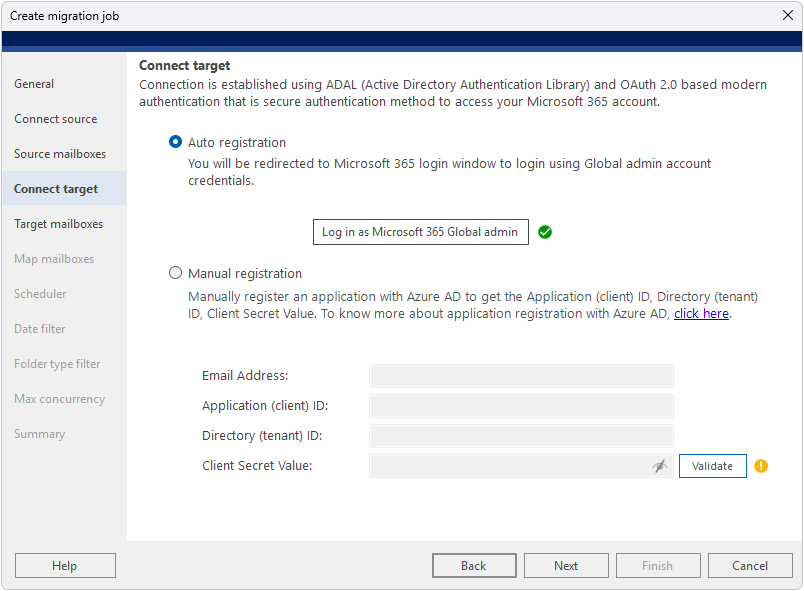
Connect the software to the target Microsoft 365 tenant using the same ADAL and OAuth 2.0 based modern authentication process. With Auto Registration selected, click “Log in as Microsoft 365 Global admin” and sign in using the target tenant’s Global Admin credentials. The Auto App Registration – Target dialog displays the verification steps, and once all steps are completed successfully with green checkmarks, click OK. Alternatively, use Manual Registration by entering the Email Address, Application (client) ID, Directory (tenant) ID, and Client Secret Value for the target tenant’s Azure AD application.
Step 11
Target Mailboxes
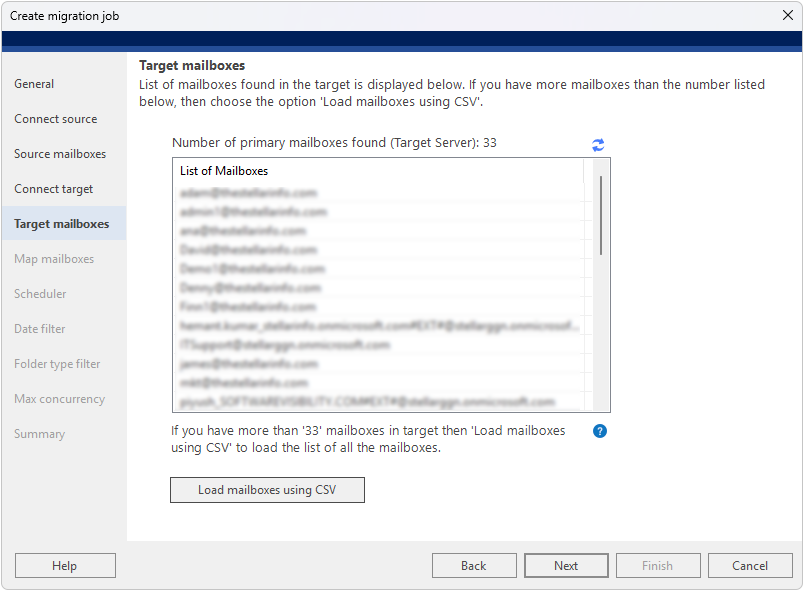
After successfully connecting to the target Microsoft 365 tenant, the next screen shows the list of mailboxes found in the destination tenant. Review the list to ensure all required target mailboxes are available for mapping.
If you cannot see all your target mailboxes, use the 'Load Mailboxes Using CSV' option to load the complete list from a CSV file.
Step 12
Map Mailboxes
The software automatically maps source and target mailboxes by comparing their email addresses. Mailboxes that are successfully matched display the target address in green; unmatched mailboxes are marked 'Not Mapped' in red. Use the Edit (…) button on any row to manually assign a target mailbox to an unmatched source mailbox. The status bar at the bottom shows the total count of mailboxes along with how many are Mapped and Not mapped.
Step 13
Scheduler
The Scheduler step lets you configure when the migration job should run. Two options are available:
• Run manually – Start the migration on demand by clicking Start in the JOB ribbon. • Schedule job – Click the Scheduler button to set the frequency (Run once, Daily, Weekly, or Monthly), the occurrence start and end times, and the start date. The Description field at the bottom previews the configured schedule in plain language.
Step 14
Date Filter
Apply a date filter to control which mail items are included in the migration (applies to mail items only). Choose one of the following options:
• Migrate all items – No date restriction; all mail items are migrated.
• Migrate items older than – Only items before the selected date are migrated.
• Migrate items not older than – Only items from the selected date onwards are migrated.
• Migrate only items from – Migrate items within a specific date range (from date to date).
Step 15
Folder Type Filter
Select the folder types to include in the migration. By default, all folder types are selected, including Emails, Contacts, Calendars, Tasks, Notes, Journals, Junk Email, Deleted Items, and Drafts. You can uncheck any folders you want to exclude so that only the required data is migrated.
Step 16
Max Concurrency
Configure migration performance and resilience settings. Adjust the following parameters based on your system and network capacity:
• Concurrent mailbox migration threads – Number of mailboxes migrated simultaneously (5 recommended).
• Concurrent item migration threads per mailbox – Number of items migrated in parallel per mailbox (5 recommended).
• In case of network failure, rerun job – Number of automatic retry attempts if the migration is interrupted (default: 2). Note: Migration speed depends on system configuration, network speed, and the performance of both the source and target Microsoft 365 tenants.
Step 17
Summary
Review the complete job summary before starting the migration and verify that all settings are correct before clicking Finish. The summary includes details such as the job name, selected mailbox types, source and target Microsoft 365 tenants, total mailboxes, mapped counts for primary/archive mailboxes and public folders, scheduler settings, date and folder type filters, and the number of concurrent mailboxes. If any setting needs to be changed, use the relevant section in the left navigation panel to go back and edit it. Once everything is verified, click Finish to create the migration job.
Step 18
Initiate Migration
After clicking Finish to create the job, click Start in the JOB ribbon at the top of the main window to begin the migration process. The migration dashboard displays real-time job progress, including the current action, source and target mailbox details, migration status percentage, total items, migrated, filtered, and failed items, along with the start and end dates. The Mailbox Progress panel at the bottom provides folder-level migration details, and you can pause or stop the migration at any time using the corresponding buttons in the JOB ribbon.
Step 19
Migration Completed
After the migration completes successfully, the Action field in the Job Progress section changes from 'Migrate' to 'Don't Migrate' for each completed mailbox, indicating that those mailboxes have been fully migrated.
If a mailbox fails to migrate, it remains in the 'Migrate' state, allowing you to retry the migration for that mailbox without reconfiguring the entire job or making repeated changes to other mailboxes.
Welcome! If you’ve registered through the Stellar Migrator for Exchange website, you will have received an email containing your login credentials. This email includes a download link for the Stellar Migrator for Exchange software (EXE) and access details for the Licensing Portal (stellarlicenseserver.com). To get started, click the download link provided in the email or access it directly from the Licensing Portal.
Step 2
Install the Software
After downloading the Stellar Migrator for Exchange setup file, run the installer and follow the on-screen instructions to complete the installation. Once installed, launch the software — no additional configuration is required. You’re now ready to start your test migration using the 2 free mailbox credits included. The next step is to create your first migration job.
Step 3
Welcome Screen
The first screen welcomes you to Stellar Migrator for Exchange, which lets you securely migrate mailboxes between Exchange Server and Microsoft 365, including M365 tenant-to-tenant. If you already have an account, click ‘Login’ to sign in with the credentials sent to your email. If you want to explore the software first, click ‘Continue without login’ instead. Use the ‘Help’ option at the bottom if you need assistance.
Step 4
Sign In to Licensing Server
The next screen prompts you to sign in to your Licensing Server account. Enter the email ID and password sent to your registered email address, then click ‘Login’. Select ‘Remember me’ if you want the software to save your credentials for future sessions. If you cannot recall your password, use the ‘Forgot password?’ link to reset it.
Step 5
Connected to Licensing Server
The next screen confirms that you are connected to the Licensing Server and shows the number of licenses available for migration. Click ‘Create job’ to start a new migration job to Exchange or Microsoft 365. If you have a migration job in progress, click ‘Open job’ to resume it. Review your available licenses before starting so you can plan the number of mailboxes to migrate.
Step 6
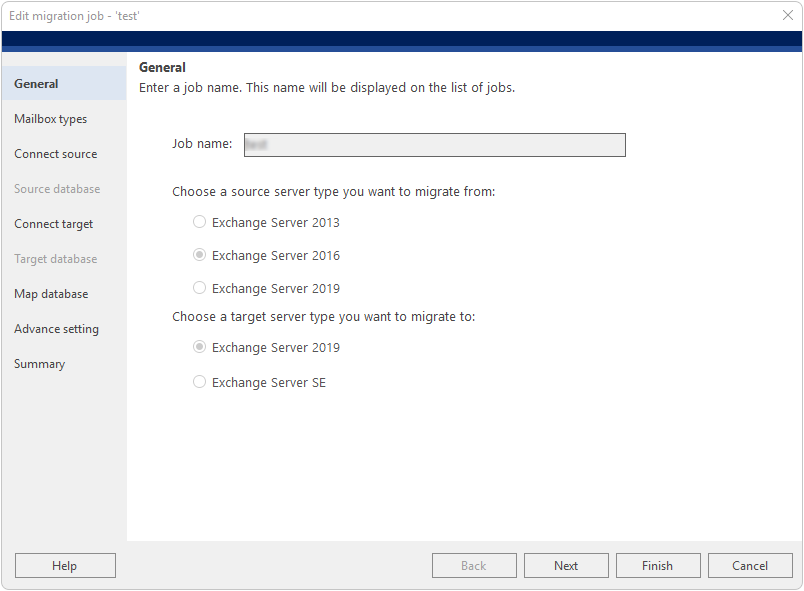
Migration Type
When you launch the software and create a new job, the Migration Type screen appears first. Under 'Choose a source server type you want to migrate from', select Exchange Server and enter the source Domain Name. Under 'Choose a target server type you want to migrate to', select Exchange Server and enter the target Domain Name. This configures the job as an Exchange to Exchange (server-to-server) migration. Click Next to proceed.
Step 7
Migration Scenario
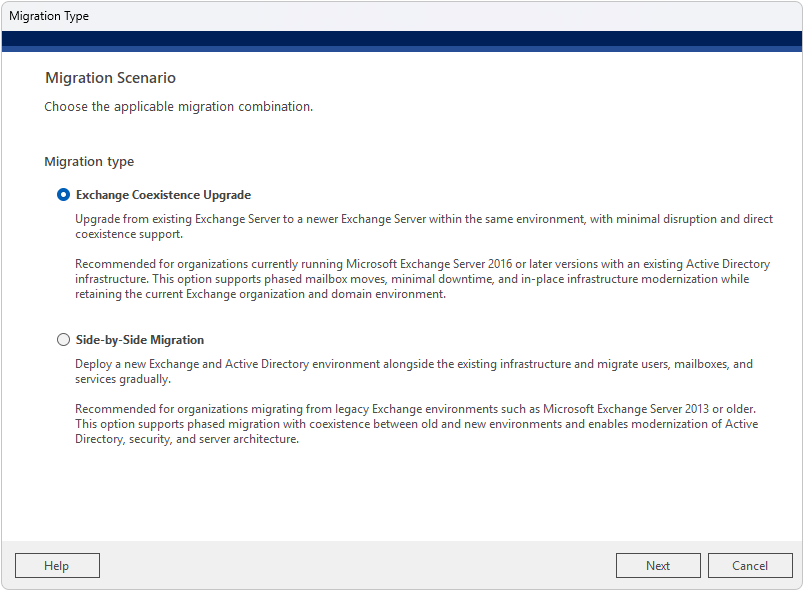
Choose the applicable migration combination. Based on your migration requirements, you can choose options such as Exchange Coexistence Upgrade or Side-by-Side Migration. Choose Exchange Coexistence Upgrade migration approach when you want to upgrade your existing Microsoft Exchange Server to a newer version within the same environment. Choose Side-by-Side Migration approach when you want to build a completely new Exchange and Active Directory environment alongside your existing infrastructure. Here we are selecting Exchange Coexistence Upgrade.
Step 8
General – Create Migration Job
Provide a name for your migration job (for example, 'Exc to Exc') — this name will be displayed on the list of jobs. Then select the mailbox type(s) you want to migrate: primary/shared mailboxes, archive mailboxes, or public folders. You can also import a pre-mapped CSV file directly from this screen.
Step 9
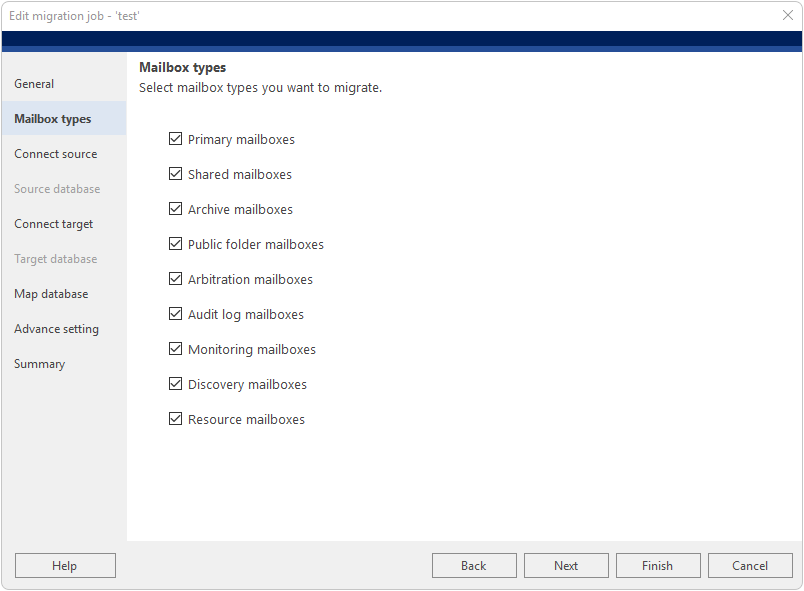
Mailbox Types
Select the mailbox types you want to include in the migration. All types are selected by default. Uncheck any types you want to exclude:
Click Next to proceed once your selection is complete.
Step 10
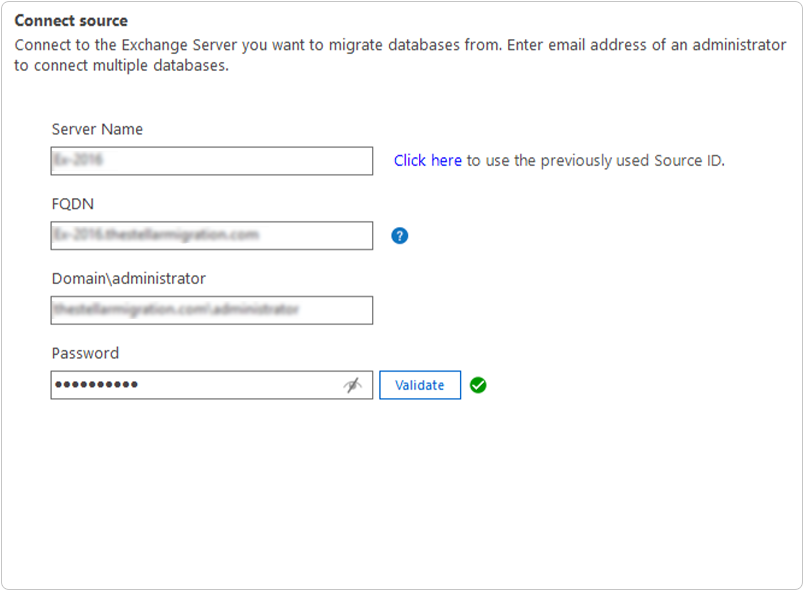
Connect Source
Connect the software to the source Exchange Server 2016. Enter the following details:
• Server Name — e.g., Ex-2016 • FQDN — e.g., Ex-2016.thestellarmigration.com • Domain\Administrator — e.g., thestellarmigration.com\administrator • Password — enter the administrator password
Click Validate to confirm the connection. A green checkmark will appear upon successful authentication. You can also click ‘Click here’ to reuse a previously saved Source ID and skip re-entering credentials.
Note: Administrator or impersonation rights are required for the account used to connect to the source Exchange Server.
Step 11
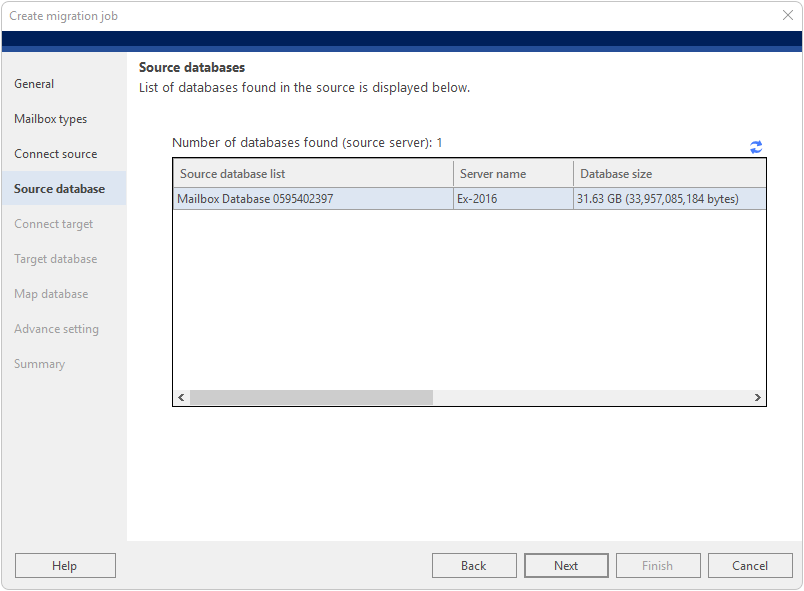
Source Databases
The software automatically discovers and displays all mailbox databases found on the source Exchange Server 2016. Review the list to confirm all required source databases are present. The database name, server name, and database size are shown for reference.
In this example, Mailbox Database 0595402397 is found on Ex-2016 with a size of 31.63 GB. Click Next to proceed.
Step 12
Connect Target
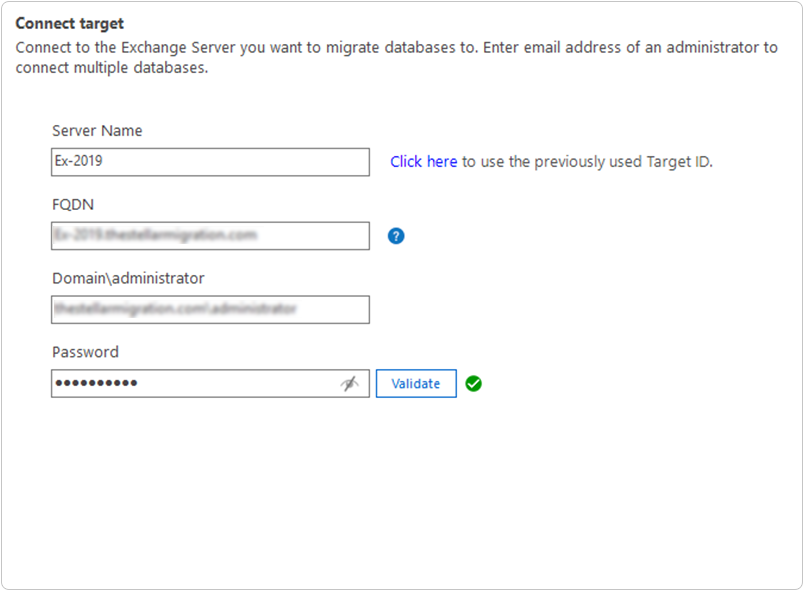
Connect the software to the target Exchange Server 2019. Enter the following details:
• Server Name — e.g., Ex-2019 • FQDN — e.g., Ex-2019.thestellarmigration.com • Domain\Administrator — e.g., thestellarmigration.com\administrator • Password — enter the administrator password
Click Validate to confirm the connection. A green checkmark will appear upon success. Alternatively, click ‘Click here’ to load a previously saved Target ID from the Saved Connections dialog — this allows you to skip re-entering credentials and streamlines the setup process.
Note: Administrator or impersonation rights are required for the account used to connect to the target Exchange Server.
Step 13
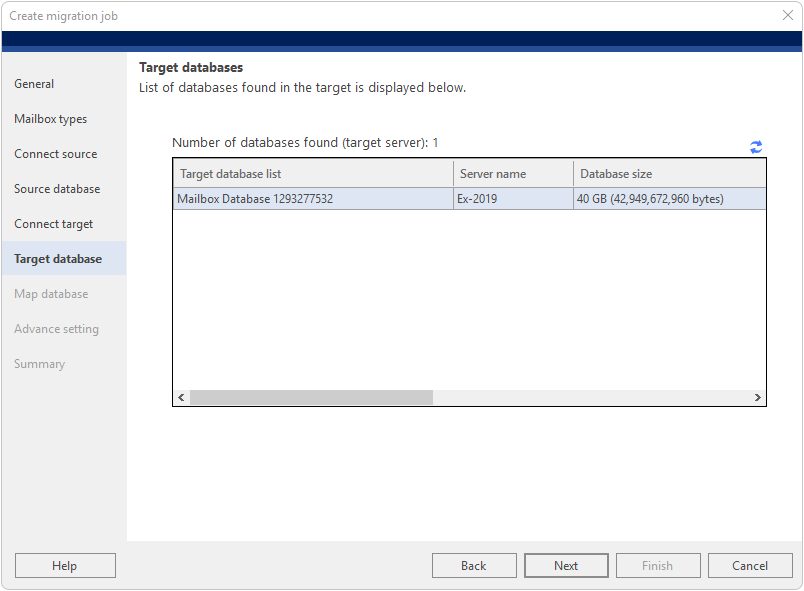
Target Databases
The software automatically discovers and displays all mailbox databases found on the target Exchange Server 2019. Verify that the destination database is available and has sufficient storage space to accommodate the migrated data.
In this example, Mailbox Database 1293277532 is found on Ex-2019 with a size of 40 GB. Click Next to proceed
Step 14
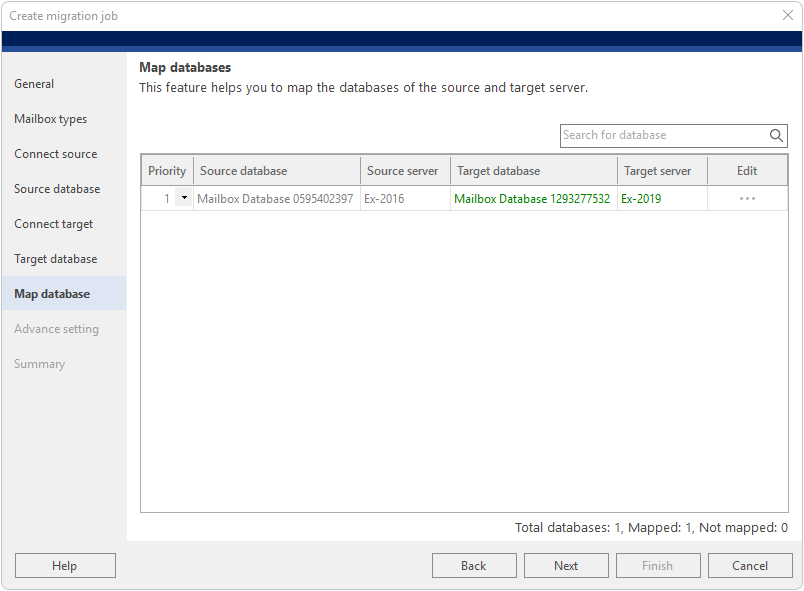
Map Databases
The software maps the source database (Exchange Server 2016) to the target database (Exchange Server 2019). The mapping screen displays the source database alongside the available target databases for pairing.
Review the mapping to ensure the correct source and target databases are paired. If the auto-mapping is incorrect, use the dropdown to select the correct target database for each source database. Click Next once all databases are correctly mapped.
Step 15
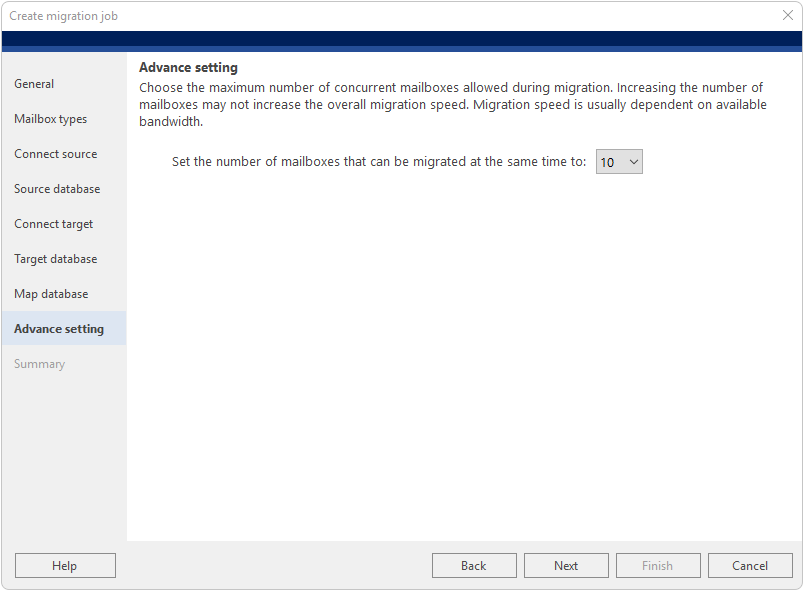
Advance Setting
Configure the maximum number of concurrent mailboxes allowed during migration. This setting controls how many mailboxes are migrated simultaneously.
Note that increasing the concurrency does not necessarily improve overall migration speed — performance is primarily dependent on available network bandwidth and server load. The default value is 10 concurrent mailboxes. Adjust as required and click Next to proceed.
Step 16
Summary
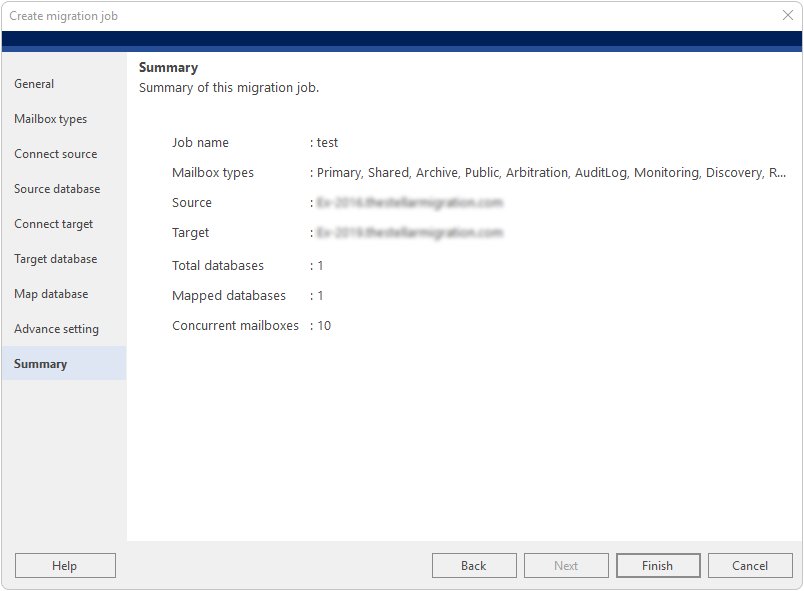
Review the complete migration job summary before finishing. The summary screen displays all configured settings for the job:
• Job name • Mailbox types selected (Primary, Shared, Archive, Public, Arbitration, AuditLog, Monitoring, Discovery, Resource) • Source server — Ex-2016.thestellarmigration.com • Target server — Ex-2019.thestellarmigration.com • Total databases and Mapped databases • Concurrent mailboxes setting
If any setting requires correction, click the relevant section in the left panel to go back and edit it. Once satisfied, click Finish to create the migration job.
Step 17
Initiate Migration
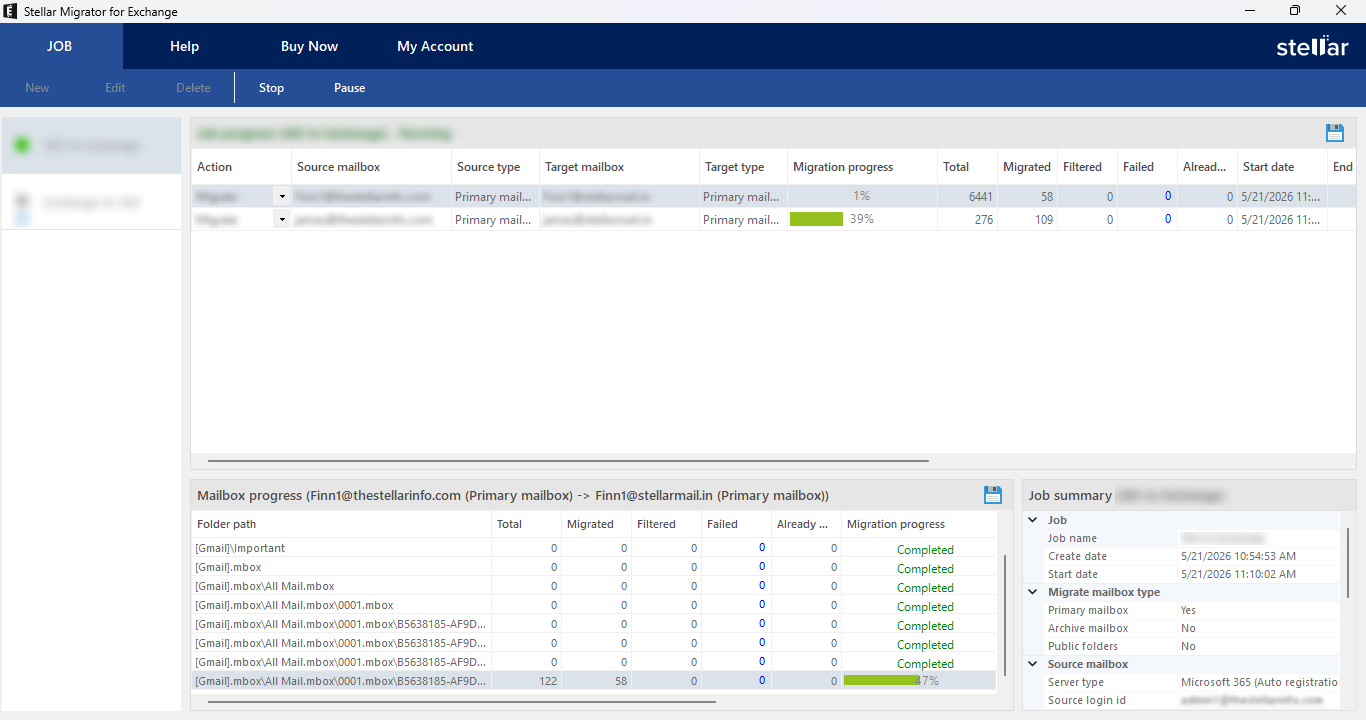
After clicking Finish to create the job, the job will appear in the jobs list. Click Start in the JOB ribbon at the top to begin the migration process.
The migration dashboard shows real-time Job Progress with the following columns:
• Action — current operation (Migrate / Don’t Migrate) • Source mailbox — the mailbox being migrated from • Target mailbox — the mailbox being migrated to • Migration progress (%) — percentage completion • Total items, Migrated, Filtered, and Failed counts • Start date — when the mailbox migration began
The Mailbox Progress panel at the bottom shows folder-level detail for each mailbox being processed. You can Pause or Stop the migration at any time using the buttons in the JOB ribbon.
Step 18
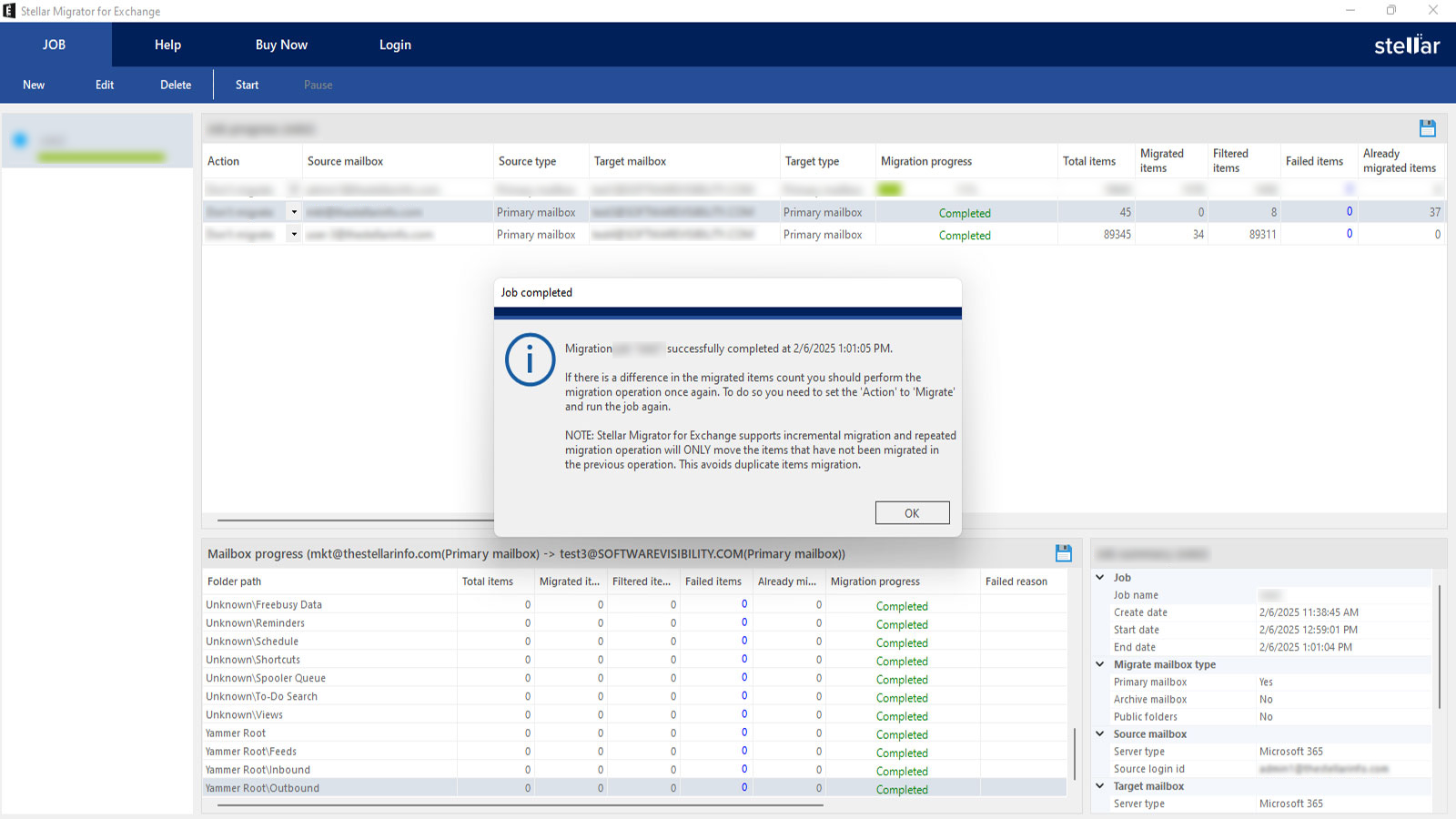
Migration Completed
After completing the migration, the Action field in the Job Progress section will change from ‘Migrate’ to ‘Don’t Migrate’, indicating the job has finished successfully.
If any mailbox fails to migrate, it will remain in the ‘Migrate’ state, allowing you to retry the failed mailboxes without reconfiguring the entire job. Review the progress report to identify and address any failures before re-running the job.
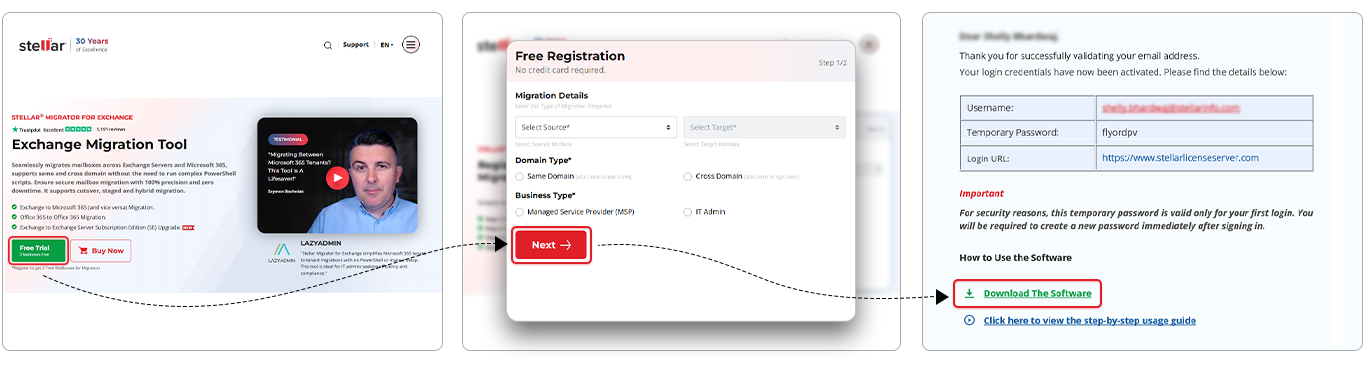
Welcome! If you're here, you've likely registered through the Stellar Migrator for Exchange website and received an email containing your login credentials. This email includes a download link for the Stellar Migrator for Exchange software (EXE) and access details for the Licensing Portal (stellarlicenseserver.com). To get started, click on the download link provided in the email or access it directly from the Licensing Portal.
Step 2
Install the Software
After downloading the Stellar Migrator for Exchange setup file, run the installer and follow the on-screen instructions to complete the installation. Once installed, launch the software — no additional configuration is required. You're now ready to start your test migration using the 2 free mailbox credits included. The next step is to create your first migration job.
Step 3
Welcome Screen
The first screen welcomes you to Stellar Migrator for Exchange, which lets you securely migrate mailboxes between Exchange Server and Microsoft 365, including M365 tenant-to-tenant. If you already have an account, click ‘Login’ to sign in with the credentials sent to your email. If you want to explore the software first, click ‘Continue without login’ instead. Use the ‘Help’ option at the bottom if you need assistance.
Step 4
Sign In to Licensing Server
The next screen prompts you to sign in to your Licensing Server account. Enter the email ID and password sent to your registered email address, then click ‘Login’. Select ‘Remember me’ if you want the software to save your credentials for future sessions. If you cannot recall your password, use the ‘Forgot password?’ link to reset it.
Step 5
Connected to Licensing Server
The next screen confirms that you are connected to the Licensing Server and shows the number of licenses available for migration. Click ‘Create job’ to start a new migration job to Exchange or Microsoft 365. If you have a migration job in progress, click ‘Open job’ to resume it. Review your available licenses before starting so you can plan the number of mailboxes to migrate.
Step 6
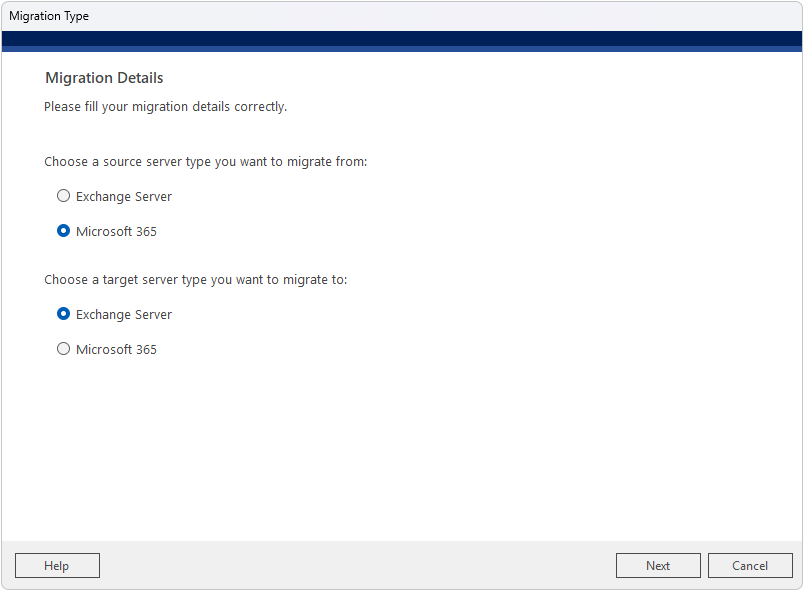
Migration Type
When you launch the software and create a new job, the Migration Type screen appears first. Under 'Choose a source server type you want to migrate from', select Microsoft 365. Under 'Choose a target server type you want to migrate to', select Exchange Server. This configures the job as an Office 365 to Exchange Server migration. Click Next to proceed.
Step 7
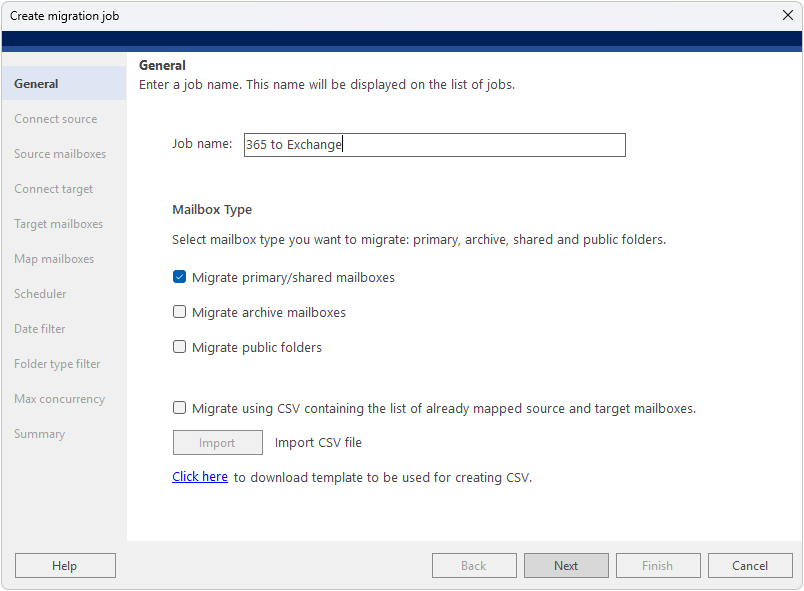
General – Create Migration Job
Provide a name for your migration job (for example, '365 to Exchange') — this name will be displayed on the list of jobs. Then select the mailbox type(s) you want to migrate: primary/shared mailboxes, archive mailboxes, or public folders. You can also import a pre-mapped CSV file directly from this screen.
Step 8
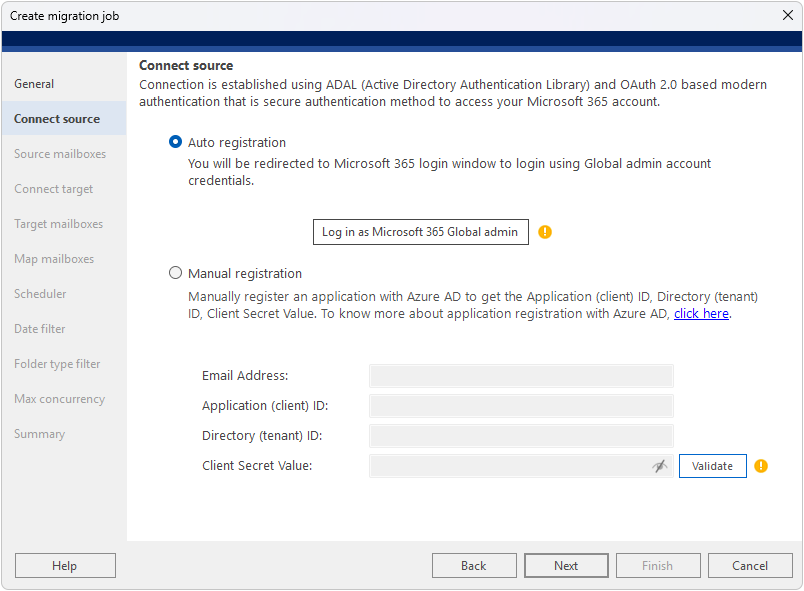
Connect Source
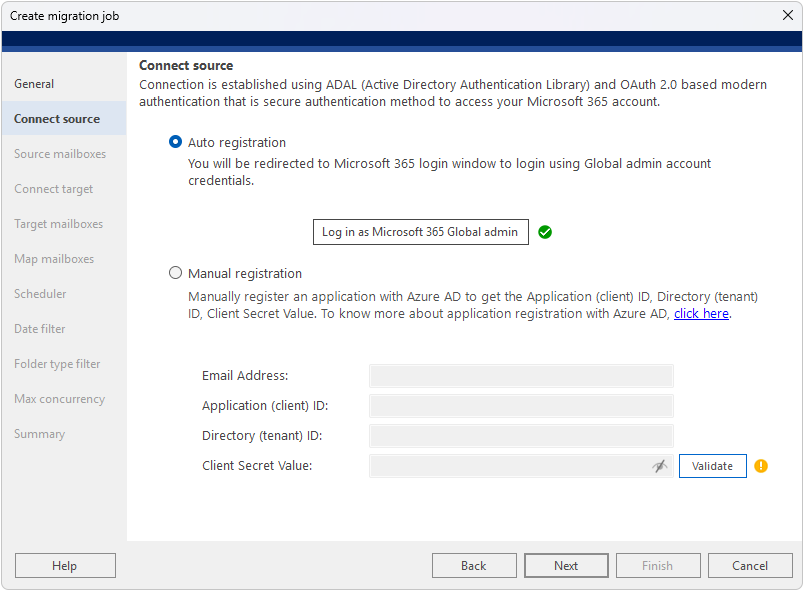
The Connect Source screen provides two registration methods for the source Microsoft 365 tenant: Auto Registration and Manual Registration. With Auto Registration, click “Log in as Microsoft 365 Global admin” to sign in through the Microsoft 365 login window, after which a green checkmark confirms the connection. For Manual Registration, register an application in Azure AD and enter the Email Address, Application (client) ID, Directory (tenant) ID, and Client Secret Value.
Step 9
Connect Source – Auto Registration
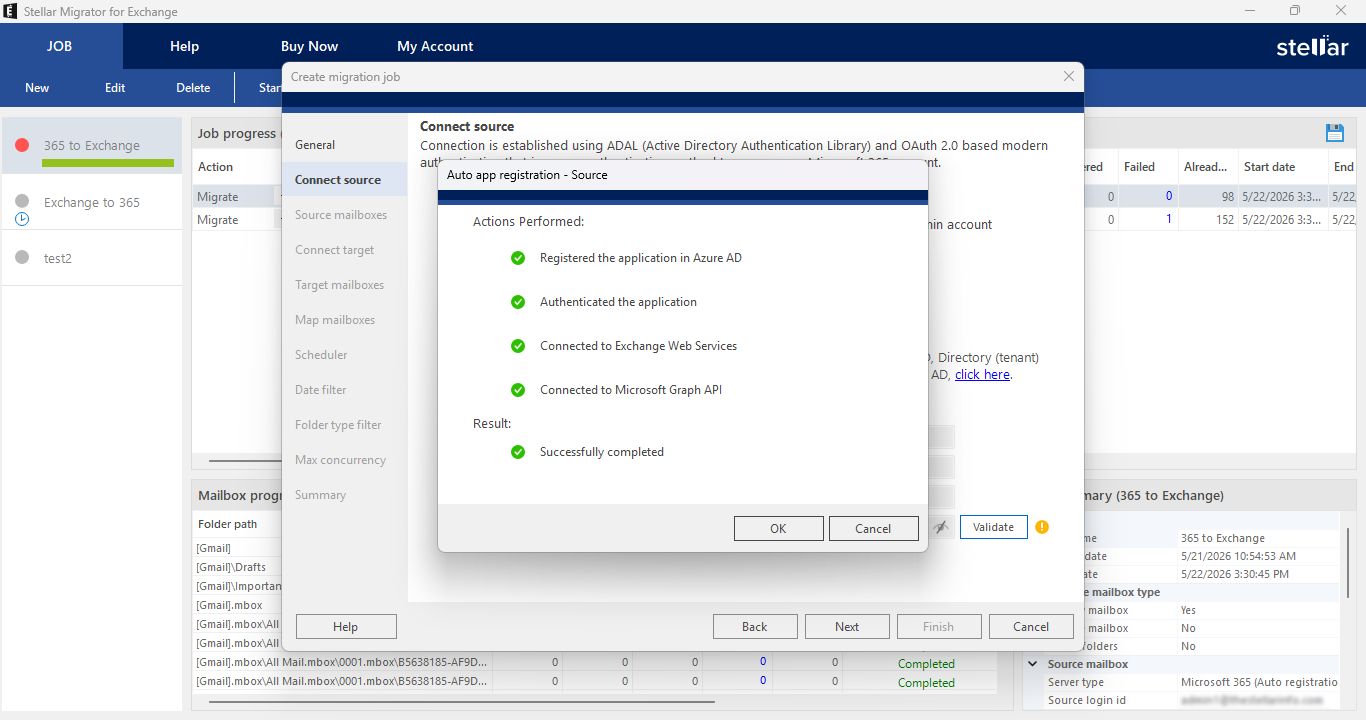
Once all Auto registration steps finish successfully, the dialog shows green checkmarks for all actions performed: Registered the application in Azure AD, Authenticated the application, Connected to Exchange Web Services, and Connected to Microsoft Graph API. The Result section confirms 'Successfully completed'. Click OK to return to the Connect Source screen.
Step 10
Connect Source – Connection Confirmed
After successful authentication, a green checkmark appears next to the 'Log in as Microsoft 365 Global admin' button, confirming the source Microsoft 365 tenant is connected.
Step 11
Source Mailboxes
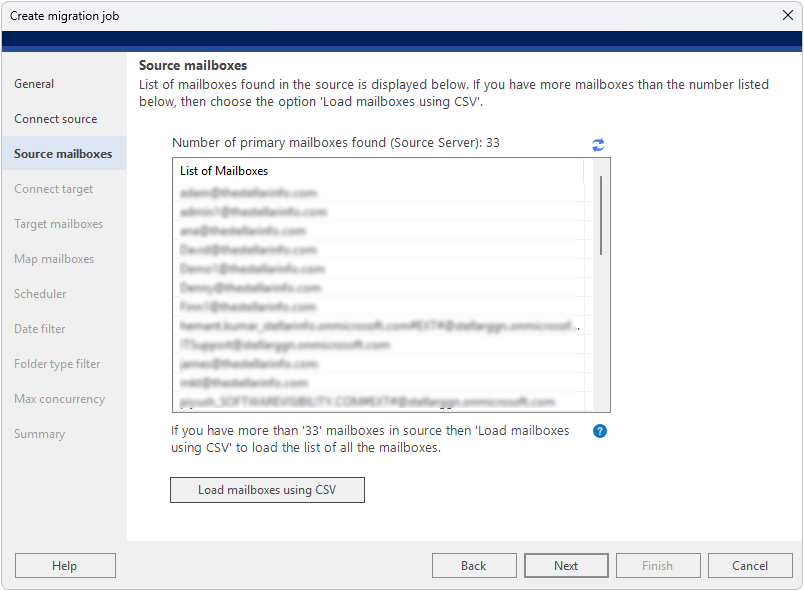
The next screen displays the list of mailboxes found in the source Microsoft 365 tenant. Review the list to confirm all required source mailboxes are present. If you have more mailboxes than the number listed, use the 'Load Mailboxes Using CSV' option and upload a CSV file containing all mailbox addresses.
Step 12
Connect Target
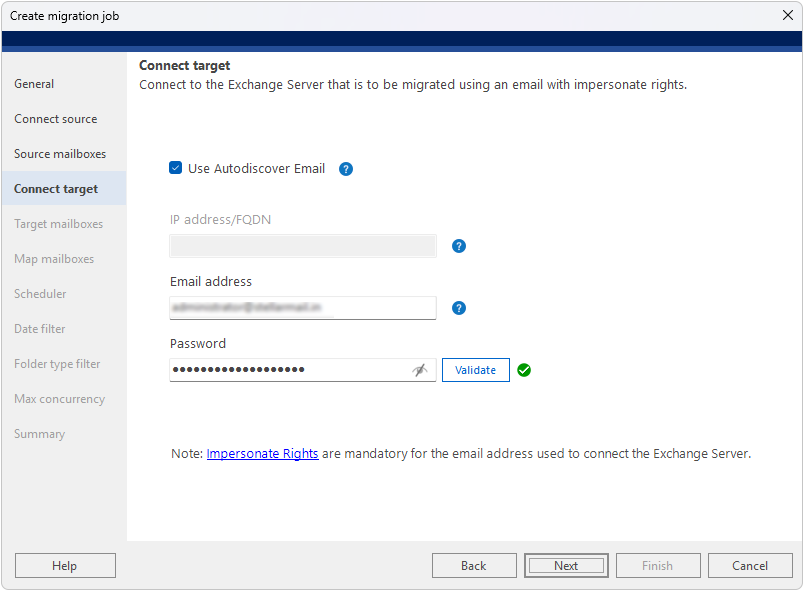
Connect the software to the target Exchange Server. Enable 'Use Autodiscover Email' and enter the Email address and Password — the software will automatically locate and connect to the target server. Alternatively, uncheck Autodiscover and manually enter the IP address/FQDN, Email address, and Password. Click Validate to confirm the connection.
Note: Impersonate Rights are mandatory for the email address used to connect to the Exchange Server.
Step 13
Target Mailboxes
The next screen displays the list of mailboxes found in the target Exchange Server. Review the list to ensure all destination mailboxes are available for mapping. If you have more mailboxes than the number listed, use the 'Load Mailboxes Using CSV' option to load the complete list.
Step 14
Map Mailboxes
The software automatically maps source and target mailboxes by comparing their email addresses. Mailboxes that are successfully matched appear in green; unmatched mailboxes are marked 'Not Mapped' in red. Use the Edit (…) button to manually map any unmatched mailboxes. The status bar at the bottom shows Total mailboxes, Mapped count, and Not mapped count.
Step 15
Scheduler
Configure when the migration job should run. Choose 'Run manually' to start migration on demand, or select 'Schedule job' and click the Scheduler button to set the frequency (Run once, Daily, Weekly, or Monthly), start and end times, and duration. The Description field at the bottom previews the configured schedule. Use the Scheduler dialog to set the exact frequency, occurrence times, start date, and optional end date for the migration run.
Step 16
Date Filter
Apply a date filter to control which mail items are migrated (applies to mail items only). Options include: Migrate all items, Migrate items older than a specific date, Migrate items not older than a specific date, or Migrate only items from a specific date range. This helps reduce migration scope when needed.
Step 17
Folder Type Filter
Select the folder types to include in the migration. Available folder types are: Emails, Contacts, Calendars, Tasks, Notes, and Journals. Special folders include Junk Email, Deleted Items, and Drafts. All are selected by default. Uncheck any folders you want to exclude to ensure only the required data is migrated.
Step 18
Max Concurrency
Configure migration speed and resilience. Set the number of Concurrent mailbox migration threads (5 recommended), Concurrent item migration threads per mailbox (5 recommended), and the number of retry attempts in case of network failure (default: 2). Migration speed depends on system configuration, network speed, and source and destination server performance.
Step 19
Summary
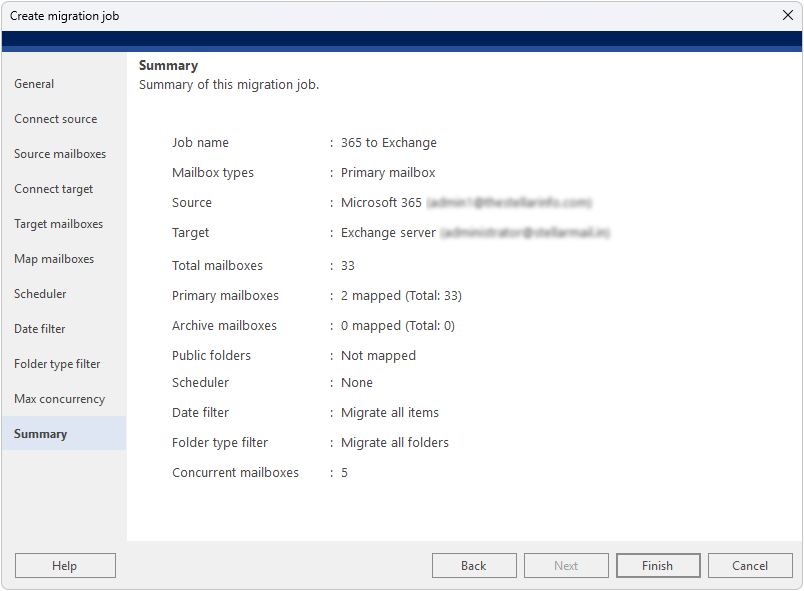
Review the complete job summary before starting migration. The summary displays: Job name, Mailbox types, Source server (Microsoft 365), Target server (Exchange Server), Total mailboxes, Mapped counts for primary/archive mailboxes and public folders, Scheduler setting, Date filter, Folder type filter, and Concurrent mailboxes. If any setting needs correction, click the relevant section in the left panel to go back and edit it. Click Finish to create the migration job.
Step 20
Initiate Migration
After clicking Finish to create the job, click Start in the JOB ribbon at the top to begin the migration process. The migration dashboard shows real-time Job Progress with columns for Action, Source mailbox, Target mailbox, Migration progress (%), Total items, Migrated, Filtered, Failed, and Start date. The Mailbox Progress panel at the bottom shows folder-level detail. You can Pause or Stop the migration at any time using the buttons in the JOB ribbon.
Step 21
Migration Completed
After completing the migration, the action field in the job progress section will change from Migrate to Don't Migrate. If the job fails to migrate, it will remain in the Migrate state, allowing you to attempt the migration again without making repeated changes.
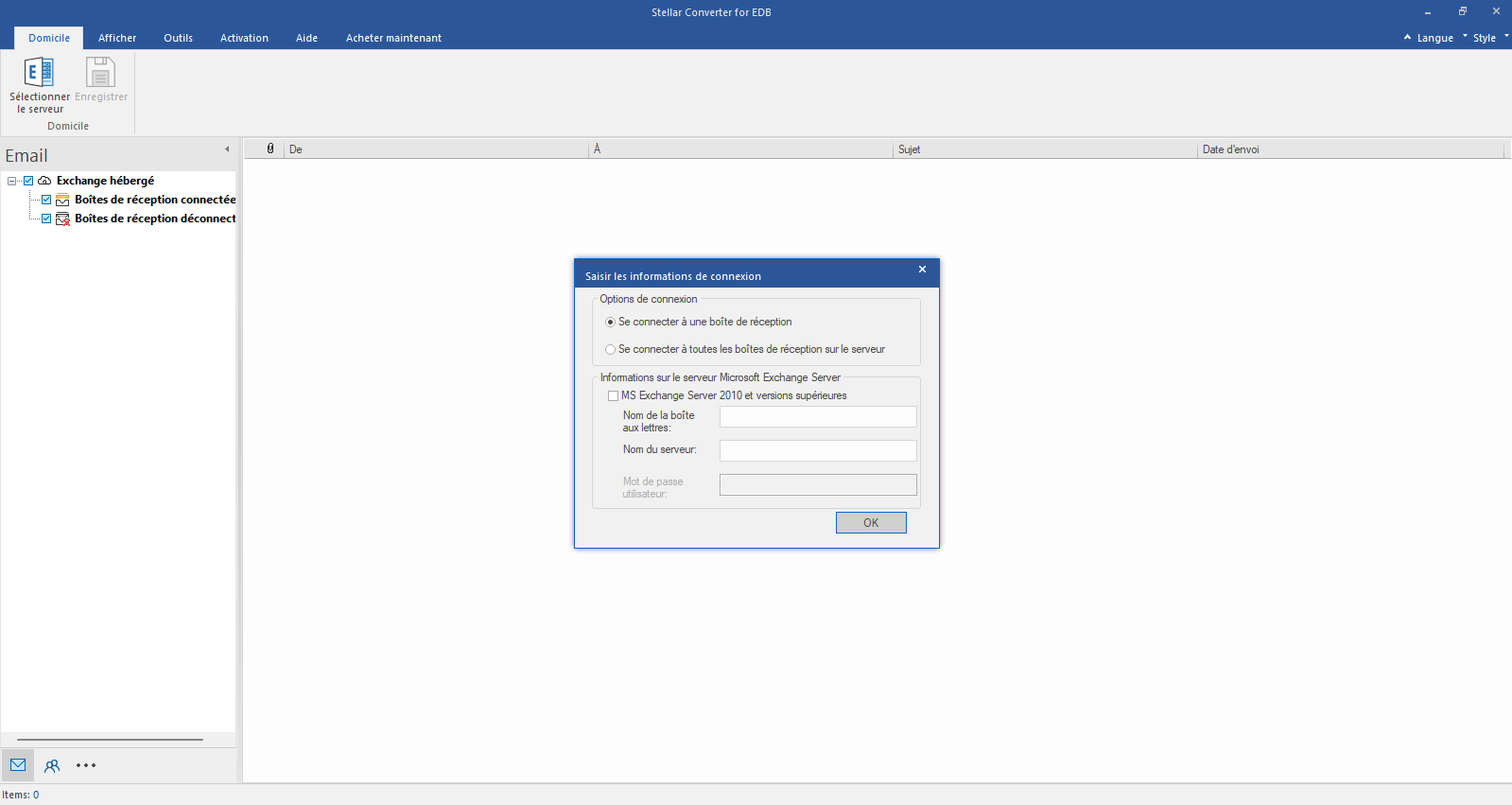
Sélectionnez Hosted Exchange et entrez vos données de connexion.
Sélectionnez Hosted Exchange pour exporter des boîtes aux lettres à partir d'un fichier EDB en ligne. Sélectionnez Connecter à une seule boîte aux lettres ou Connecter à une seule boîte aux lettres dans les options de connexion.
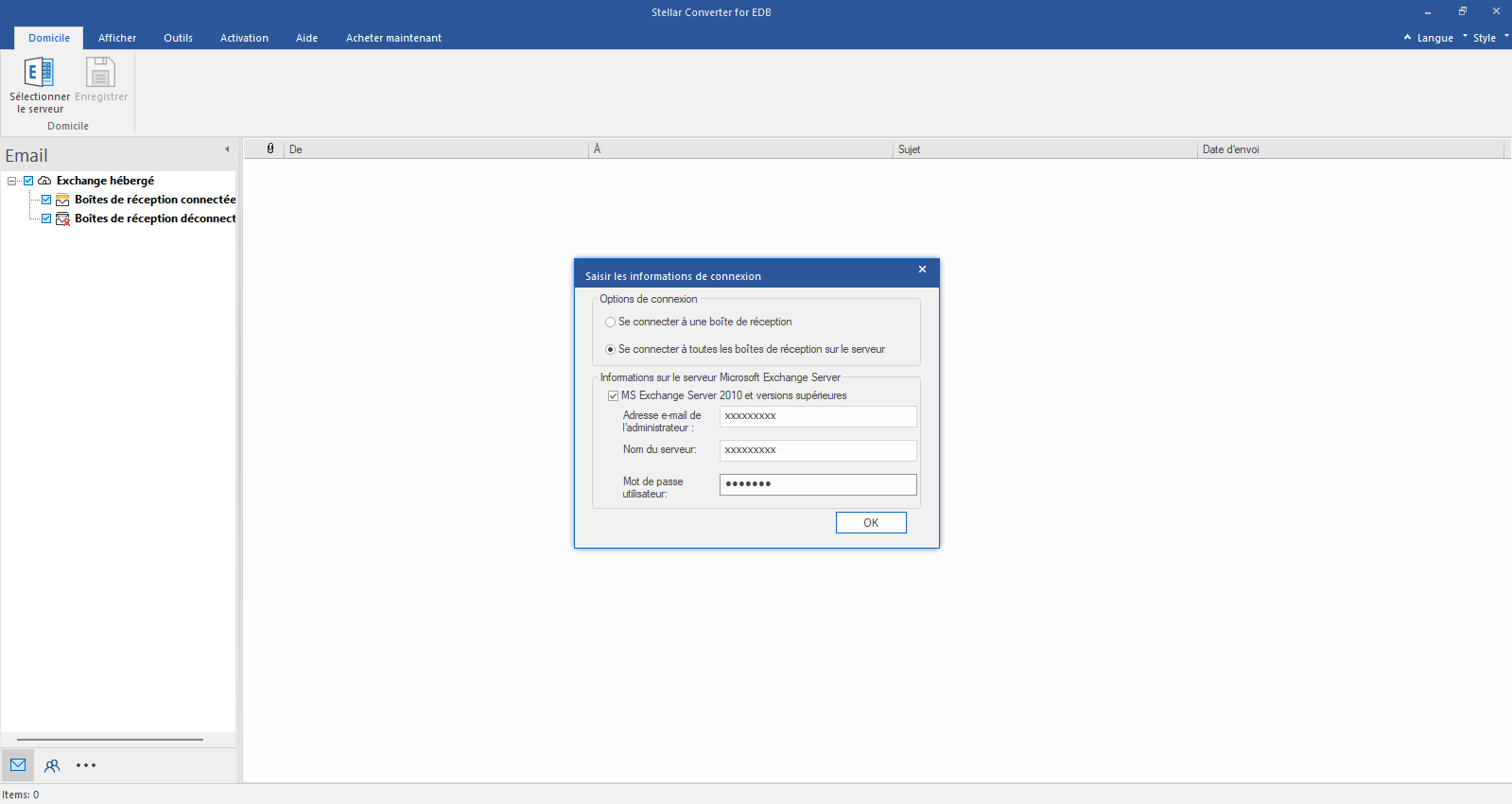
Étape 2
Saisissez l'adresse électronique de l'administrateur et le nom du serveur
Saisissez le courriel de l'administrateur et le nom du serveur (pour Exchange 5.5, 2000, 2003, 2007) ou cochez la case "Exchange Server 2010 and higher" pour saisir le courriel de l'administrateur, le nom du serveur et le mot de passe (pour MS Exchange 2010, 2013, 2016 et 2019). Cliquez sur OK.
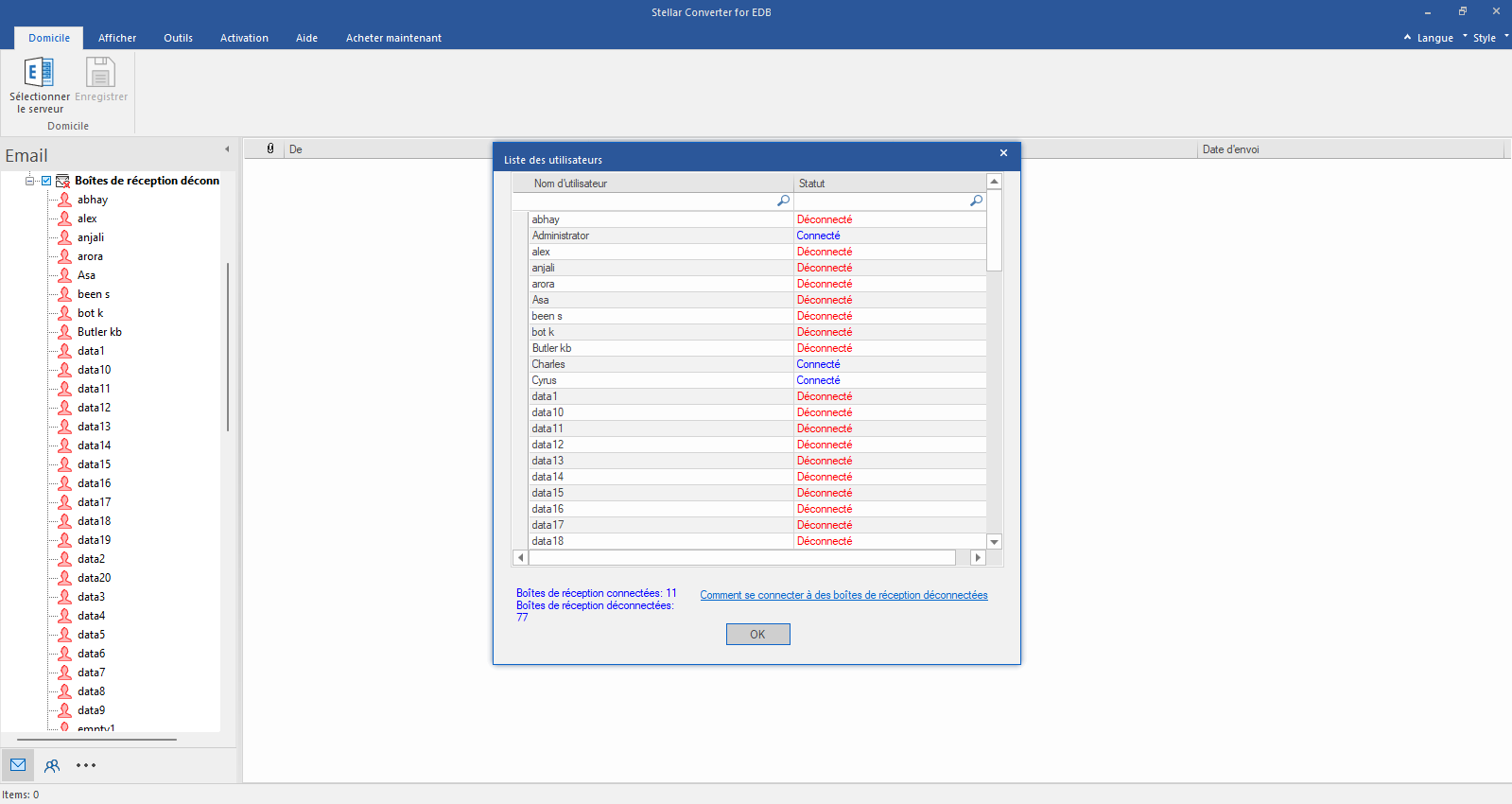
Étape 3
Vérifier l'état de la boîte aux lettres connectée/déconnectée
Une fois la connexion à Exchange Server établie, une liste des boîtes aux lettres connectées et déconnectées s'affiche dans la fenêtre suivante. Cliquez sur "OK" pour continuer.
Étape 4
Vérifier l'aperçu de toutes les boîtes aux lettres
Vérifiez l'aperçu de toutes les boîtes aux lettres - courriels, calendrier, contacts, etc.
Étape 5
Sélectionnez "Enregistrer sous PST".
Cliquez sur Enregistrer dans le ruban Démarrer et sélectionnez l'option Enregistrer sous PST. Cliquez sur "Suivant" pour continuer.
Selezioni Hosted Exchange e inserisca i suoi dati di accesso.
Selezioni Hosted Exchange per esportare le caselle postali da un file EDB online. Selezioni Connetti a una singola casella postale o Connetti a una singola casella postale dalle opzioni di connessione.
Passo 2
Inserisca l'e-mail dell'amministratore e il nome del server
Inserisca il nome dell'amministratore e del server (per Exchange 5.5, 2000, 2003, 2007) o selezioni la casella di controllo "Exchange Server 2010 e superiore" per inserire l'e-mail dell'amministratore, il nome del server e la password (per MS Exchange 2010, 2013, 2016 e 2019). Clicchi su OK.
Passo 3
Controlli lo stato della mailbox collegata/disconnessa.
Una volta stabilita la connessione a Exchange Server, nella finestra successiva viene visualizzato un elenco di caselle postali collegate e scollegate. Clicchi su "OK" per continuare.
Passo 4
Controlli l'anteprima di tutte le cassette postali
Controlli l'anteprima di tutte le caselle di posta elettronica - e-mail, calendario, contatti, ecc.
Passo 5
Selezionare "Salva come PST".
Clicchi su Salva nella barra multifunzione Avvio e selezioni l'opzione Salva come PST. Clicchi su "Avanti" per continuare.
Seleccione Hosted Exchange e introduzca sus datos de acceso.
Seleccione Hosted Exchange para exportar buzones desde un archivo EDB en línea. Seleccione Conectarse a un único buzón o Conectarse a un único buzón en las opciones de conexión.
Paso 2
Introduzca el correo electrónico del administrador y el nombre del servidor
Introduzca el correo electrónico del administrador y el nombre del servidor (para Exchange 5.5, 2000, 2003, 2007) o marque la casilla "Exchange Server 2010 y superior" para introducir el correo electrónico del administrador, el nombre del servidor y la contraseña (para MS Exchange 2010, 2013, 2016 y 2019). Haga clic en Aceptar.
Paso 3
Comprobar el estado del buzón conectado/desconectado
Una vez establecida la conexión con Exchange Server, en la siguiente ventana aparecerá una lista de los buzones conectados y desconectados. Haga clic en "Aceptar" para continuar.
Paso 4
Comprobar la vista previa de todos los buzones
Compruebe la vista previa de todos los buzones: correos electrónicos, calendario, contactos, etc.
Paso 5
Seleccione "Guardar como PST".
Haga clic en Guardar en la cinta Inicio y seleccione la opción Guardar como PST. Haga clic en "Siguiente" para continuar.
Wählen Sie Hosted Exchange und geben Sie Ihre Anmeldedaten ein.
Wählen Sie Hosted Exchange, um Postfächer aus einer Online-EDB-Datei zu exportieren. Wählen Sie Verbinden mit einem einzelnen Postfach oder Verbinden mit einem einzelnen Postfach aus den Verbindungsoptionen
Schritt 2
Admin-E-Mail und Servernamen eingeben
Geben Sie admin und den Servernamen ein (für Exchange 5.5, 2000, 2003, 2007) oder aktivieren Sie das Kontrollkästchen "Exchange Server 2010 und höher", um admin E-Mail, Servernamen und Passwort einzugeben (für MS Exchange 2010, 2013, 2016 und 2019). Klicken Sie auf OK.
Schritt 3
Prüfen Sie den Status der verbundenen/getrennten Mailbox
Sobald die Verbindung zu Exchange Server hergestellt ist, wird im nächsten Fenster eine Liste der verbundenen und nicht verbundenen Postfächer angezeigt. Klicken Sie auf "OK", um fortzufahren.
Schritt 4
Prüfen Sie die Vorschau aller Postfächer
Prüfen Sie die Vorschau aller Postfächer - E-Mails, Kalender, Kontakte, etc.
Schritt 5
Wählen Sie "Als PST speichern".
Klicken Sie im Menüband Start auf Speichern und wählen Sie die Option Als PST speichern. Klicken Sie auf "Weiter", um fortzufahren.
How to Video
Comience a utilizar Stellar Converter for EDB hoy mismo.
Sin limitaciones de tamaño de archivo
Recomendado por los MVP de Microsoft y los administradores de TI
 Para IndividuosVolver al menú principal
 Recuperación de datos
 Reparación de archivos
 Borrado de datos
  Para EmpresasVolver al menú principal
 Reparación por correo electrónico
 Conversor de correo electrónico
 Reparación de archivos
  Toolkit
 Lab Services
  Nuestros Socios
  Acerca de
 Recursos
 Soporte
  Contáctenos
  Empresa
 Leadership
  Cobertura Mediática
 Comunicados de prensa
 Case Studies
 Blogs
Blogs  Artículos
  Videos



 Installation