How to Solve "Error: MySQL shutdown unexpectedly"?

info-icon  Our content follows trusted Editorial Standards - accurate & unbiased.

Table of Contents

Introduction

Error MySQL shutdown unexpectedly means MySQL service has stopped or crashed. You may encounter this error while using MySQL in XAMPP/WAMP or in a standalone MySQL server.
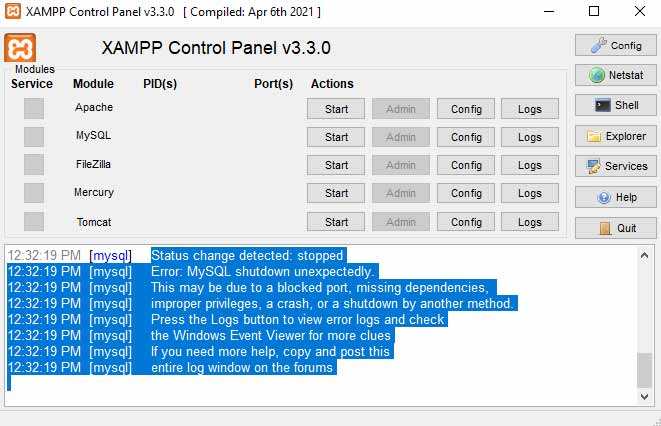
XAMPP error message MySQL shutdown unexpectedly error message

In cPanel, you may see “MySQL is not running” when trying to access databases on a hosted server. In WAMP, the MySQL service may fail to start or terminate immediately after launch. It can occur due to corruption in the InnoDB-related files, incorrect configuration settings, improper privileges, blocked port, etc. When this error occurs, it makes your database inaccessible. Here, in this article, we will explain how to solve the “MySQL shutdown unexpectedly error”.

Why does MySQL shut down unexpectedly?

This error can occur for several reasons — from small configuration mistakes to serious data corruption. Some common causes include:


 Cause

Why it happens

Port Conflict

MySQL can’t start on port 3306 if it is already in use

Insufficient Resources

If your system hosting MySQL has less memory space, it can crash unexpectedly.

Configuration Anomalies

Incorrect parameters in my.cnf/my.ini files can lead to an abrupt shutdown.

InnoDB table corruption

If the log files or InnoDB tables are damaged due to any reason

Software conflicts

The mysqld.exe can get blocked by Firewalls. This can cause Server crash or prevent its startup.

Re-installation conflicts

If you forgot to delete old installation files and re-install MySQL

Insufficient file permissions

If MySQL cannot read its data folder due to permissions, it fails to start or shuts down immediately.

Crash recovery failure

If your system shuts down suddenly, MySQL may leave work incomplete. If it can’t recover those transactions, it won’t start.

How to Fix the MySQL Shutdown Unexpectedly Error

When this error occurs, first check the error logs. They can help you find the real cause — whether it's an incorrect setting, insufficient file permission, or a corrupted table. Once you confirm the reasons, next, move through the following fixes one by one:

Method 1: Run XAMPP/WAMP with Administrator Privileges

If there is a permission issue, you may fail to start MySQL in the control panel. Running the stack as Administrator gives MySQL the permissions it needs to initialize properly and prevents unexpected shutdowns. Here’s how to do so:
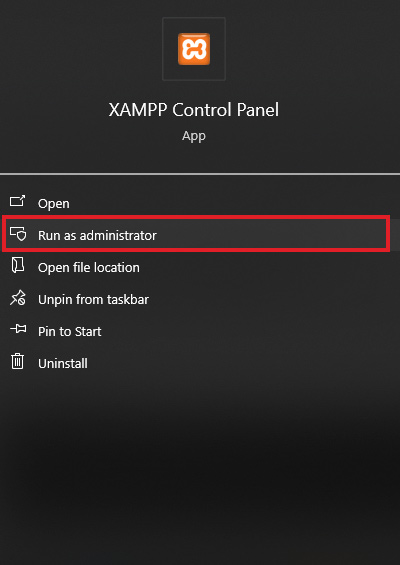
  • Close XAMPP/WAMP completely.
  • Right‑click the control panel executable.
  • Select Run as Administrator.

Opening XAMPP Control Panel App as an administrater

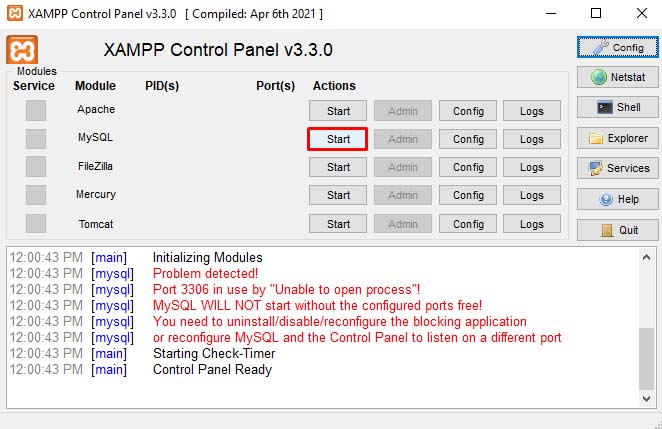
  • With Admin rights, relaunch the Control Panel and Start MySQL.
Re launching XAMPP Control panel to start MySQL

Method 2: Resolve Port Conflicts (Port 3306 in Use)

MySQL may shut down unexpectedly if another process is already using port 3306. Identifying the conflicting PID and stopping or reconfiguring that process allows MySQL to bind to its default port and start normally. Here’s how to do so:

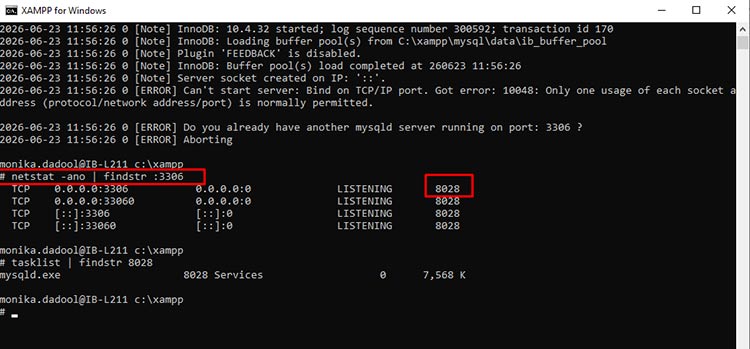
  • In the XAMM/WAMP tool, click Shell to open PowerShell and run  netstat -ano | findstr 3306

Running netstat-ano findstr 3306 command in XAMPP shell to identity conflicting PID

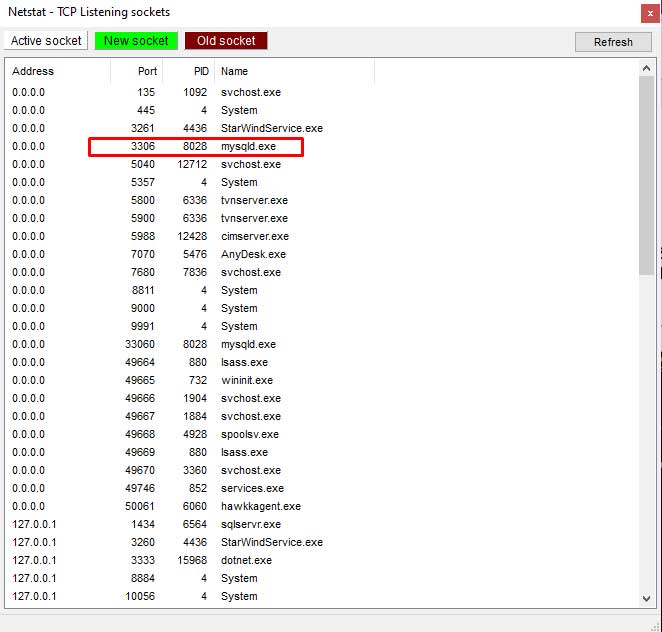
You can also check the conflicting ports by clicking on Netstat.
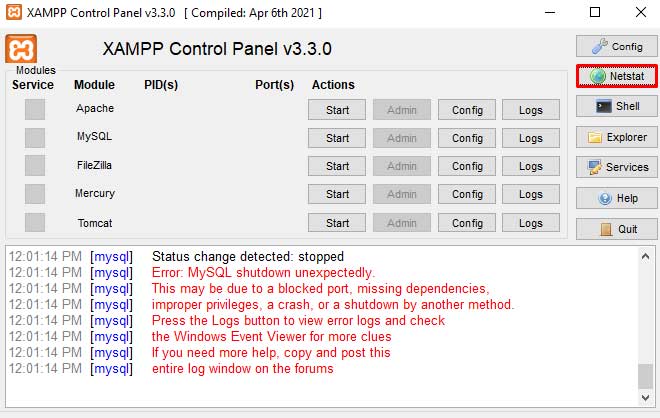
Selected Netstat option in XAMPP to check conflicting ports

  • In Netstat, search for the 3306 port number.

searching 3306 port number in XAMPP Netstat

Or in CMD, run the following command:
netstat -aon | find "3306"

Finding 3306 in CMD window

  • Now, identify which process is using the port number by running the following command.
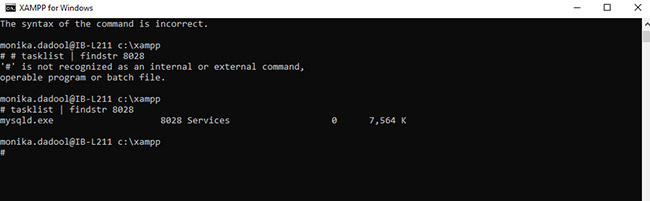
tasklist | findstr 8028

Finding 3306 in cmd window

  • Now, either stop the conflicting application or change MySQL’s port.
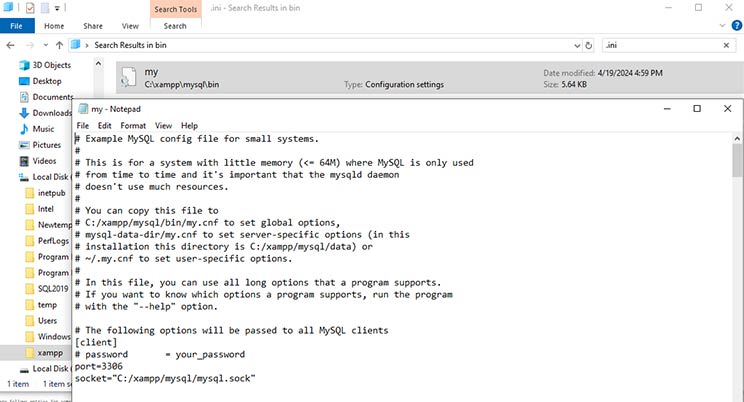
  • To change the port, you can open Notepad (manually) from the XAMPP folder in Windows Explorer to edit the MySQL configuration file. Here's how to do so:
  • In Windows Explorer, go to XAMPP > mysql > bin > my.ini.

locating configuration file in XAMPP

  • In the configuration file in Notepad, change the server port number and save the applied changes.
  • Next, try to start MySQL in XAMPP.

Alternatively, in the XAMPP Control Panel, click Config.
Locating MySQL configuration files in XAMPP

  • In the Configuration (my.ini) file, find port number 3306 and then replace it with port number 3307.
  • Save the applied changes and close the configuration file.

Method 3 - Run MySQL Server using Shell Command in XAMPP

If the shutdown is caused by a corrupted mysql.user tables, then you can try to run the MySQL server in XAMPP using the following command:
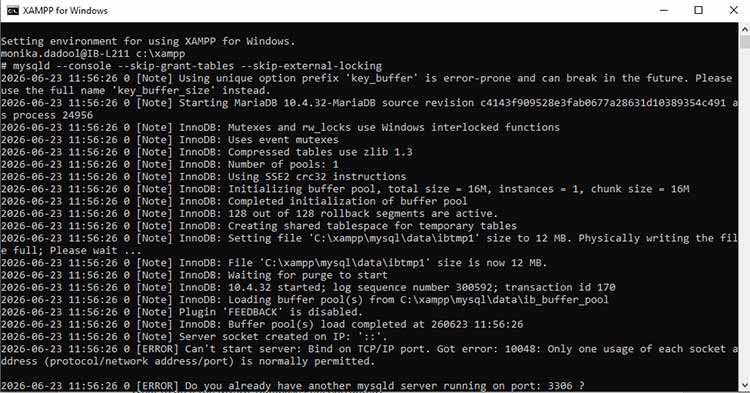
mysqld --console --skip-grant-tables --skip-external-locking

Run  MySQL server using shell command in XAMPP

Method 4: Check and Fix Configuration File (my.ini)

You can check and fix the incorrect configuration settings to resolve “MySQL shut down unexpectedly” error. Here’s how:

  • Locate my.ini (Windows).
  • Back up the file before editing.
  • Verify basedir paths point to the correct location.
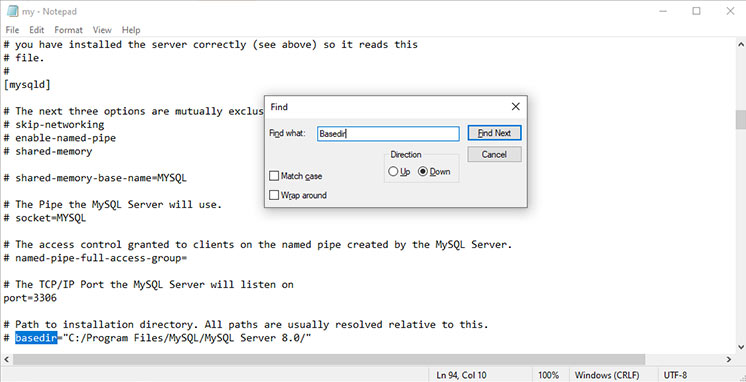
Verify basedir paths  in MySQL configuration file

  • Check parameters like innodb_buffer_pool_size for proper sizing.
  • Save and restart MySQL.

Method 5: Check and fix Folder Permissions

If the MySQL data folder is behind the "MySQL shuts down unexpectedly" error, then check the properties of MySQL data folder in XAMPP folder. For this, right-click on the data folder and select Properties.
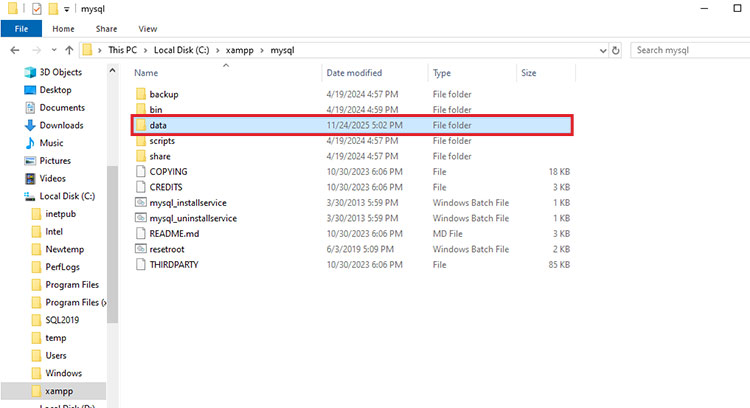
Open propeties of MySQL data folder

In the Properties window, click Security and make sure users have the following permissions:
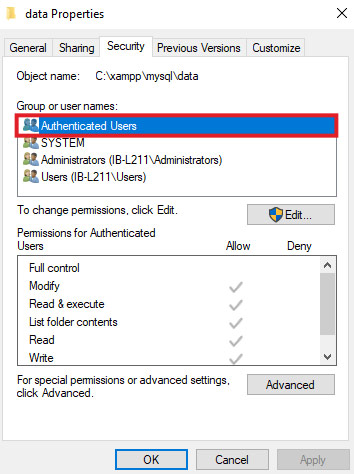
  • Full Control
  • Write
  • List folder contents
  • Modify
  • Read
  • Read & Execute

Allowing file permissions

Method 7- Check Disk Space and System Resources:

MySQL may shut down unexpectedly if the server runs out of disk space or system resources. You can check for available storage space and remove unnecessary files to free up some space. Steps are below:

  • In your Windows, right‑click the drive hosting MySQL’s data directory>Properties and check free space.
  • If there is a low space, then delete unnecessary files, logs, or temporary data. To check resource usage, open Task Manager

Method 8: Check for Conflicting Software

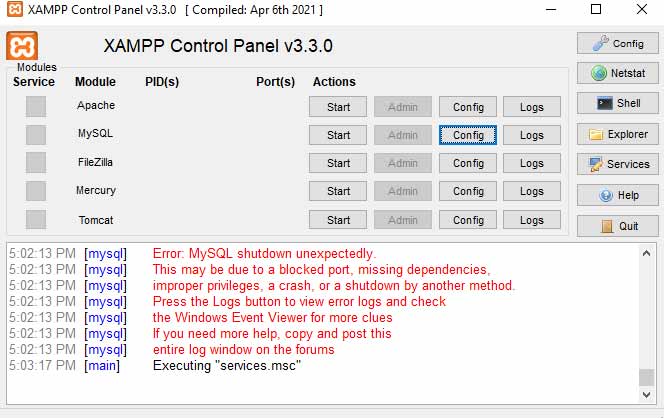
 The MySQL shutdown unexpectedly error can occur if the service is in conflict with another program. You can reset the service. For this, in CMD, run tasklist.
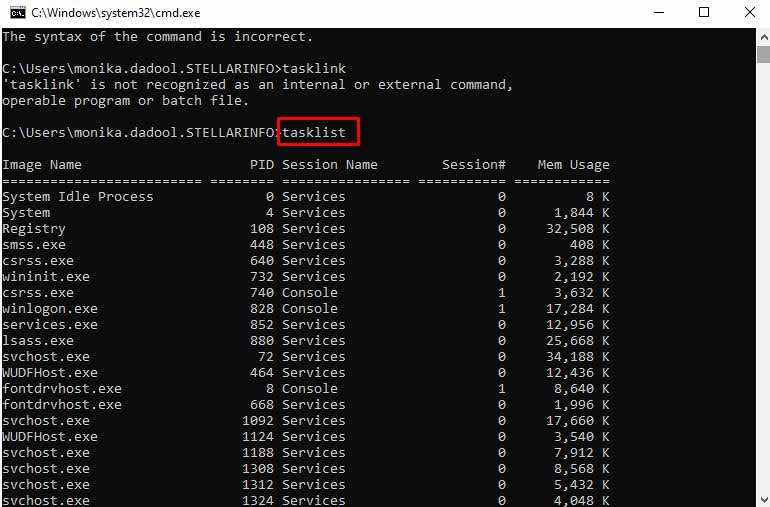
Running tasklist in CMD to fix Service Conflicts

  • First, stop the service (type services.msc in the Run window and press Enter). Then, restart it via the XAMPP service.

Method 9- Restore from Backup (XAMPP/WAMP):

If corruption in MySQL database has caused the ‘MySQL shutdown unexpectedly’ error in XAMPP/WAMP, restoring from backup folder can help you restore it. It allows the server to start normally.

Here’s how to do so:

  • Stop the MySQL service. For this, in the XAMPP/WAMP control panel, click Stop for MySQL.
  • Navigate to the data directory

Path: c:\xampp\mysql\data (XAMPP) or equivalent in WAMP.

  • Next, rename the existing data folder
  • Copy backup contents
  • Go to c:\xampp\mysql\backup.
  • Copy all contents into a new data folder.
  • Restart MySQL from the XAMPP control panel.
  • Verify that the service runs without crashing.

Read restoring old MySQL databases into a fresh XAMPP installation to learn more.

Method 10: Use innodb_force_recovery for InnoDB Corruption

The SQL Server may fail to start due to corruption in InnoDB tables. To repair InnoDB tables, you can use innodb_force_recovery in the configuration file. It lets the server bypass damaged pages and start in a read-only mode. This allows you to dump/export data before restoring from a backup file.

NOTE:  Learn blog innodb_force_recovery not working if you face error while repairing InnoDB tables.

The "Error: MySQL shutdown unexpectedly" indicates that the MySQL service has prematurely ceased its operations. The reasons behind this include incorrect configurations, resource depletion, or conflicts with additional software.

When MySQL Shutdown Unexpectedly Is Caused by Severe Database Corruption

If the above repair methods fail, or MySQL crashes after restart, it indicates the InnoDB or MyISAM tables are severely corrupted. To confirm this, you can check the signs in MySQL error logs like repeated crashes, data inconsistency after attempted recovery, or tables marked as “crashed” in the error logs.

In these cases, use a professional MySQL repair tool. It can recover the database with no data loss.

Fix Corrupted MySQL Databases with Stellar Repair for MySQL

When InnoDB/MyISAM corruption is confirmed, and manual recovery (Method 9) hasn't worked, Stellar Repair for MySQL directly repairs the database files and recovers all components — without requiring a clean backup.

Key capabilities of the tool

  • Repairs both InnoDB and MyISAM tables in MySQL databases

  • Recovers keys, tables, table properties, data types, views, and triggers

  • Provides a preview of recoverable database objects before saving

  • Allows you to save repaired databases in MySQL and other useful formats.

 • Supports MySQL 8.x, 6.x, 5.x, 4.x, 3.x.

 • Supports repairing a MySQL database on Windows and Linux systems

Conclusion

The "MySQL shutdown unexpectedly" error can occur for several reasons like misconfiguration, resource conflicts or corrupt data files. Follow the above article to resolve the error quickly. If corrupt or inaccessible InnoDB data files are behind it, then rebuild them by restoring the backup or by using force recovery. To repair MySQL tables quickly and with full integrity, you can use Stellar Repair for MySQL. It can repair MySQL database with complete integrity and help you resolve issues related to corruption, without delays and with no complexity.


Was this article helpful?
FAQs
Corruption in InnoDB tables can keep the server from shutting down after a restart. To confirm this, refer to the MySQL error log and consider using manual repair methods or a professional repair tool.
The underlying causes overlap (port conflicts, corruption, permissions), but XAMPP and WAMP add their own layer — such as reinstallation conflicts and bundled backup/restore folders — that don't apply to standalone or production MySQL installs.
Yes, you can lose data if you have used higher recovery levels (4-6).
Yes, this repair tool can help you repair and open the corrupt MySQL database that you're not able to open in Workbench.
The InnoDB engine has a crash-recovery feature. So, to repair InnoDB tables, you may be required to use innodb_force_recovery. Use standard repair commands to recover MyISAM tables. Stellar Repair for MySQL can help you recover tables created in both engines.
About The Author
author image
Bharat Bhushan linkdin Icon

Technical Marketer at Stellar Information Technology Private Limited. He makes Tech concepts easy to understand with his strong grip on Technology.

WHY STELLAR® IS GLOBAL LEADER

Why Choose Stellar?
  • 0M+

    Customers

  • 0+

    Years of Excellence

  • 0+

    R&D Engineers

  • 0+

    Countries

  • 0+

    PARTNERS

  • 0+

    Awards Received

BitRaser With 30 Years of Excellence
Technology You Can Trust
Data Care Experts since 1993
google-trust
×
{ "@context": "https://schema.org", "@type": "HowTo", "name": "How to Fix the MySQL Shutdown Unexpectedly Error", "description": "Step-by-step methods to troubleshoot and resolve the 'MySQL shutdown unexpectedly' error in XAMPP/WAMP, including permission fixes, port conflicts, corrupted tables, and configuration issues.", "step": [ { "@type": "HowToStep", "name": "Run XAMPP/WAMP with Administrator Privileges", "text": "Close XAMPP/WAMP completely, right-click the control panel executable, select Run as Administrator, then relaunch the Control Panel and start MySQL." }, { "@type": "HowToStep", "name": "Resolve Port Conflicts (Port 3306 in Use)", "text": "Open Shell/CMD and run netstat -ano | findstr 3306 or netstat -aon | find \"3306\" to identify the conflicting process, then run tasklist | findstr to find the application. Stop the conflicting app or change MySQL's port by editing my.ini in XAMPP > mysql > bin, or via the Config option in the XAMPP Control Panel, replacing port 3306 with 3307." }, { "@type": "HowToStep", "name": "Run MySQL Server using Shell Command in XAMPP", "text": "If a corrupted mysql.user table is the cause, run the MySQL server using: mysqld --console --skip-grant-tables --skip-external-locking" }, { "@type": "HowToStep", "name": "Check and Fix Configuration File (my.ini)", "text": "Locate my.ini, back it up, verify basedir paths are correct, check parameters like innodb_buffer_pool_size for proper sizing, then save and restart MySQL." }, { "@type": "HowToStep", "name": "Check and Fix Folder Permissions", "text": "Right-click the MySQL data folder in the XAMPP directory, select Properties, go to Security, and ensure users have Full Control, Write, List folder contents, Modify, Read, and Read & Execute permissions." }, { "@type": "HowToStep", "name": "Check Disk Space and System Resources", "text": "Right-click the drive hosting MySQL's data directory, select Properties, and check free space. Delete unnecessary files, logs, or temporary data if space is low, and check resource usage via Task Manager." }, { "@type": "HowToStep", "name": "Check for Conflicting Software", "text": "Run tasklist in CMD to check for conflicting programs. Stop the MySQL service via services.msc, then restart it via the XAMPP service." }, { "@type": "HowToStep", "name": "Restore from Backup (XAMPP/WAMP)", "text": "Stop the MySQL service, navigate to the data directory (e.g., c:\\xampp\\mysql\\data), rename the existing data folder, copy the contents from c:\\xampp\\mysql\\backup into a new data folder, then restart MySQL and verify it runs without crashing." }, { "@type": "HowToStep", "name": "Use innodb_force_recovery for InnoDB Corruption", "text": "Add the innodb_force_recovery setting to the configuration file to let the server bypass damaged pages and start in read-only mode, allowing you to dump or export data before restoring from backup." } ] }